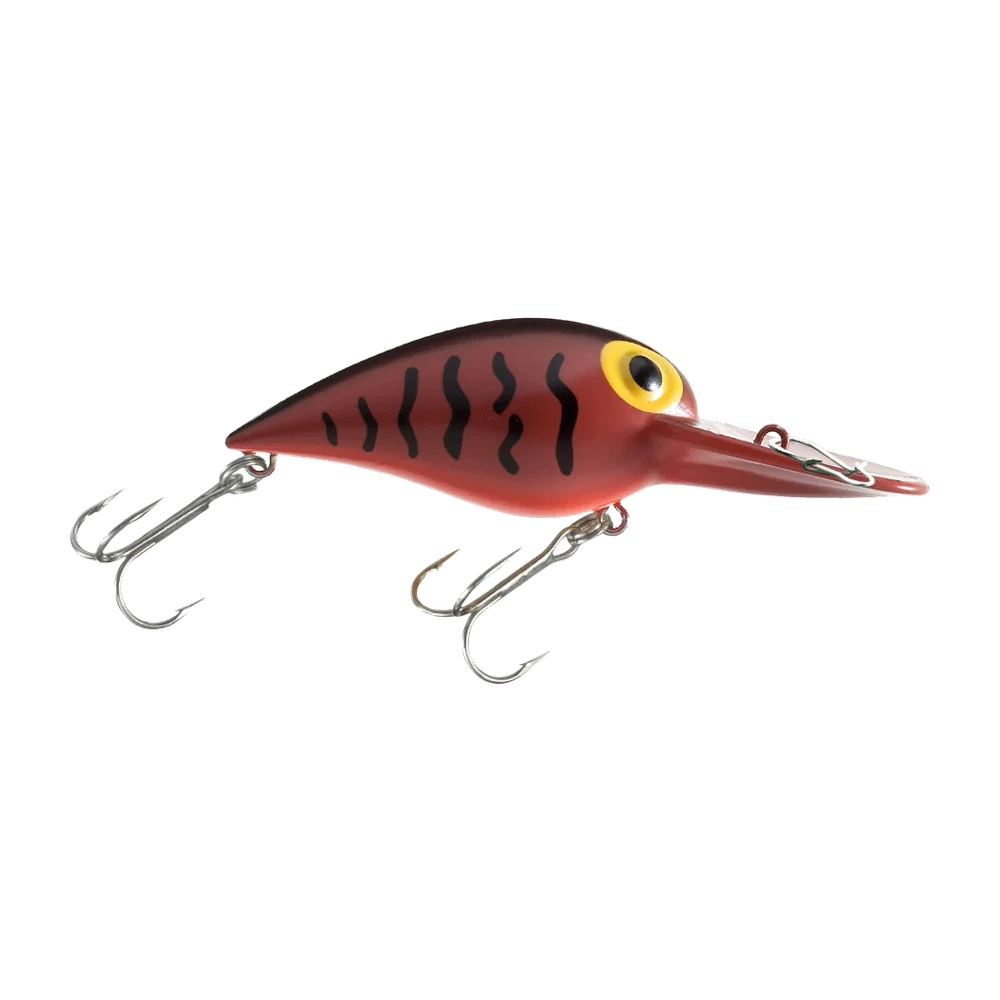
Storm Wiggle Wart: the crankbait that goes off-kilter on purpose
Rather not fish it blind? Photograph your spot — CarnaFish cross-checks the conditions and points you the right way.
Most manufacturers spend considerable effort removing irregularities from their crankbaits' action. A lure that wanders off its axis, rolls unevenly or blows out is treated as a manufacturing defect. The Wiggle Wart owes its reputation to the exact opposite: its action is not perfectly stable, and that is precisely what makes it effective.
A roll that is not regular
The Wiggle Wart has a stocky body and a wide, short, steeply angled lip. That geometry produces a large-amplitude roll which, at certain speeds, becomes slightly erratic — the lure leans a little further one way, catches itself, carries on.
To a fish, the difference from a perfectly calibrated crankbait is clear:
- A stable crankbait produces a regular, predictable signal. Effective, but quickly identifiable by a fish that has seen plenty of them.
- The Wiggle Wart produces a signal that varies constantly and slightly. It looks less like a mechanical object and more like something alive and clumsy.
That is a real advantage on heavily fished waters, and it explains why old examples of this lure change hands at unreasonable prices among collectors and tournament anglers.
Deflection on contact: the heart of the technique
Like any crankbait, the Wiggle Wart has to collide. But its wide lip and unstable roll produce a particularly sharp deflection when it hits a rock.
- Retrieve at a medium, steady speed until you feel the bottom or an obstacle.
- Let the lure knock into it rather than avoiding it. The lip shields the hooks by striking first.
- Change nothing after the contact: the lure veers off by itself, then recovers. That sequence is what triggers takes.
Field rule: with a crankbait, the obstacle is not a problem to steer around, it is the main tool. A lure that never touches anything never provokes a reaction.
Crawfish in spring
The Wiggle Wart has a historic association with spring fishing in crawfish colours, and it is not arbitrary.
In spring, crawfish leave their shelters, move slowly over hard bottom and form an important food source for bass. A crankbait scraping the bottom, knocking into stones and veering off reproduces fairly well the behaviour of a fleeing crawfish — hence the effectiveness of brown, red or orange finishes at that time.
For the rest of the year, baitfish tones take over.
Choosing the depth
The Wiggle Wart comes in several versions, broadly covering 1.5 to 3 m. Two parameters change the actual depth:
- Line diameter: thin fluorocarbon lets the lure run markedly deeper than thick line.
- Casting distance: a crankbait only reaches its maximum depth after several metres of retrieve. A short cast means a reduced working zone.
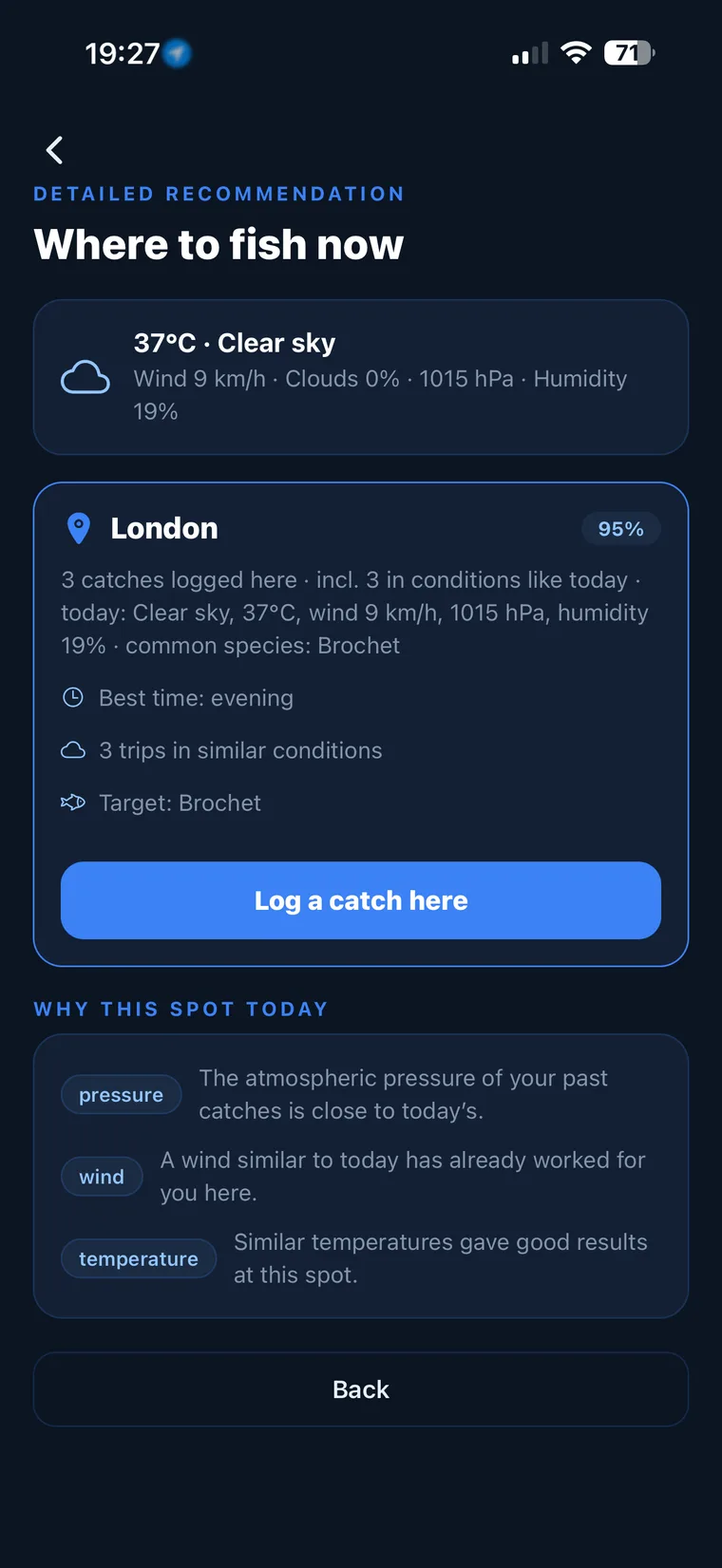
Not sure what to tie on?
Photograph your spot: CarnaFish reads the scene, cross-checks the conditions and gives you the zone, the lure and the retrieve. Free on iOS and Android.
Where it gives its best
- Hard bottoms: gravel, rock, revetments. That is the ground where deflection on contact works.
- Shallow drop-offs between 1.5 and 3 m, particularly in spring and autumn.
- Heavily fished waters, where its irregular action sets it apart from the classic crankbaits the fish have already seen.
Over soft or silty bottom it ploughs without producing any useful deflection.
Wiggle Wart or a modern crankbait
A deep crankbait such as the 6XD runs far deeper and covers zones the Wiggle Wart cannot reach. A tight-action crankbait such as the Shad Rap is more discreet and more credible in very clear water.
The Wiggle Wart occupies a precise niche: medium depth, hard bottom, fish that have seen too many well-behaved lures. For bass, our beginner's guide to bass fishing covers when to favour this kind of lure. And on an unfamiliar spot, CarnaFish analyses a photo and points you to the depth to attack.
Key points
- Its slightly unstable action is a quality, not a fault.
- Contact with hard bottom is the main technique, not an accident.
- Crawfish tones in spring over rock, baitfish the rest of the year.
- Thin line and long casts to reach maximum depth.
- Ineffective over soft bottom: it needs something hard to deflect off.
FAQ
Why is the Wiggle Wart's action irregular?
Its wide, short lip combined with a stocky body produces a large-amplitude roll that turns slightly erratic at certain speeds. That is a sought-after characteristic, not a manufacturing defect.
How deep does it run?
Between 1.5 and 3 m depending on the version, line diameter and casting distance. Thin fluorocarbon and a long cast gain noticeable depth.
Why crawfish colours in spring?
Because crawfish emerge at that time and form an important prey item. A crankbait scraping the bottom and deflecting off stones reproduces a fleeing crawfish fairly faithfully.
Do I really have to hit the bottom?
Yes. The sharp deflection caused by contact with a rock is the main trigger on this lure. Without contact you lose most of its point.
Is the Wiggle Wart suitable for zander?
Yes, over hard bottom and shallow drop-offs, on a steady retrieve. It is a less classic use than bass, but effective in spring and autumn.
Why are old models so sought after?
Because certain old production runs had a more pronounced action irregularity, considered more effective. It is as much a collecting phenomenon as a fishing one, and current models remain perfectly functional.
The full bass lure guideSeason-by-season strategy: which family of lure, when, and why.Go from theory to fish
CarnaFish reads your spot from a photo and gives you the game plan: zone, lure, retrieve. Free on iOS and Android.