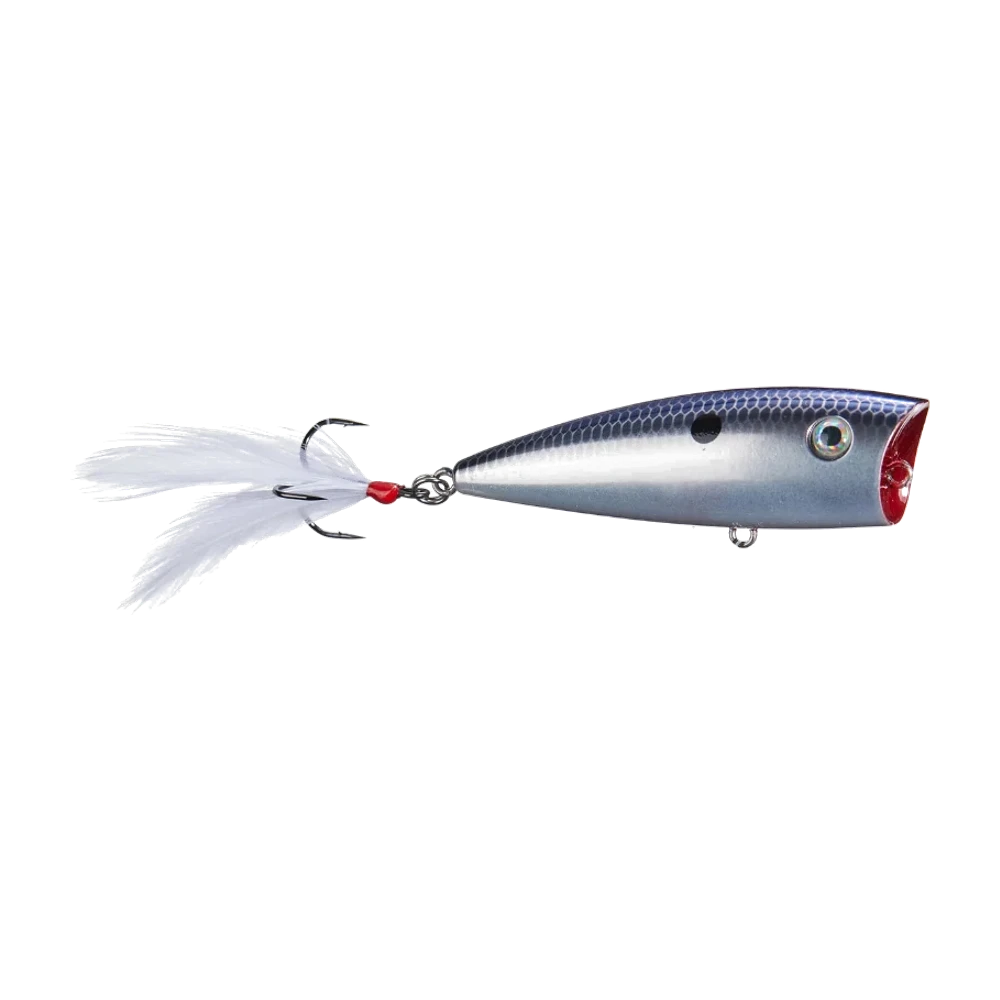
Strike King KVD Splash: the popper that walks instead of staying put
The right lure in the wrong spot still catches nothing. CarnaFish spots the zone that works, from a single photo.
You are working a two-hundred-metre bank lined with fallen trees, you have two hours, and the fish are active on the surface. The classic popper then poses a real problem: it fishes well, but it fishes slowly. One pop, one pause, and the lure has not moved thirty centimetres. At that rate you cover a tenth of the bank before the activity window closes.
The KVD Splash was drawn for exactly this case. It is not a finishing popper, it is a searching popper: it throws water and it travels, because its mouth is cut at an upward bevel and its tail is weighted. On every pull it spits a spray forward then slides sideways, exactly like a stickbait walking.
The result is a hybrid that does the work of two: the noise of a popper, the ground speed of a walking bait. That changes how you fish a whole bank.
A bevelled mouth and a weighted tail
The difference comes down to two design details you can see with the naked eye.
The mouth is not a straight cut. It is angled, cupped more deeply at the bottom than at the top. A straight-cut popper strikes the water vertically: it displaces a lot, throws a high spray, and the energy goes upwards — so the lure does not move. The KVD Splash's bevel directs part of that energy backwards, which drives the lure forward.
The tail is weighted. At rest, the lure floats tail down, nose out, in an almost vertical attitude. That attitude does two things: it puts the mouth at the right angle to attack the surface film on the very first pull, and it acts as a pivot point for the sideways slide. Without that rear weight, the lure would simply slide straight ahead.
Add the internal bead system it usually carries and you get a three-layer signal: the plop of the spray, the clicking of the beads, and the wake left by the travel. Three distinct reasons for a bass sitting five metres away to come and look.
The retrieve: pop-pop-pop, without stopping
Forget the rhythm of a finishing popper. Here you link them.
- Cast beyond the spot, a metre or two past the obstacle you are aiming at, so the lure crosses the hot zone in full action rather than while getting started.
- Take up the slack and drop the rod tip towards the water, at forty-five degrees to the side. It is that low, sideways position that allows the slide.
- Link three to five short, regular pops, wrist only, taking half a turn of the handle between each. You should hear one spray per pop and see the lure zigzag.
- Pause for one second, no more. Just enough for a following fish to close the gap.
- Set off again immediately on the same sequence all the way in.
The base cadence is about two pops per second. It is fast, it is physical, and it is deliberate: this lure works on reflex, not on reflection.
On the water: when a fish explodes beside the lure without taking it, do not strike and do not stop either. Speed up. A bass that misses a fleeing prey goes straight back after it; a bass that sees its prey freeze after the attack works out that something is wrong and pulls off. The second attack almost always comes within the next two metres.
Matching size to the water layer and the wind
The KVD Splash comes in several sizes, and it is not just a question of fish size: it is above all a question of casting distance and resistance to chop.
| Situation | Size to favour | Why |
|---|---|---|
| Sheltered bank, flat water, 30-40 cm fish | The smallest (around 8 cm) | Contained spray, less spooking on calm water |
| General searching, moderate wind | Mid size | Best compromise between distance and discretion |
| Large expanse, wind, chop, big fish | The largest (around 11 cm) | Carries far, the spray stays readable among the ripples |
Two rigging choices matter as much as the size:
The line. Fine braid with a fluorocarbon leader of around 0.30 mm. Braid does not stretch, so every pop transmits in full — essential for a fast retrieve. The fluorocarbon leader cushions the pops on the bite and stops you shedding a lightly hooked fish.
The rod. A tip that is too stiff pulls the lure clean out of the water on every pull. A model with a slightly progressive tip, in 1.80 to 2.10 m, lets you keep the spray in the water while still linking pops fast.
Not sure what to tie on?
Photograph your spot: CarnaFish reads the scene, cross-checks the conditions and gives you the zone, the lure and the retrieve. Free on iOS and Android.
Where it excels, where it is useless
It excels on long banks to search: rock causeways, lines of drowned trees, lily edges running for hundreds of metres. It also excels when there is a bit of wind — the chop that kills small discreet poppers does not bother it, because its signal is strong and redundant. And it is deadly on actively feeding fish, when the fry are jumping and the bass does not take time to inspect.
It is useless in three cases. On a small, very clear pond with pressured fish: its signal is too loud and you will empty the spot. On a single precise spot — an isolated stump, a jetty — where you want to keep working without moving the lure: it is not built to stay put. And in cold water, below about 15 °C, where a fish no longer has the speed to intercept something fleeing at that pace.
KVD Splash or finishing popper
It is the exact opposite of the Megabass Pop-X, and that is what makes the two complementary. The Pop-X dips its nose, throws a fine spray and stays put: it is a spot lure, for clear water and educated fish, and it works during the pause. The KVD Splash does exactly the reverse: broad spray, continuous travel, fast rhythm, and it is the movement that triggers. You do not choose one as "better" than the other, you choose according to the area to cover.
Against the Rebel Pop-R the distinction is finer: the Pop-R pops very well but travels little, and stays in the static popper family. The KVD Splash is closer to a walking bait with a cupped mouth. And if you fish the sea, the same spray principle exists in a reinforced version with the Shimano World Pop, designed for sea bass and very long casts.
Our beginner's guide to bass fishing covers the time windows when topwater takes over. And if you are unsure what retrieve rhythm to try when you arrive on a bank, CarnaFish analyses a photo of the spot and answers.
Key takeaways
- Bevelled mouth plus weighted tail: the lure pops and zigzags forward instead of staying put.
- Three to five linked pops, about two per second, with a one-second pause maximum.
- Rod tip low and to the side: that is what allows the sideways slide.
- A searching lure for long banks, not a lure for an isolated spot.
- Pointless in cold water or on a small, clear, heavily fished pond.
FAQ
Does the KVD Splash really walk the dog?
Not in the strict sense of a stickbait, but it comes close. The angled mouth and weighted tail make it slide one way then the other on every pull, with a spray each time. You get a narrower zigzag than a true walking bait, but a lot more noise.
How fast should I work it?
About two pops per second, in series of three to five, with a one-second pause between series. Slow down to the rhythm of a classic popper and you lose the point of the model: it is designed to travel.
Braid or monofilament?
Fine braid with a fluorocarbon leader of around 0.30 mm. Braid transmits closely spaced pops in full, which stretchy mono does not. The fluorocarbon leader cushions the hookset and prevents lost fish.
Why do fish so often miss the lure?
Because they are attacking a fast target. The right reaction is neither to strike at nothing nor to stop: speed up, and let the fish come back. The second attack is usually the one that sticks.
From what water temperature does it become effective?
Roughly above 15 °C, with a real peak once the water passes 20 °C. Below that, a fish no longer has the swimming speed to intercept a prey fleeing at that pace, and a slower lure will pay better.
Is it suited to a small, clear, heavily fished pond?
Poorly. Its signal is deliberately strong and redundant, which is an asset over a large expanse and a fault in a small volume of clear water. In that case a compact, discreet popper will be the better call.
The full bass lure guideSeason-by-season strategy: which family of lure, when, and why.Go from theory to fish
CarnaFish reads your spot from a photo and gives you the game plan: zone, lure, retrieve. Free on iOS and Android.