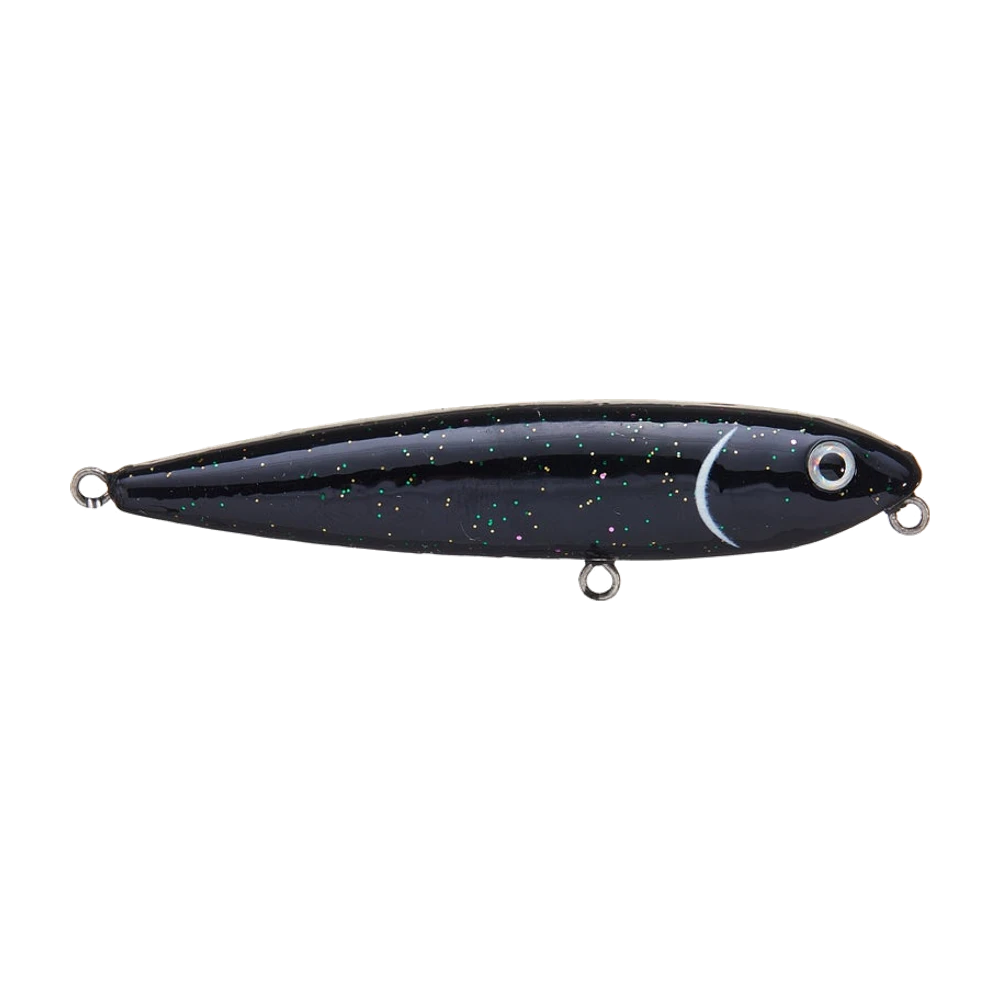
Strike King Bitsy Dawg: the 7.6 cm walking bait for small forage
Rather not fish it blind? Photograph your spot — CarnaFish cross-checks the conditions and points you the right way.
Late August, the water is low and clear, and every ten minutes the surface wrinkles as a cloud of one-inch fry scatters. You throw your five-inch stickbait, it walks perfectly, a fish rises underneath it, looks, and sinks back down. The problem is neither the color nor the stroke: the forage of the day is not that size. That is exactly the window of the Bitsy Dawg, which Strike King itself describes as a downsized version of its Sexy Dawg for light-tackle anglers, for the moments when bigger baits stop producing.
Three inches and four and a half grams
Strike King lists one version only: 3 in, so 7.6 cm, at 0.16 oz. That weight figure deserves a note, because the form is unusual: 0.16 oz corresponds almost exactly to 4.5 g, so it looks like a rounded conversion from a metric value. Treat it as an order of magnitude rather than a precision number: you are fishing a topwater bait of about four and a half grams.
The maker classes the bait as topwater. It therefore floats at rest and never goes under, whatever you do with it, which is the nature of a lipless stickbait working purely on the film.
Four and a half grams is not much. It means a light rod, say 5 to 20 g casting weight at most, and above all a tip that lets you give short sharp inputs without pulling the bait clean out of the water. A heavy rod kills the action: the bait jumps instead of sweeping.
Walking the dog, scaled down
The stated action is the Sexy Dawg's: the regular sweep from one side to the other that anglers call walking the dog. The mechanics are simple, the execution takes a little practice.
The stroke
Rod pointed down, around forty-five degrees to the surface, with some slack in the line. Give short sharp wrist snaps, one every half second, taking up a little line between each. Each input kicks the nose one way, the next kicks it back the other. Rhythm matters more than force: it is the regularity of the cadence that builds the zigzag.
On a bait this short the zigzag is necessarily tighter than on a five-inch model. It sweeps less wide but sweeps faster, and that nervous profile reads more like a panicked fry than a wounded baitfish.
The classic mistake
Fishing a tight line. With the line tight, the input drags the bait straight toward you instead of pivoting it. You want thirty or forty centimetres of slack between the tip and the bait, and you want the input to be absorbed by that slack. If your Bitsy Dawg tracks straight instead of zigzagging, nine times out of ten it is the slack, not the bait.
When a fish misses the bait on top, do not set the hook and do not change anything: keep the exact same cadence without speeding up. A bass that missed almost always comes back within two seconds, and it is the second pass that gets it. Setting into nothing rips the bait out of the zone and ends the affair.
A light bait that casts better than it looks
Strike King stresses casting distance despite the reduced profile. That is a manufacturer's claim, but it covers a real design reality: a stickbait of this type carries its mass near the tail, which stabilises it in flight and avoids the helicoptering that ruins the distance of small topwaters.
That said, four and a half grams is still four and a half grams. Into a headwind you will lose a lot of length, and that is the bait's real limit: it wants a calm or lightly rippled surface. As soon as there is chop, the zigzag becomes invisible to the fish and to you, and a popper or a prop bait does a better job of signalling.
Rigging, hooks and line
Clip the bait to a snap or use a loop knot: a knot tightened onto the nose ring chokes the pivot and makes the walk irregular. An 8 to 10 lb fluorocarbon leader is enough, and thin braid as main line gives the responsiveness the small inputs need.
Strike King states that premium trebles are fitted as standard. Note what the product photo actually shows, though: the sample pictured is bare, with three split rings and no trebles in place. That is an observation on a photo, not a specification, so trust the packaging. If you do change the trebles, stay on the same size and the same weight: on a topwater this light, a heavier treble alters the resting attitude and can be enough to kill the action.
In Europe this size also interests perch, which readily attack a small topwater along the margins in summer. Strike King only names bass, but the swimming action does not know species borders: if you see perch busting on top, the Bitsy Dawg is the right tool.
Not sure what to tie on?
Photograph your spot: CarnaFish reads the scene, cross-checks the conditions and gives you the zone, the lure and the retrieve. Free on iOS and Android.
Colors by light
- Low light, dawn, dusk, heavy overcast: the glitter black of the pictured sample. On the surface the fish sees the bait against the light, so the full silhouette carries, not the detail.
- Clear water in bright sun: a natural silver back, which matches the size and tone of the real forage on most waters.
- Overcast without rain: a pale belly and a neutral flank, the compromise that gives nothing away and puts nobody off.
Where it beats the big model, and where it loses
The Bitsy Dawg is not a better bait than the Strike King KVD Sexy Dawg, it is a bait for another situation. The big model casts far, shows up in chop and sorts the better fish. The small one takes over when the forage is tiny, when the water is clear and low, and when the fish have watched three five-inch stickbaits go past over the same weekend. In the same downsizing logic, the Heddon Zara Puppy sits in exactly the same slot with an older approach, and the Megabass Dog-X adds a Japanese finish to it.
Knowing when the topwater window actually opens on a given water is what CarnaFish saves you: a photo of the bank, and the AI suggests the zone, the depth and the lure type that match the conditions. To go further on small lures and the species they reach, our guide to perch fishing with lures is a good companion to this page.
What to remember
- 7.6 cm for about 4.5 g, a weight published as 0.16 oz that looks like a rounded conversion: an order of magnitude, not a precision figure.
- Classed as topwater by Strike King: it floats, it never goes under, it works only on the film.
- The zigzag needs slack in the line and a regular cadence; a tight line makes the bait track straight.
- Real limit: wind. Beyond a light ripple, a popper or a prop bait signals better.
FAQ
What size is the Bitsy Dawg exactly?
Strike King lists 3 in, so 7.6 cm, and 0.16 oz. That last figure works out at about 4.5 g, and its unusual decimal form suggests a rounded conversion, so take the order of magnitude rather than the exact number.
Does the Bitsy Dawg sink at rest?
No. The maker classes it as topwater: it floats at rest and stays on the surface whatever the retrieve. It is a lipless stickbait and has no way of diving.
What tackle suits a 4.5 g topwater?
A light rod rated 5 to 20 g with a lively tip, thin braid and an 8 to 10 lb fluorocarbon leader. Too much rod and the bait jumps instead of sweeping.
Why will my Bitsy Dawg not zigzag?
Almost always because the line is tight. Leave thirty to forty centimetres of slack between the tip and the bait, give short inputs every half second, and the pivot happens on its own.
Does it catch perch?
In Europe, yes: this size of topwater matches exactly what a perch hunts along the margins in summer. Strike King only names bass in its description, but the size and the action suit both.
Should I change the stock trebles?
Not necessarily, Strike King states that premium trebles are fitted at the factory. If you do swap them, keep strictly to the same weight: on a 4.5 g topwater, a heavier treble changes the resting attitude and can kill the action.
The full bass lure guideSeason-by-season strategy: which family of lure, when, and why.Go from theory to fish
CarnaFish reads your spot from a photo and gives you the game plan: zone, lure, retrieve. Free on iOS and Android.