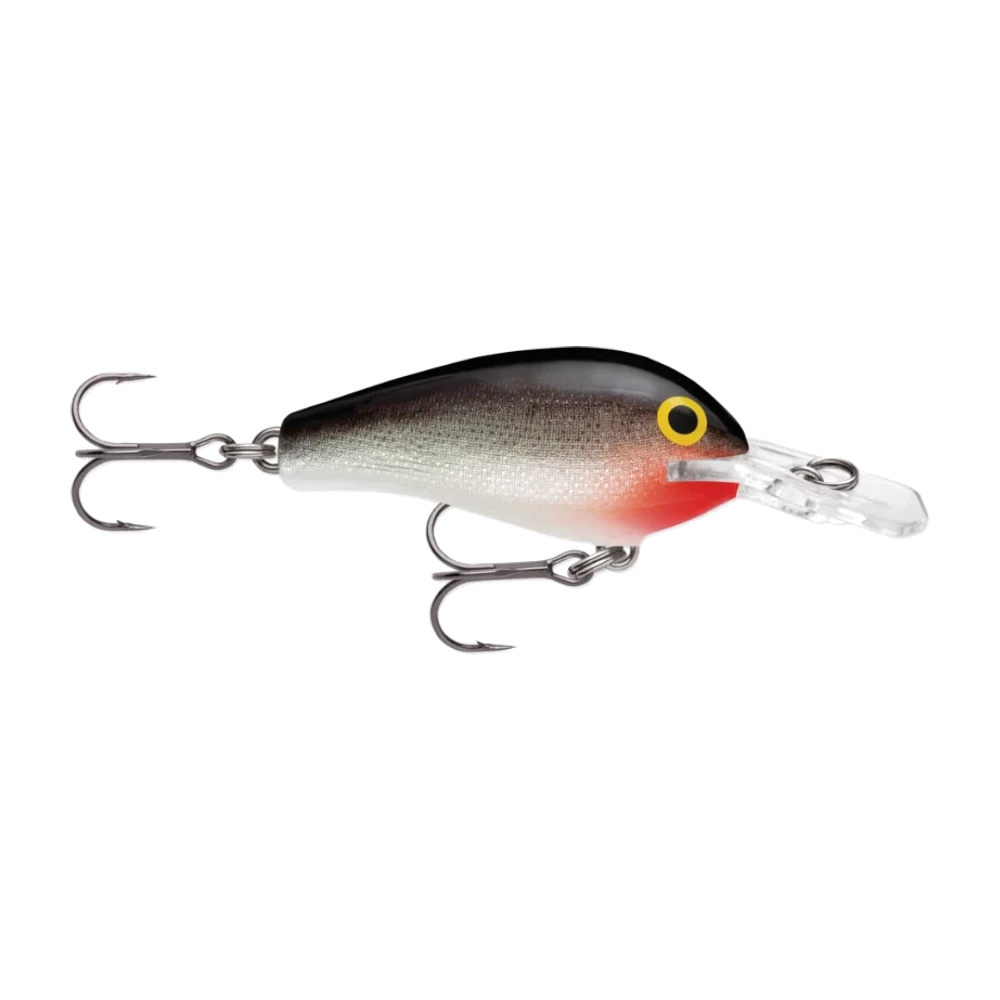
Rapala Fat Rap: the balsa crankbait that fishes by banging into things
Before tying this one on, it helps to know if the spot actually calls for it. CarnaFish reads the scene from a photo.
Over a cobble bottom, most plastic crankbaits end up in the same place: wedged between two rocks, or buried in a branch. So you slow down to avoid that, you lift the lure off the bottom — and you lose exactly the bites you came for, because a crankbait that touches nothing triggers almost nothing.
The Fat Rap solves the problem through material. A balsa body, very light for its volume, rises much faster than a hollow plastic body the moment you stop winding. That rise is a tool: it lets you knock the bottom deliberately, then free the lure in a fraction of a second.
This is a lure you fish in contact, not above it.
What balsa actually changes
Wood is not a nod to tradition. It produces three measurable behaviours on the water.
Strong buoyancy. On the stop, the Fat Rap rises firmly, not drifting up limply. On an obstacle, a second of stop is often enough to send it over the top instead of sticking into it.
A lively action at low speed. A light body starts rolling with very little energy. The lure works from the moment you start winding, including at slow speeds — which matters in cold water, when a dense crankbait needs pushing before it comes alive.
Deflection behaviour. When the lip hits a rock, the lure kicks sideways, rears up, then resumes its swim. That involuntary deflection is what triggers the vast majority of bites on this kind of lure. A heavier model knocks too, but it gets back into its swim more slowly and stays snagged longer.
In exchange, balsa is more fragile. Knocking it against riprap eventually marks the paint, and a pike's tooth punctures the body. This is not a lure you abuse for ten years.
The retrieve: find the bottom, then lose it
The aim is not to wind back at a constant depth. It is to alternate contact and lift-off.
- Cast long and leave little slack. The lure needs to dive from the first turns of the handle, before it is back too close to you.
- Wind steadily until you feel the first contact with the bottom — a dull resistance, not a snag.
- On contact, stop everything for half a second. The lure rears up and rises twenty to thirty centimetres.
- Resume the retrieve at the same rhythm. The lure dives again and goes looking for the next contact.
- On a firm bottom bite, do not strike immediately: a lot of "bites" are rocks. Wait until you feel weight or a sideways pull.
- At the end of the retrieve, slow right down over the last three metres. Followers often make up their minds as the lure climbs up the margin.
The rhythm depends on temperature: the colder the water, the longer you stretch the stops after contact. Below 12 °C, two seconds of stop is not excessive.
On the water: over an uneven bottom, deliberately pick a lure that dives 50 cm deeper than the water you are fishing. A crankbait that grinds constantly catches more than one swimming just above the bottom, because it is the deflection that triggers, not the swim. You will snag a little more, but you will catch clearly more.
Size, depth and line: what you can actually tune
| Parameter | Effect |
|---|---|
| 5 cm version | Around 9 g, 2 to 2.5 m band, ideal perch profile |
| 7 cm version | Around 12 g, 2.5 to 3 m band, casts further, targets bass and big perch |
| 0.22 mm fluorocarbon | Maximum depth, better transmission of contact |
| 0.28 mm fluorocarbon | 20 to 30 cm less, but more margin near rock |
| Floating mono | Lure runs 40 cm higher, action slightly damped |
| Long cast | The lure reaches its maximum depth over a longer stretch |
The simple rule: casting distance influences depth as much as the model does. A Fat Rap cast fifteen metres will never reach its stated band, because it spends half the retrieve going down and then coming back up.
Not sure what to tie on?
Photograph your spot: CarnaFish reads the scene, cross-checks the conditions and gives you the zone, the lure and the retrieve. Free on iOS and Android.
Where it excels, and where it should stay in the box
The Fat Rap is built for hard, uneven bottoms between 1.5 and 3 m.
- Riprap and cobble beaches on lakes and reservoirs, in late spring and autumn.
- Gravel pit humps where perch are hunting fry over a hard flat.
- Slow river margins with a stony bottom and moderate current.
- Slightly stained water, where the wide roll makes up for reduced visibility.
Elsewhere it is poorly suited. Over soft, silty bottom there is no deflection: the lure sinks in and brings back mud. In sunken wood and branches, its lip and two trebles make it a serious snag machine despite the buoyancy. And beyond 3 m you need a dedicated model — forcing a crankbait deeper than its band does not work.
Fat Rap, Shad Rap or squarebill
The three look alike from a distance and do different jobs.
The Rapala Shad Rap is slimmer, with a tighter roll and a baitfish silhouette: it is the choice in clear water, on wary fish, or when the forage is slender. The Fat Rap, with its chunky body, displaces more water and produces a stronger signal — it takes the lead in stained water, on active fish, or when you are trying to provoke rather than imitate.
A squarebill such as the Strike King KVD plays on the same deflection principle but in the top layer, between 0.5 and 1.5 m, with a square lip that clears wood better. If your obstacle is a stump, take the squarebill; if it is a rock at two metres, take the Fat Rap. And to go clearly deeper over the same kind of bottom, a Norman Deep Little N takes over.
Our guide to lure fishing for perch covers how to work through these depth bands on a single spot. And if you do not know which band to aim for when you arrive in front of riprap, CarnaFish analyses a photo of the spot and answers.
Key takeaways
- Balsa rises fast: that is what lets you knock the bottom deliberately without snagging everything.
- Aim 50 cm deeper than the actual water depth. Deflection triggers more than the swim does.
- Stop the retrieve for half a second on every contact, up to two seconds in cold water.
- Hard, uneven bottoms between 1.5 and 3 m; useless over silt, risky in sunken wood.
- Fragile body: a pike's tooth or hard riprap leaves lasting marks.
FAQ
How deep does the Fat Rap run?
Between 2 and 3 m depending on size, with thin fluorocarbon and a long cast. On a short cast it does not reach its maximum band: retrieve distance counts as much as the model you choose.
Why a balsa body rather than plastic?
Balsa is very buoyant and very light: the lure starts its action at low speed and rises fast the moment you stop. That fast rise is what lets it clear an obstacle instead of burying itself in it.
How do I avoid snagging it on rock?
Stop the retrieve as soon as you feel contact; half a second is enough to float it up. Do avoid sunken timber, though, where buoyancy is not enough to make up for two exposed trebles.
What line should I use?
A 0.22 to 0.28 mm fluorocarbon. Finer and you gain depth and feel for contact; heavier and you limit breakages near riprap, but the lure swims 20 to 30 cm higher.
Fat Rap or Shad Rap, which one?
The Shad Rap, slimmer and with a tighter roll, suits clear water and wary fish. The Fat Rap, chunkier, displaces more water and takes the lead in stained water or on active fish you need to provoke.
Does it work in cold water?
Yes, provided you slow down and lengthen the stops. Its light body keeps working at reduced speed, where a dense crankbait needs pushing before it swims properly.
The full perch lure guideSeason-by-season strategy: which family of lure, when, and why.Go from theory to fish
CarnaFish reads your spot from a photo and gives you the game plan: zone, lure, retrieve. Free on iOS and Android.