Strike King Hack Attack Fluorocarbon Flipping Jig: the jig built around fluoro
This lure shines under specific conditions. CarnaFish tells you in 10 seconds if today is one of them.
There is a situation every jig fisherman eventually runs into: the water is clear, the fish have watched six boats go by, and the high-vis braid you normally use to pick apart brush has stopped producing. You switch to fluorocarbon for stealth, and a new problem appears: you lose fish you would have buttoned without thinking. That exact problem is what Strike King built the Hack Attack Fluorocarbon Flipping Jig around.
The real issue is line stretch, not jig colour
Fluorocarbon stretches. Less than monofilament, noticeably more than braid. When you set the hook on a fish twelve metres away inside a brush pile, part of that sweep is absorbed by the stretch instead of driving the hook point home. The point grazes, buries halfway, and the fish throws it on the first head shake.
The manufacturer's answer is not a stiffer rod but a reduced hook wire diameter. Strike King states it fitted a smaller-diameter hook than the one on the original Hack Attack Jig, specifically so the point penetrates faster and with less effort. The reasoning is simple: for a given force, a thinner point passes through more tissue, so less of your energy is needed to bury the hook past the barb.
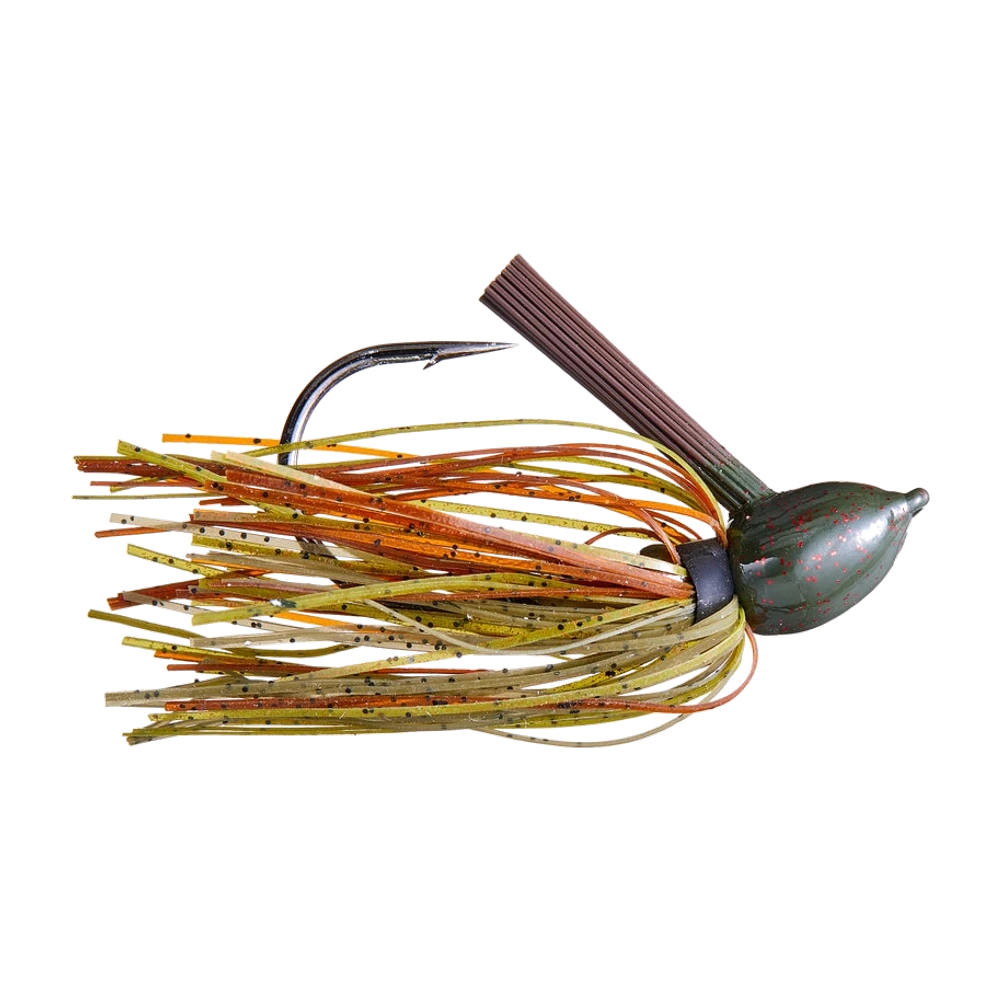
The product photo does show a dark-coated wide-gap single hook with the point rising clear of the fibre guard. That is an observation from a product photo rather than a specification: Strike King publishes neither the hook size nor the hook maker in its description.
The trade-off to know before you buy
Thinner wire bends more easily. That is mechanics, and there is no way around it. If you are punching thick pads with 50 lb braid and a heavy rod, you are better off with a heavy-wire jig. This model is designed to pair with fluorocarbon and a slightly less brutal setup; outside that context you lose the advantage and keep the drawback.
A head and a guard carried over from the original
Strike King reuses the head shape and the weedguard combination of the standard Hack Attack. On the photo the head is conical, with a pointed nose and a broad rear, and the fibre brush lies forward rather than standing vertical. That is exactly what a flipping jig needs: the nose parts branches, the brush protects the point on the fall and collapses under jaw pressure when a fish eats it.
The profile, by contrast, is deliberately more compact than on the original. That is what makes this model relevant in clear water, on pressured fish, or when bass are keying on smaller forage — the three situations the manufacturer explicitly names.
Skirt, keeper and trailer
The skirt is stated to be silicone, 60 strands, full-bodied. Sixty strands is a lot: at rest the skirt opens and breathes, and that motionless pulsing is what draws a bite from a jig sitting still. A fuller skirt also slows the drop, which helps when you want the jig to sink gently down a piling.
The bait keeper is a wire corkscrew screwed onto the shank rather than a plain barb. In practice that changes two things: the trailer rides up far less after a dozen casts, and you can reset it without tearing it. A Strike King Rage Craw threads on in seconds and adds the claw flutter a skirt alone cannot produce. If you want to slow the fall further and cut volume, a thin-appendage trailer remains the better call.
Change trailers before you change skirt colour. On a jig sitting at the base of cover, it is the trailer's bulk and fall rate that decide whether a fish commits — far more than the shade, which a bass sees backlit inside a brush pile anyway.
What the manufacturer does not tell you
The description contains no spec table at all: no length, no head weight, no list of available sizes. That is a genuine gap on a jig, because weight dictates everything — fall rate, depth reached, how much cover you can punch. Check the packaging or the retailer's listing before ordering, and do not assume the range matches another jig in the line.
The same goes for head material: nothing is stated. A flipping jig sinks, obviously, but the description never says whether the head is lead or tungsten, and that detail changes how much you feel through the rod. On that point a Strike King Compact Tungsten Casting Jig states its material outright, which makes the choice easier.
One last thing: the brand presents this model as the best flipping jig there is for heavy cover when you want to downsize. That is a Strike King marketing claim rather than a measured result, and the colours are described as hand-picked by Greg Hackney.
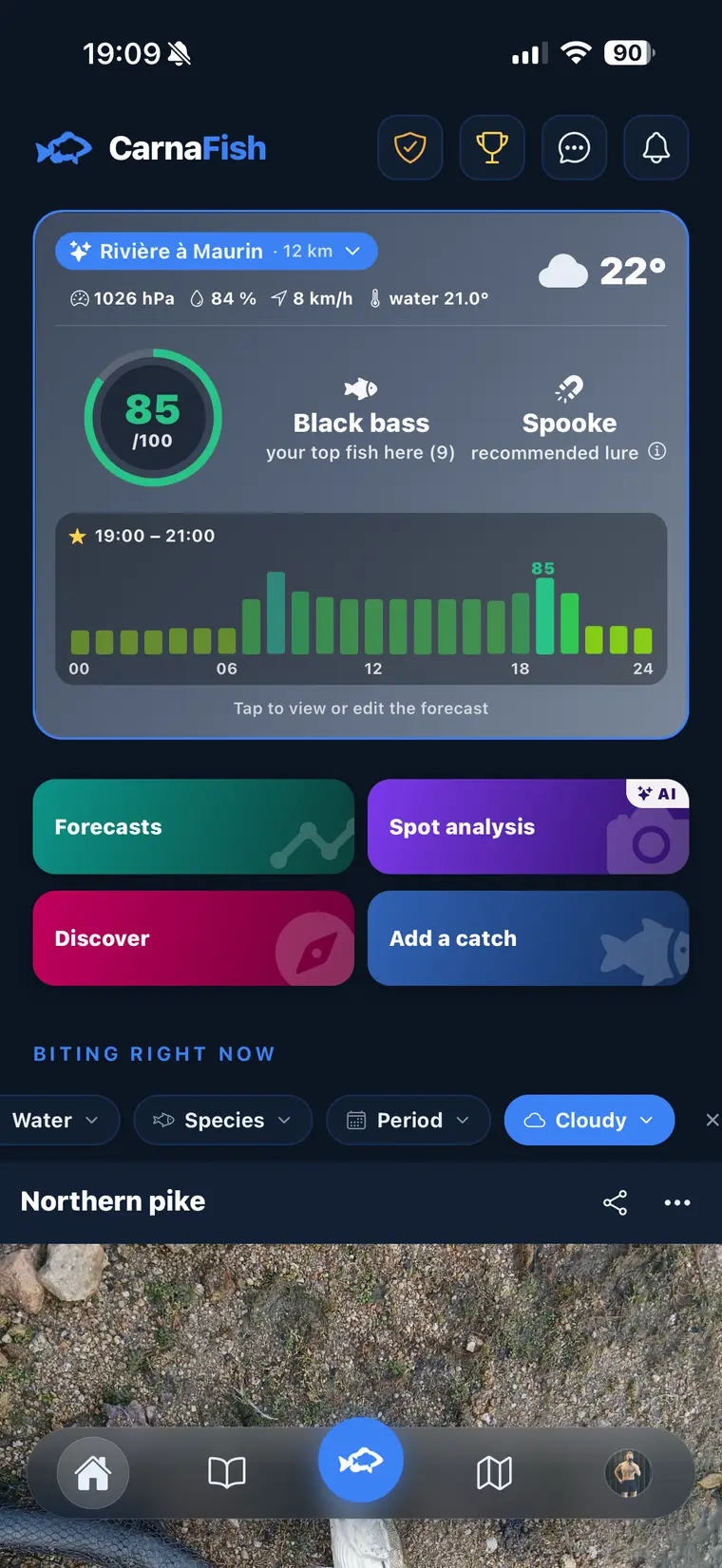
Not sure what to tie on?
Photograph your spot: CarnaFish reads the scene, cross-checks the conditions and gives you the zone, the lure and the retrieve. Free on iOS and Android.
How to actually fish it
Flipping is a short cast, almost a drop. You feed line through your fingers, the jig falls vertically against the cover, and you watch the line: nine bites out of ten come during that fall, and you see them rather than feel them. If the line stops before the depth you expected, or starts moving sideways, set.
Once on the bottom the jig works in small twenty to thirty centimetre lifts followed by long pauses. Three or four cycles per piece of cover is enough: if nothing happens, move rather than insist. A flipping jig covers water by stacking up targets, not by length of retrieve.
Colours by water clarity
- Clear water: Green Pumpkin Craw, an understated olive that works everywhere once fish can see properly — it is the colour family of the lure photographed here, with its olive, orange and brown mix.
- Dark water or overcast days: Black and Blue, the cleanest silhouette when light is short.
- Wood and stained bottom: Texas Craw, whose red-brown highlights match what bass genuinely eat around branches.
Choosing the jig always comes after reading the spot, and you still have to know where the fishable cover is. That is what CarnaFish does: it analyses a photo of your spot and suggests the zone, the depth and the lure type that match the day's conditions. To go back over the basics of this fishing, our beginner's guide to bass fishing covers the structure and the tackle.
What to remember
- A smaller-diameter hook wire than the original Hack Attack, meant to penetrate despite fluorocarbon stretch.
- The trade-off is mechanical: thinner wire bends sooner, so this is not the jig for muscling fish on heavy braid.
- Conical head and forward-laid fibre guard carried over from the classic model, with a trimmed profile for clear water and pressured fish.
- No weight and no length appear in the description: confirm the size before you buy.
FAQ
How does it differ from the original Hack Attack Jig?
The hook wire is smaller in diameter and the overall profile is more compact. The head shape and the weedguard, according to the manufacturer, are carried over unchanged from the original model.
Why a thinner hook with fluorocarbon?
Because fluorocarbon stretches under load and absorbs part of your hookset. A thinner wire point needs less energy to pass through a jaw, which offsets that stretch.
What head weight should I pick?
The manufacturer publishes no spec table, so no safe range can be given from the description alone. Go by the packaging, and keep the general rule in mind: the lightest head that still gets through the cover you are fishing.
Which trailer should I use?
A craw-style trailer such as the Strike King Rage Craw adds movement a skirt alone cannot. The corkscrew keeper the brand specifies holds it in place far better than a standard barb.
Is this jig right for very thick vegetation?
It is presented for heavy cover, but its finer hook points it toward fluorocarbon use rather than winching fish out on thick braid. For matted pads, a heavy-wire jig remains the safer choice.
Braid or fluorocarbon with this model?
Fluorocarbon — that is the whole logic of the jig, which exists for the situations where you need the stealth of fluoro. On braid you lose the line's benefit and keep the thinner hook.
The full bass lure guideSeason-by-season strategy: which family of lure, when, and why.Go from theory to fish
CarnaFish reads your spot from a photo and gives you the game plan: zone, lure, retrieve. Free on iOS and Android.