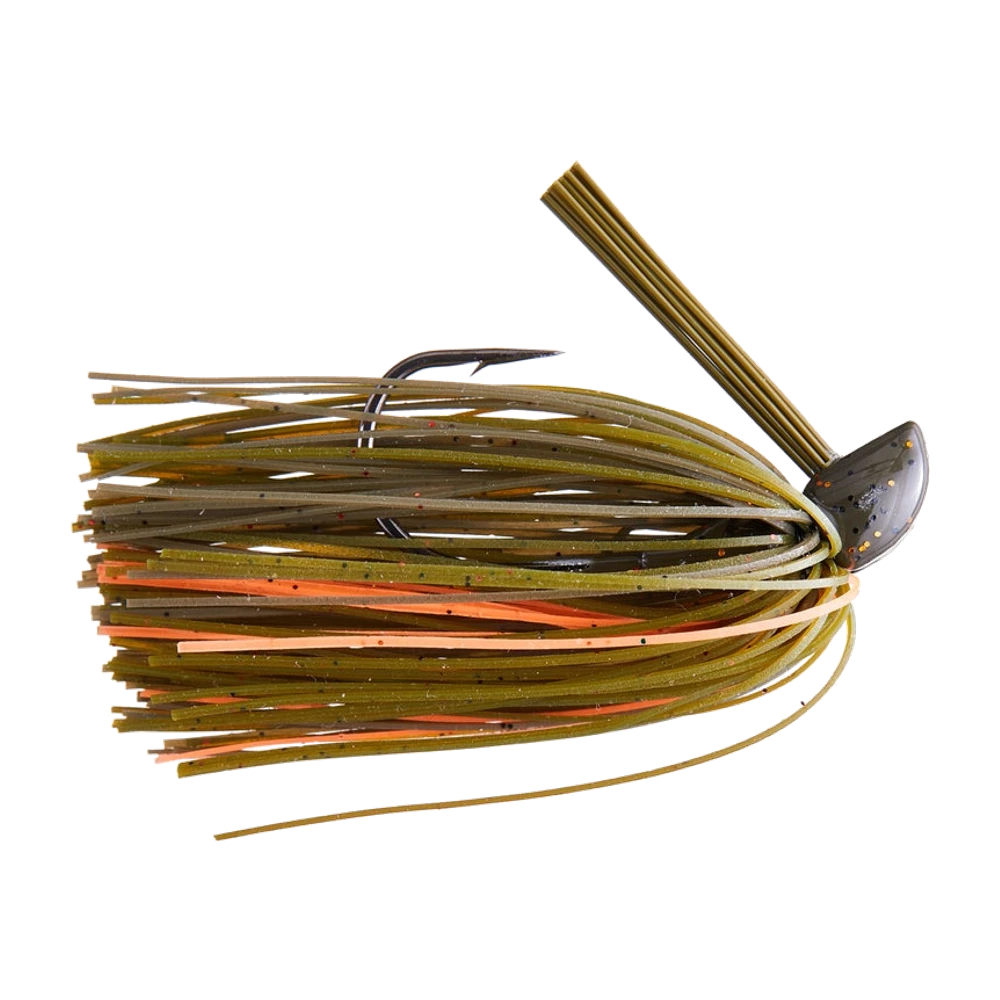
Strike King Compact Tungsten Casting Jig: small profile, full weight
Not sure this lure fits YOUR spot today? CarnaFish tells you in 10 seconds, from a photo.
A half-ounce lead jig has a head volume you can see. On pressured water, where the bass have already refused three jigs that morning, that volume becomes a liability: the fish follows, looks, and does not commit. Tungsten solves the problem in a purely physical way — at equal weight the head is noticeably smaller, because the metal is nearly twice as dense as lead. That is the whole argument behind this Compact Tungsten Casting Jig, and it stands up.
What the density actually changes
The manufacturer puts forward two benefits. The first is profile: showing pressured fish a smaller silhouette without reducing the weight, so without losing fall rate or the ability to hold in current. The second is sensitivity: tungsten, being harder, transmits vibration better than lead, which absorbs part of what comes up from the bottom. Strike King draws two stated consequences from that — reading the contours of the bottom, and detecting subtle bites.
Both of those are the manufacturer's claims, and it is fair to label them as such. That said, the hardness gap between the two metals is a material reality, not advertising copy: on the water, a tungsten jig touching a rock sends a crisp signal up the rod where a lead jig sends a soft one. Over rock or gravel the difference is obvious. Over soft silt it disappears entirely — the bottom has nothing to transmit.
The hook is the most useful line in the description
This is the most precise piece of information on the whole product sheet: a 3/0 short shank hook in heavy-gauge wire. Do not confuse the figures: 3/0 is a hook size, not a weight or a head dimension.
The manufacturer stresses that this wire is heavier than what you find on most finesse jigs, and that it was chosen so it will not flex on a hard hookset. That is a genuine point of difference. Plenty of compact jigs are built on thin wire because they are conceived for a light rod; in practice, an angler reaching for a compact jig is often doing it in branches or flooded timber, and that is exactly where thin wire deforms. The short shank, for its part, brings the point closer to the head: the hookset transfers more directly, with less leverage lost along the way.
What the manufacturer does not publish
There is no size chart at all for this model: no weight, no head dimension. The description talks about jigs in the plural and about several colours, but lists no range of weights. I am not going to invent a figure: if the exact weight matters to you — and on a jig it matters a great deal — check the packaging before buying. The description does not mention a weedguard either. The product photo does show a fibre brush set behind the head and angled towards the point, but that is an observation from a product photo, not a specification.
How to fish it
A casting jig is cast and worked in contact with the bottom, in short hops of eight to twelve inches followed by a pause where it rests completely. During that pause the silicone skirt, hand-tied according to the manufacturer, closes slowly back on itself — and it is that breathing movement, not the hop, that triggers most of the bites.
A bite on a resting jig is almost never a solid thump. It is a weight that appears, or a line that drifts off to one side. The habit to build: reel up the slack, then set wide and sideways. On a 3/0 heavy-wire hook you need power to drive the point home — a medium-heavy to heavy rod and 0.30 to 0.40 mm fluorocarbon are not a luxury.
Put the jig down and count to five before you re-establish contact. Most anglers work a jig too fast because stillness makes them uncomfortable. It is during those five seconds when nothing moves that the bass makes up its mind.
Not sure what to tie on?
Photograph your spot: CarnaFish reads the scene, cross-checks the conditions and gives you the zone, the lure and the retrieve. Free on iOS and Android.
The trailer changes everything about its behaviour
A casting jig is almost never fished bare. The trailer you thread onto the shank changes both the profile and the fall rate, and it is the fastest adjustment you have. A big-clawed craw like the Strike King Rage Craw slows the descent, adds movement on the fall and widens the silhouette: that is the choice for stained water and active fish. A tighter creature such as the Strike King Rage Bug keeps the whole package compact and lets the jig fall straight and fast, which fits the spirit of this model better.
If you want to compare head geometries, the Strike King Tungsten Football Jig uses the same metal with a football head, which tips differently over gravel. The two do different jobs: the football rolls along the bottom, the casting jig falls straighter and threads through cover better.
Colours by bottom and water
- Clear to lightly stained water: the flaked green pumpkin of the photo, a base that works nearly everywhere and imitates a crawfish as readily as a small bottom-dwelling fish.
- Dark water, silt bottom: black and blue, the sharpest contrast once visibility drops under half a metre.
- Rock and gravel: a brown to orange crawfish tone, matching the prey actually present over that kind of substrate.
Whether a spot calls for a heavy jig on the bottom or a presentation higher in the column is decided before you tie on. That is what CarnaFish does: one photo of the spot, and the AI suggests the zone, the depth and the lure type that match the conditions. To build the full approach on this fish, our beginner's guide to bass fishing covers the lure families worth knowing.
What to remember
- Tungsten gives a smaller head at equal weight: that is the only real argument, and on pressured fish it is enough.
- The stated hook is a 3/0 short shank in heavy wire — a hook size, not a head weight.
- No size chart is published: the available weights are not in the description, so check the packaging.
- The trailer is your main adjustment: big claws to slow the fall, a compact creature to drop straight.
FAQ
What weights does this jig come in?
The manufacturer publishes no size chart for this model: no weight is listed in the description. Check the packaging or the retailer's listing before buying, because weight is decisive on a jig.
What does 3/0 mean in the description?
It is the hook size, not a weight. The manufacturer specifies a 3/0 short shank built on heavy-gauge wire, chosen so it will not deform on a hard hookset.
Is tungsten really worth the premium over lead?
Over hard bottom, yes: the head is smaller at equal weight and the contact is crisper in the rod. Over soft silt the transmission difference disappears and lead does the job perfectly well.
Does this jig have a weedguard?
The description does not mention one. The product photo shows a fibre brush behind the head, but that is an observation from an image, not a specification confirmed by the manufacturer.
What trailer should you put on it?
A big-clawed craw to slow the fall and widen the silhouette, or a compact creature to keep the drop fast and straight. It is the quickest adjustment to change on the water.
What rod sets a heavy-wire hook?
A medium-heavy to heavy casting rod with 0.30 to 0.40 mm fluorocarbon. Heavy wire needs power to penetrate, and a rod that is too soft lets the fish throw the jig on its first jump.
The full bass lure guideSeason-by-season strategy: which family of lure, when, and why.Go from theory to fish
CarnaFish reads your spot from a photo and gives you the game plan: zone, lure, retrieve. Free on iOS and Android.