Strike King Rage Scounbug: a slim craw built for flipping
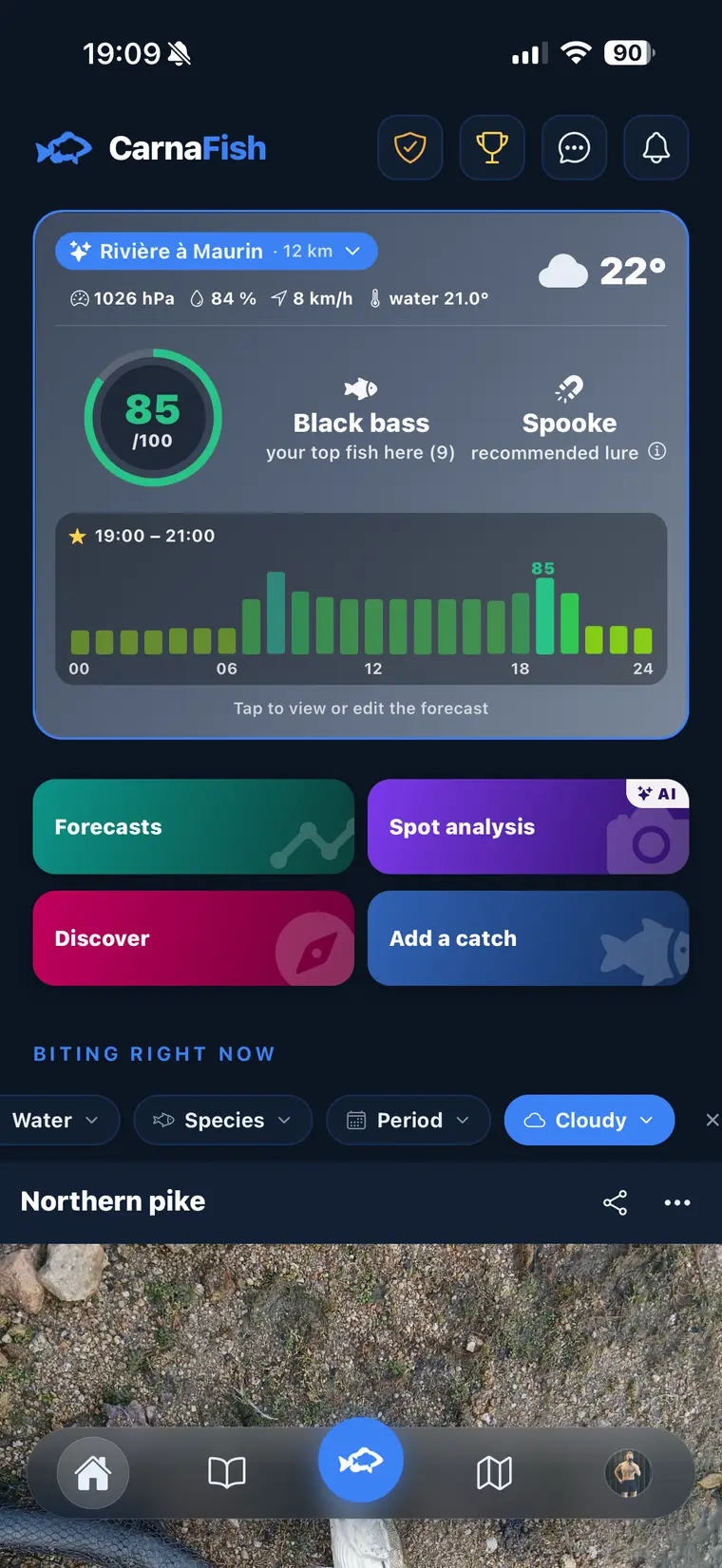
Before tying this one on, it helps to know if the spot actually calls for it. CarnaFish reads the scene from a photo.
A sunken stump on the edge of a channel, fifty centimetres of water and a bass that will not leave it. You do not go after that fish with a searching bait: you drop something thirty centimetres from its nose, make it vibrate on the spot and wait. That is exactly the Rage Scounbug's job, a craw imitation Strike King drew slim so it slides into cover and back out without fighting the vegetation.
A slender body, and why that is the right call
Strike King highlights a deliberately slim body profile, meant to slip in and out of cover easily. That choice deserves explaining, because it runs against the usual reflex on a soft craw: we tend to want bulk, for signal and for silhouette.
Except that in flipping, bulk is a handicap. A wide bait stops on every branch, bounces off vegetation instead of passing through it and forces you to muscle the cast. A slim body falls straight, slides between two branches and comes back out cleanly when you lift. All the signal is then carried by the appendages, which is exactly the principle here: a discreet body and noisy claws.
Rage Tail claws: a lot of signal for a tiny input
The two claw arms use the brand's patented Rage Tail technology. They are flat, wide, slightly cupped paddles that catch water on their concave face. The manufacturer states they flap vigorously at the slightest movement of the rod tip and create a huge amount of vibration — that quantity is a Strike King sales claim, not a measurement we can verify.
What is verifiable on the water, though, is the principle: you do not need to move the bait to make it live. A simple quiver of the rod tip, rod still and line tight, is enough to set the claws going. That is exactly what you want when a fish sits on a precise spot and you want to fish one square metre for thirty seconds, instead of reeling in and casting again.
Two sizes, and a table to read in full
The table attached to the description has two columns — length and quantity, not length and weight — and two rows. It gives a 3.5 in version, 8.9 cm, packed 9 to a bag, and a 4 in version, 10.2 cm, packed 7 to a bag. That is all.
No weight is published, for either size. On an unweighted soft bait that is not dramatic since the rig's weight sets the fall rate, but it does complicate the choice of tungsten bullet. We will not invent it: if you want a starting point, try 7 g on the 3.5 in over two metres of water and adjust from what you see going down.
The 3.5 in is the version for difficult fish and small cluttered spots; the 4 in gives more claw surface, so more signal, and suits stained water or jig-trailer duty better.
A thickened base, to last and to take a bigger hook
The detail the description mentions last is in fact one of the most useful: the bait is poured with a thicker base, which increases durability over multiple hooksets and lets you thread it onto a larger hook.
It is the same reasoning as on a thickened worm, and it matters even more here, because a craw is fished in wood and weed: you set hard, often dragging the fish towards you through an obstacle. Thin plastic tears on the third hookset and you spend the day sliding the bait back up the hook. A reinforced body at the hook point is a few more fish per bag.
What the product photo shows
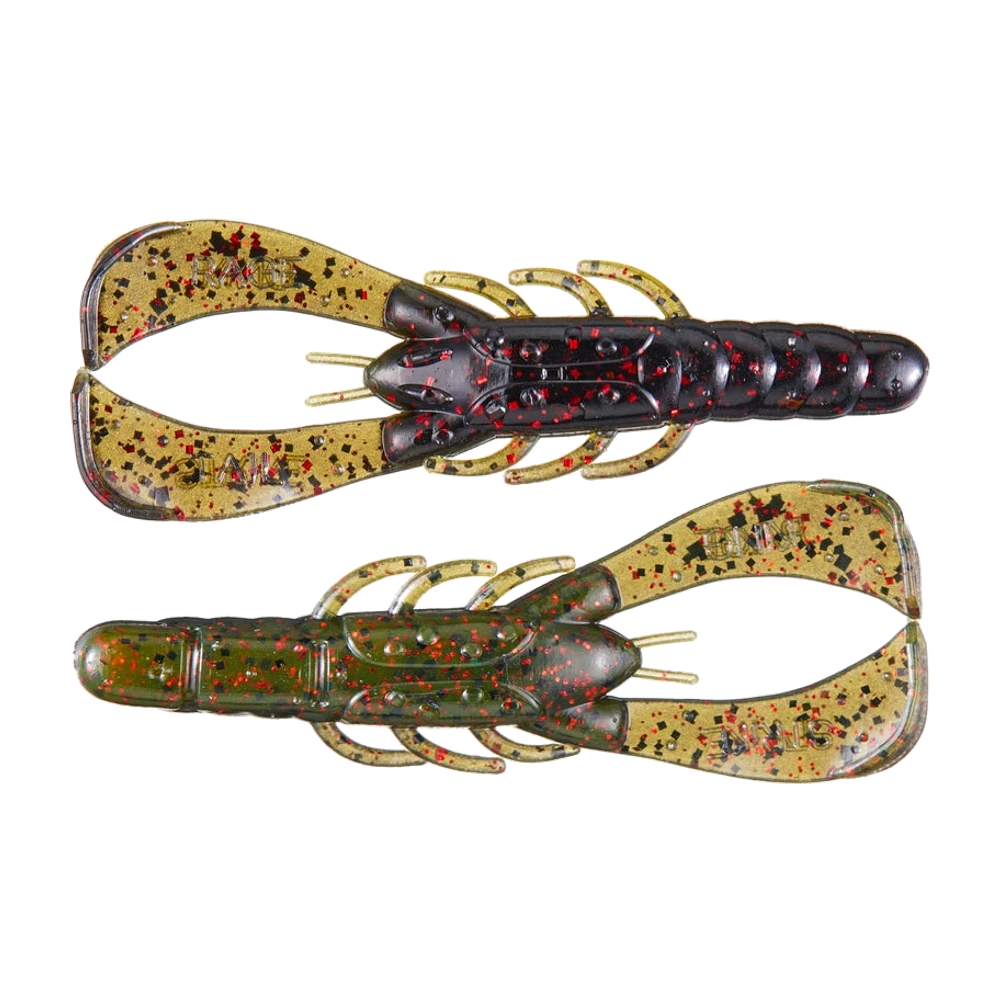
The two examples photographed are bare, with no hook and no weight. The finish is two-tone: a dark body loaded with red flake, and distinctly paler claws, translucent gold-green, speckled with black and red. The claws are flat, wide, carry the words Rage Tail in relief and finish in a fine point. The body shows a tapered head with two thin antennae, several pairs of moulded legs along the flanks and a segmented abdomen at the rear. These are observations from a product photo, not specifications.
Not sure what to tie on?
Photograph your spot: CarnaFish reads the scene, cross-checks the conditions and gives you the zone, the lure and the retrieve. Free on iOS and Android.
The three claimed uses
Flipping
The first one listed. Heavy weight, a short accurate pitch under the rod, and a vertical fall into a hole in the cover. The bait drops, the claws flap on the way down, and the bite almost always comes right there. If nothing happens, two quivers on the spot, then lift and move to the next target.
Texas rig with a tungsten bullet
The all-round rig. A wide-gap hook through the thickened base, point tucked into the back, bullet free or pegged depending on whether you want to separate the sound from the bait or concentrate it. You can then drag the bottom and fish weed edges and breaks.
Jig trailer
The third stated use, and perhaps the most interesting in practice. Behind a Strike King Tungsten Football Jig, the Scounbug adds exactly what a skirt lacks: clean lateral movement while the jig sits still. In 4 in it also lengthens the silhouette and slows the jig's fall, which is often good on an inactive fish.
The classic mistake: too much amplitude
The reflex that ruins this bait is pulling it in long strokes. The claws do not need amplitude, they need tension. Keep the line tight, move the rod tip two centimetres, let the bait settle back, repeat. If your line travels fifty centimetres on every input, you are fishing too fast.
On a precise target, count inputs rather than casts. Three quivers, three seconds of stillness, and repeat four times before you lift. Most anglers give up on a spot after ten seconds, and it is often on the fifteenth that the fish makes up its mind.
Colour by water
- Clear water: green pumpkin, the universal soft-plastic colour for bass, passing equally well for a crawfish or a bottom invertebrate.
- Stained water: black with red flake, exactly the register of the body in the product photo. The silhouette stays clean and the flake gives a point to focus on.
- Spring, over crawfish ground: orange and brown, because a moulting crawfish takes on far brighter tones and bass recognise them.
Against other soft craws
The Scounbug sits between two baits from the same brand: the Strike King Rage Craw, bulkier and more demonstrative, and the Strike King Rage Bug, which leans on multiple appendages instead. Its own edge is the slimness of the body, designed for passing through wood. If you want more bulk and more appendages for covering wide weed flats, a Zoom Brush Hog remains the reference in that other family. In Europe this kind of bait is used mainly on bass reservoirs, where crawfish make up a large share of the summer diet.
Picking the right craw is pointless if it lands two metres off the target. That is exactly what CarnaFish makes easier: a photo of the spot, and the app suggests a zone, a depth and a presentation suited to the day. For the basics of spot reading and tackle, our beginner's guide to bass fishing is still the right way in.
Key takeaways
- The body is deliberately slim, to enter and leave cover rather than to make bulk.
- All the signal comes from the two flat claws, which flap without you having to move the bait.
- The table publishes two lengths, 8.9 and 10.2 cm, with quantities of 9 and 7: no weight for either.
- The thickened base is there to survive several hooksets and to take a hook one size up.
FAQ
What sizes does the Rage Scounbug come in?
Two: 3.5 in or 8.9 cm, packed 9, and 4 in or 10.2 cm, packed 7. Watch the original table, whose second column is a quantity and not a weight: no unit weight is given by the manufacturer.
What weight should I use with this bait?
The description gives no weight guidance, and the bait's own weight is not published. A reasonable starting point is a 5 to 7 g tungsten bullet over two metres of water, heavier in dense cover and lighter in clear water on wary fish.
Can it be used as a jig trailer?
Yes, it is one of the three uses the manufacturer explicitly states. The 4 in version lengthens the jig's silhouette and slows its fall, while the claws add lateral movement that a skirt alone does not produce at rest.
Why does this bait last longer than others?
Because it is poured with a thicker base where the hook goes through. Strike King highlights this, and it has two effects: more hooksets before it tears, and the option of threading on a heavier-gauge hook.
Do I have to move the bait to make it work?
No, and that is its main value. The claws react to tension in the line, not to travel. You can fish one square metre for thirty seconds without the bait moving more than a few centimetres.
Is the Rage Scounbug good for anything other than bass?
The description points this bait at bass, and that is where it performs. A craw imitation on a light Texas rig can occasionally interest other predators, but that is not the use this model was drawn for, and we will not invent a versatility the manufacturer does not claim.
The full bass lure guideSeason-by-season strategy: which family of lure, when, and why.Go from theory to fish
CarnaFish reads your spot from a photo and gives you the game plan: zone, lure, retrieve. Free on iOS and Android.