Strike King Bitsy Flip Jig: the flipping jig that slips into small holes
This lure shines under specific conditions. CarnaFish tells you in 10 seconds if today is one of them.
A tree down in two metres of water, branches crossing each other, and in the middle three openings the size of your hand. That is where the fish is, and no search bait will ever reach it. You have to place something exactly in the hole, let it drop straight, and bring it back out without unhooking the whole tree. A standard half-ounce flipping jig snags on the way in; the Bitsy Flip Jig is drawn to go through. Strike King presents it as a jig optimised for probing heavy cover, with a compact profile that slips into the tightest openings in brush and vegetation.
A flipping jig, not a casting jig
The difference from its catalogue cousin is clear. The Strike King Bitsy Bug Jig is a casting jig you work back along a slope. The Bitsy Flip is set down at rod's length, five to eight metres from you, into a hole you picked out by eye. Everything about the bait follows from that: a snagless head design, a fuller weedguard, a hook described as more muscular.
Strike King adds an interesting and slightly counter-intuitive detail: this jig is aimed at cleaner water and at pressured bass that have already seen a million full-sized jigs. So this is not punching mats in muddy water, it is a fine approach to a precise piece of cover, where the bulk of a standard jig backs the fish off instead of triggering it.
The black weedguard, the detail that separates the two models
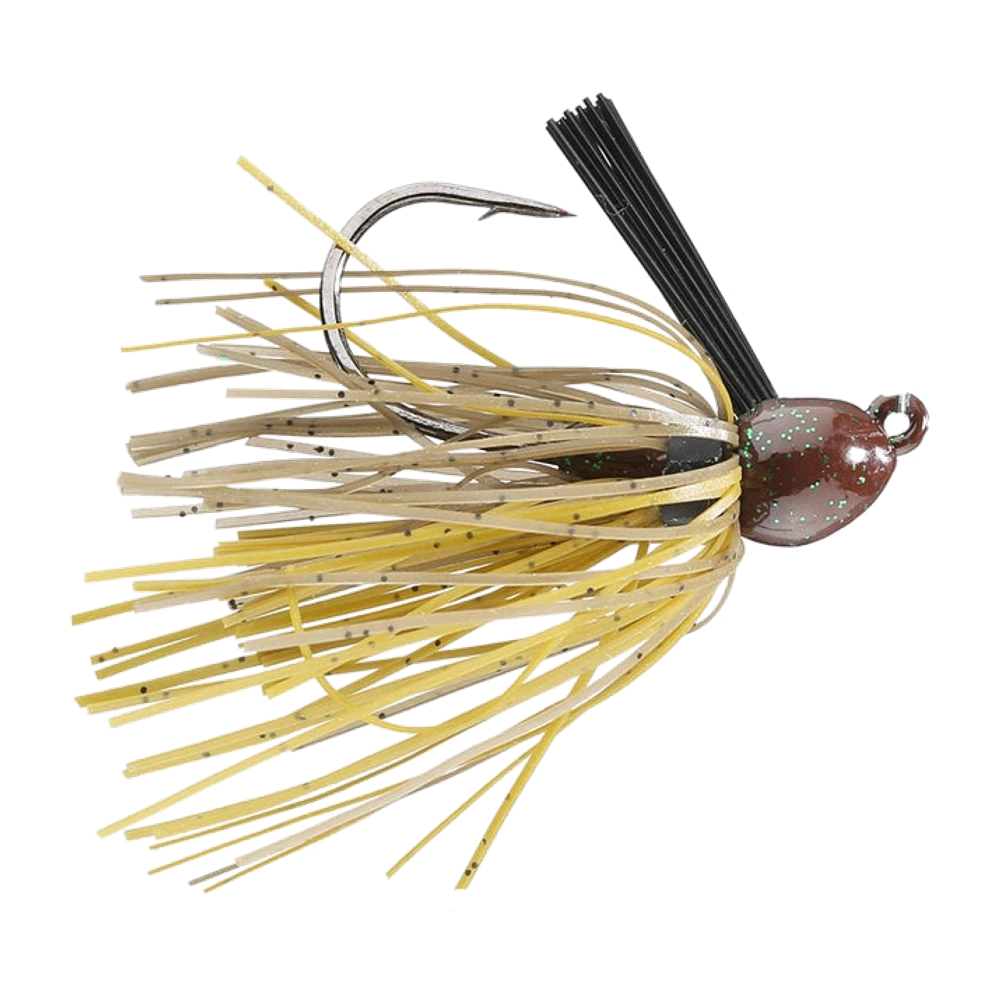
In the photo the fiber guard is black, dense, set in a tight bunch and clearly fuller than the one on a finesse jig. That is exactly what the maker states: a beefier weedguard for enhanced snag protection. On the water it translates into two things. The jig passes through branches instead of hanging on them, and you have to set harder, because the guard offers more resistance before it collapses.
Before you fish, fan the fibers open with your thumb: a bunch that stays tight deflects the hook point on the set. It is a ten second move that almost nobody makes.
The hook and the line tie
Strike King states a robust black-nickel Mustad hook and an inverted line tie meant to protect the knot against rock abrasion. An honest note: on the sample photographed, the hook appears with a bright, shiny finish rather than a black one. That is an observation on a product photo, not a specification. Finishes vary from batch to batch and colour to colour, and the description is the reference.
The line tie, on the other hand, is plainly visible in the photo: it emerges behind the point of the head, laid slightly back, instead of projecting from the nose. On a jig you rub against wood and rock all day long, the knot lasts noticeably longer.
When you flip into wood, deliberately give a little line just after the jig enters the hole. A jig falling on a tight line swings in an arc and bumps the branch; a jig falling on free line drops straight, stays in the opening and arrives where the fish actually is.
The stroke, and why entry matters as much as the fall
Flipping is not casting, it is placing. You let out about a rod length of line, swing the jig like a pendulum and guide it into the target hole. The aim is not distance, it is accuracy to within ten centimetres and silence on entry.
A jig that slaps the surface empties a spot in clear water. Brake the drop with your thumb on the spool just before contact so the jig pierces the surface instead of hitting it. Then let it drop to the bottom while you watch the line, give two short sharp inputs while keeping it inside the cover, and lift it out to aim at the next hole. Three seconds per opening, not thirty: flipping is a numbers game of presentations.
The classic mistake
Staying too long on the same hole. In heavy cover a bass decides in two or three seconds. If nothing has happened after two inputs, it is either not there or not eating. Work through the openings: a good flipper makes a hundred and fifty presentations an hour, and it is volume that pays, not persistence.
No length and no weight in the description
Let us be straight: the manufacturer's description we have contains no size table, no length and no weight. So we will not put forward a figure. The weight is printed on the bag, and that is the only reliable source at the point of purchase.
The selection logic is simple enough. In flipping you generally go heavier than in casting, because you need to punch through vegetation and drop straight despite the branches. But on a bait presented for clean water and pressured fish there is no point overloading: the lightest weight that drops into the opening without deflecting is enough, and a slower fall gives the fish time to decide.
Not sure what to tie on?
Photograph your spot: CarnaFish reads the scene, cross-checks the conditions and gives you the zone, the lure and the retrieve. Free on iOS and Android.
The trailer sets the bulk
The barbed keeper moulded on the shank is designed for a small craw or a short creature. Mount it dead straight, otherwise the jig starts spinning on the drop and loses its vertical line. A small Strike King Rage Bug makes a coherent trailer for this format: enough appendages to animate the pause, not enough bulk to cancel the compact profile.
The wider the trailer, the slower the fall and the more the jig glides, which is what you want in clear water. The slimmer it is, the faster and straighter you drop into a narrow hole. For genuinely heavier cover, a dedicated punching model such as the Dirty Jigs Tour Level No Jack Punchin Jig remains the right tool.
Colors by surroundings
- Laydowns and brush: brown with green flake on the head, the crayfish tone that disappears into bark and a leafy bottom.
- Clear water on grass or margins: a pale yellow and tan flecked skirt, like the pictured sample, which reads as a small bank fish rather than a crayfish.
- Stained water: black and blue, the most legible silhouette as soon as visibility drops.
A precision bait, not a search bait
The Bitsy Flip Jig is useless as a search bait: it covers no water, it does not swim, and it asks you to see the spot before you fish it. It makes full sense once you have identified cover and the fish are pinned inside it. In Europe this approach stays less common, because bass spots in flooded timber are fewer than on American lakes, but on a reservoir with standing timber there is no real alternative.
Spotting the cover that deserves a jig is exactly where CarnaFish saves you time: a photo of the bank, and the AI suggests the zone, the depth and the lure type that fit the conditions. To build the foundations around this species, our guide to getting started on bass covers the tackle and the spots worth looking for.
What to remember
- A reduced-profile flipping jig, designed to enter small openings in brush and vegetation.
- Beefier fiber weedguard, snagless head and recessed line tie: three Strike King features that keep the bait out of trouble.
- The description gives neither length nor weight: read the size on the bag.
- A volume game: three seconds per opening, a hundred and fifty presentations an hour, not one per hole.
FAQ
How is it different from the Bitsy Bug Jig?
The Strike King Bitsy Bug Jig is a casting jig for clear water and wary fish. The Bitsy Flip is built for flipping into heavy cover, with a fuller weedguard and a hook the maker describes as more robust.
What weight should I choose?
Strike King publishes no weight in this description, so read it on the bag. In flipping you generally go slightly heavier than for casting to punch through vegetation, but without excess on a bait aimed at clean water.
Do I need braid for this jig?
Yes, in heavy cover it is close to mandatory. Braid of 30 to 50 lb lets you set through branches and pull the fish out before it wraps you up. On a clean margin, heavy fluorocarbon can do.
Why does my jig fall sideways?
Two causes: a trailer mounted crooked on the barbed keeper, or a line too tight, which swings the jig in an arc. Re-mount the trailer dead straight and give a little line after entry.
Does the beefier weedguard hurt hooksets?
It asks for a firmer set than a finesse guard, but it collapses under pressure. Fan the fibers open before you fish: a bunch left tight deflects the point at the moment of the set.
Is this jig any good from the bank?
Yes, it is actually an excellent bank approach when you walk a wooded shoreline. You only need to get within five to eight metres of the spot without being seen, which asks for a quiet approach.
The full bass lure guideSeason-by-season strategy: which family of lure, when, and why.Go from theory to fish
CarnaFish reads your spot from a photo and gives you the game plan: zone, lure, retrieve. Free on iOS and Android.