Strike King KVD 100 Jerkbait: the small suspender for pressured fish
Before tying this one on, it helps to know if the spot actually calls for it. CarnaFish reads the scene from a photo.
Some days the fish are clearly there — marked on the sonar, or giving themselves away with a surface boil — and nothing works. The crankbait comes back empty, the soft plastic is ignored, and the few follows die two metres from the boat. That is the window the KVD 100 aims at: a jerkbait shorter and lighter than the norm, built for fish that have already watched three boats go past that day. The question is what it actually does underwater, and how to work that reduced size so it becomes an advantage.
The published numbers, and what they mean
Strike King lists four figures for this model: a length of three and a half inches, or 8.9 cm, a weight of a quarter of an ounce, or about 7 g, a running range of two to four feet, or 0.60-1.20 m, and a buoyancy class given as suspending.
The metric figures are conversions of round imperial catalogue specs, not millimetre measurements — treat them as orders of magnitude. A bait listed at 7 g may weigh 6.8 or 7.2 g depending on the batch, the paint thickness and the mass of the split rings. That matters on a suspender, where a couple of tenths of a gram are enough to make it rise slowly or sink slowly instead of hanging still.
A range of 0.60-1.20 m is shallow for a jerkbait, and it tells you most of what you need about the use case. This bait is not meant to reach a fish pinned at six metres; it works the band just under the surface — over drowned weed, along a steep bank, across a shallow hump. To go deeper, reach for the Strike King KVD Jerkbait 300 instead.
A wide action on paper, and how to get it
The maker describes very wide side-to-side travel on the jerk, plus erratic darting and wobbling between twitches. That is a brand claim, not a measurement, and it should be read as one. It is at least consistent with the design: a short wide lip, a slim body, and a weight transfer system that moves a ball to the rear on the cast and brings it forward again once the bait starts working.
What matters to you is that a design like this punishes stiff animation. A wide-action jerkbait needs slack in the line to express its sideways darts. Pull with the line tight and you get a narrow, tidy zigzag, nowhere near the erratic behaviour you are after. The maker is explicit on the point: work it on slack line.
The test that settles it: run the bait past you two metres out, in open water, and watch. If it breaks hard right then hard left, changing axis each time, your stroke is right. If it zigzags politely along the line, you are pulling instead of snapping, and no colour will fix that.
Cadence is the only thing that really counts
The basic sequence
Cast, take three or four turns of the handle to pull the bait down to its running depth, then start the cycle. Two sharp rod strokes, downwards rather than sideways, followed by a pause. Between each stroke you give back enough line for the bait to work on its own: it is the slack that allows the dart, not the force of the stroke.
The pause is the variable to play with. At fifteen or sixteen degrees, a second is often enough. Below ten degrees, stretch it to five, eight, sometimes fifteen seconds. It feels long and uncomfortable, and that is exactly where a suspender earns its keep: a bait hanging motionless at mid-depth eventually wears down a fish that is watching it. The take almost always comes during the pause, and it feels like the line turning heavy, not like a hit.
The mistake everybody makes early on
Working it too fast and pausing too little. The reflex is understandable — the bait is good to watch. But a jerkbait this size is a provocation tool, not a search tool. To cover a big flat quickly, a squarebill like the Strike King KVD Squarebill does the job far better. The KVD 100 is for grinding away at a small area you already know holds fish.
Second mistake: a rod that is too long and too soft. A 1.98 to 2.10 m blank with a fast action transmits the sharp stroke better and creates less drag at the line tie. With a 2.40 m rod you spend the day slapping the water.
Casting seven grams without losing patience
This is the real limit of the format, and it is better known before you buy. Seven grams on a standard baitcasting setup is not much. The weight transfer system offsets part of the problem — it is the main argument Strike King puts forward on this model — but it does not turn a light bait into a heavy one.
Two options. Spinning gear, with thin braid and a 0.20-0.25 mm fluorocarbon leader: comfortable casts and real accuracy under low branches. Or a light baitcaster with a shallow spool, BFS style. The fluorocarbon has a second benefit here: it sinks, which helps hold depth through the long pauses, where floating monofilament slowly pulls the nose of the bait upwards.
What the product photo shows
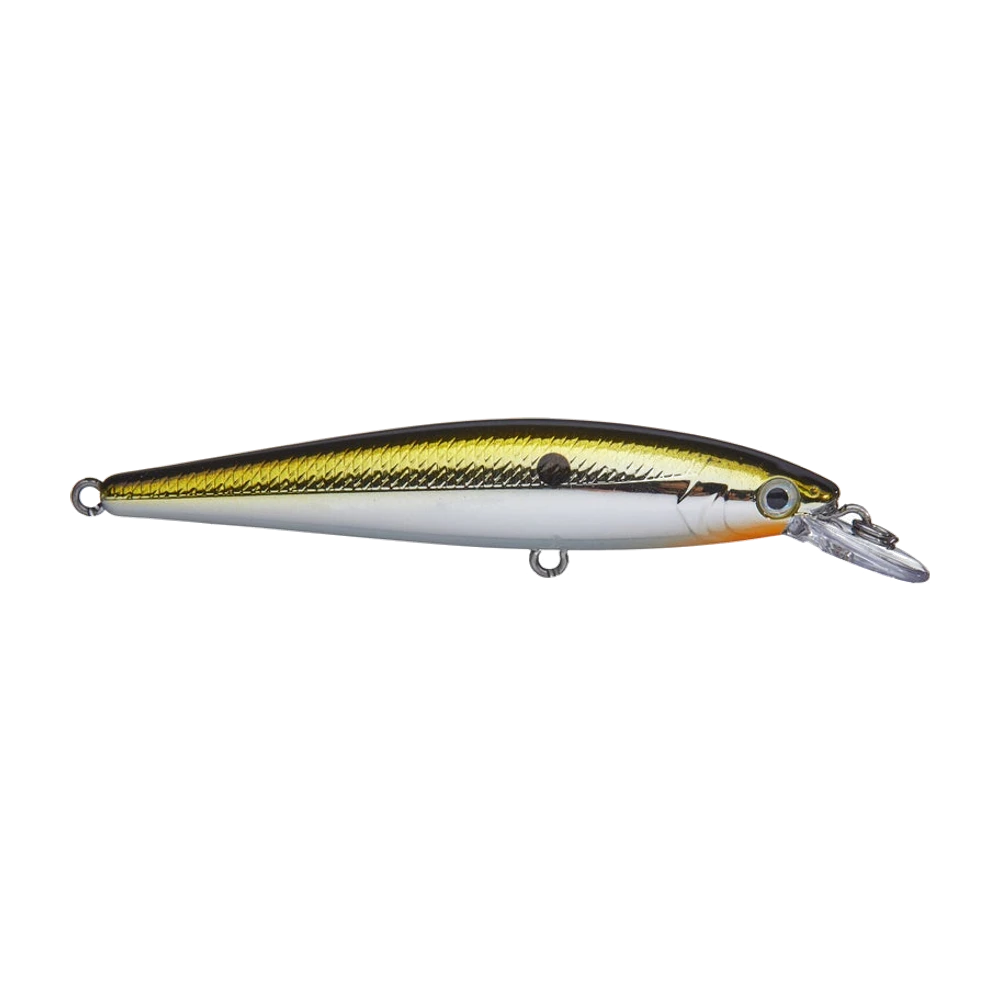
In the image for this model the bait is shown bare, with no treble fitted: you can see the nose line tie with its split ring, a belly hanger mid-body and a tail hanger, all three empty. That is an observation on a product photo, not a specification — the written description does state that trebles come fitted. Check the hooks on arrival: on this size, two number 6 trebles are the norm, and oversizing them wrecks the suspending balance.
Not sure what to tie on?
Photograph your spot: CarnaFish reads the scene, cross-checks the conditions and gives you the zone, the lure and the retrieve. Free on iOS and Android.
Colours by water clarity
- Clear to lightly stained water: the finish in the photo, scaled gold back with a black dorsal line, pearl white flank and orange throat, imitates a standard baitfish while keeping a visual trigger at the front.
- Cold water under cloud: a white or pearl dominant without excess flash, which stays readable when light is low and fish are not rising far.
- Dark water, end of day: a plain dark silhouette. In low light it is the contrast against the sky that registers, not the colour.
Strike King advertises a colour range handpicked by Kevin VanDam: that is a marketing argument from the brand, not a technical criterion. Make the call on water clarity and light.
A situational bait, not an everyday one
The KVD 100 is a specialist. It shines when fish are present, visible and uncooperative, between the surface and a metre down. It is less useful blind, and frankly limited as soon as you have wind in your face. Against a soft jerkbait like the Zoom Super Fluke, it brings what plastic cannot: stillness at a constant depth, which gives a fish time to commit.
Knowing which lure to tie on matters less than knowing where to cast it, and that is exactly what CarnaFish does: one photo of the spot, and the AI suggests the zone, the depth and the presentation that suit the day's conditions. To build the groundwork first, our guide to getting started with bass fishing covers the key spots and tackle.
Key takeaways
- Published specs: 8.9 cm / 3.5 in, about 7 g / 1/4 oz, 0.60-1.20 m / 2-4 ft, suspending — conversions of round imperial figures, so orders of magnitude.
- The wide action the maker describes only appears if you work it on slack line, with give between each rod stroke.
- Seven grams calls for light spinning gear or a BFS baitcaster; on a standard baitcaster you will cast short.
- In the product photo the bait carries no trebles: that is an image observation, not a specification.
FAQ
Does the KVD 100 really hang still on the pause?
It is listed as suspending by the maker, so yes in theory. In practice the balance depends on water temperature and on your line: fluorocarbon makes it sink slightly, monofilament makes it rise. Check the real behaviour on the first cast, in sight, before building your cadence around it.
How is it different from the KVD 200?
Size and depth. The 100 is 8.9 cm / 3.5 in and works between 0.60 and 1.20 m, the 200 is noticeably longer and runs deeper. The 100 is the clear-water, pressured-fish choice, the 200 the one for deeper structure.
Can you catch perch on it?
Yes, and it is one of its best uses in Europe. A jerkbait of 8.9 cm working between the surface and a metre matches exactly the band where perch hunt in schools, and the erratic action converts those lazy follows.
What rod suits a jerkbait this size?
A 1.98 to 2.10 m blank, fast action, medium light to medium power. The short length is the key point: it lets you drive sharp strokes downwards without slapping the water or wrecking your wrist over a full day.
Should the stock trebles be replaced?
Not automatically. If you do swap them, keep the same size and above all the same total weight: a heavier treble sinks a suspender, a lighter one floats it. That is the classic trap when moving to heavy-wire hooks.
Is this jerkbait suitable for pike?
Occasionally, on small fish, but it is not what it is for. Its size and hook rating are built around bass and perch. To target pike seriously you need to move up in size, in hook strength, and to add a suitable leader.
The full bass lure guideSeason-by-season strategy: which family of lure, when, and why.Go from theory to fish
CarnaFish reads your spot from a photo and gives you the game plan: zone, lure, retrieve. Free on iOS and Android.