Strike King KVD Blade Minnow: the soft minnow with a kicking forked tail
One lure, endless conditions. CarnaFish reads your spot from a photo so you are not just guessing.
Soft minnows nearly all look alike: a tapered body, a paddle tail or a plain flat appendage, and an action that depends entirely on retrieve speed. The Blade Minnow takes a different road, with a body deliberately thinned in profile and a forked tail whose two lobes are of unequal length. The result is a bait that works at speeds where a conventional shad sits dead, which makes it a lure for calm fish rather than active ones.
What the maker publishes, and what it does not
The spec table for this bait is short, and it has to be read exactly as written: it has two columns, length and pack count — four and a half inches, that is 11.4 cm, and eight baits per pack.
There is no weight column. That is not us misreading the table: the maker simply publishes no mass for this model, and we are not going to invent one. On an unrigged soft bait it does not matter much in itself — the useful weight is that of the finished rig, jighead included — but it becomes awkward when you want to compare two models at the counter or pick a rod rating to the gram. If you need the figure, weigh a bait yourself on a kitchen scale: it takes ten seconds and beats a rough guess.
The rest of the technical information comes down to three points: the material is Strike King's own Perfect Plastic, the body has an articulated rear and a forked tail, and the plastic is coffee scented. Strike King states that the scent conceals human odours and oils — that is a claim from the brand, not a measured result, and it should be read as such. The scent itself, on the other hand, is a real property of the product, obvious the moment you open the bag.
The thinned profile, visible in the photo
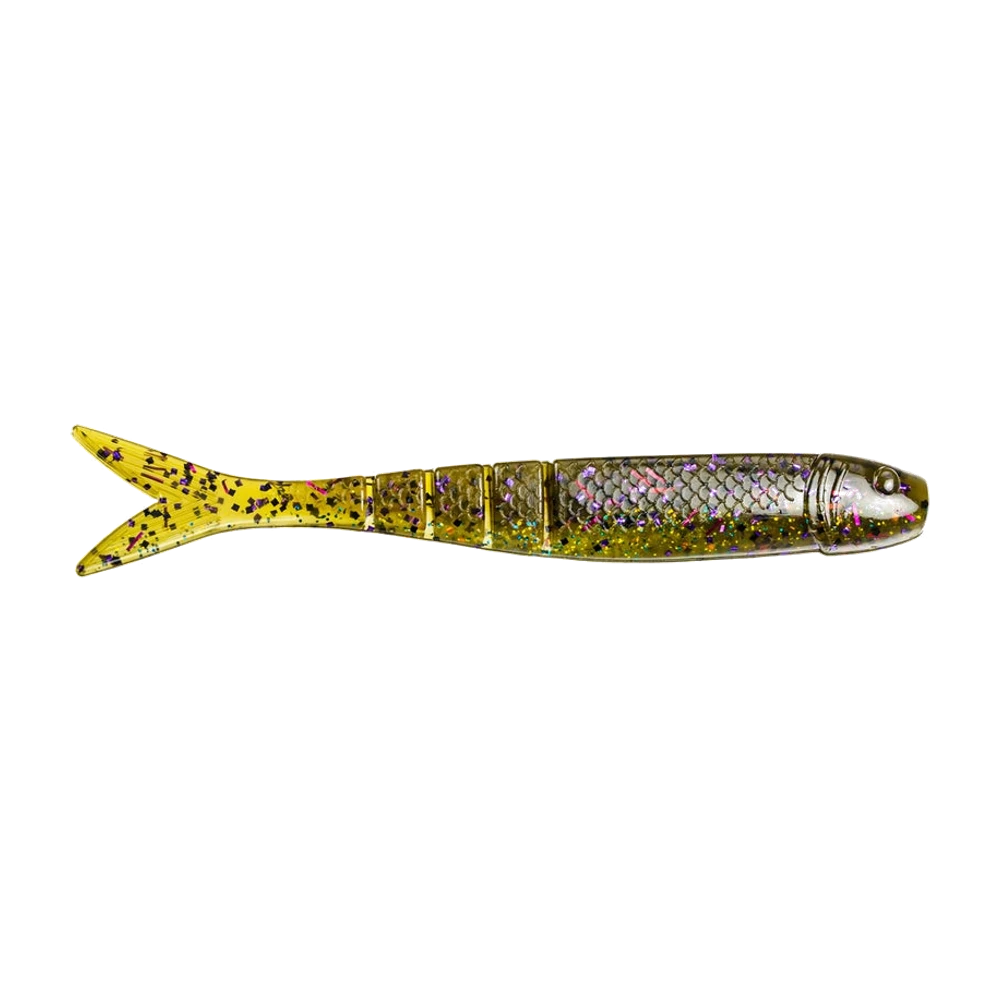
The description speaks of a thinned-out baitfish profile. The product photo bears that out: the body is very flat in profile, with moulded scales on the upper flank, a head separated by a gill-plate groove, and a run of deep transverse grooves across the rear half that give it its segmented look. The forked tail is made of two thin translucent lobes of unequal length, and it does all the work. That is an observation on a product photo, not a specification, but it explains how the bait behaves underwater.
A flat body deforms more easily than a round one of the same volume. That is why the Blade Minnow comes alive at low speed: a trickle of water is enough for the segments to undulate and for the two tail lobes to start beating against each other. The flip side is fragility around toothed fish — one passing pike and the bait is in two pieces.
Do a visual test before you fish it: bring it back at the slowest speed your reel allows, a metre from the bank. If the tail is already kicking, you know you can slow down further out on the water. That is the kind of information no spec sheet will give you.
The rigs that get something out of it
Weighted EWG hook
This is the most logical rig for the bait and the one its stated swimbait use points to. A wide-gap hook with a screw lock or a bait keeper, weighted 2 to 5 g depending on depth and wind. The hook point tucked into the back lets it through light weed, and the weight centred under the body keeps the horizontal attitude that makes the tail work.
Round jighead
To fish deeper or further out, a conventional round head of 3 to 7 g. The bait then swims slightly nose-down, which exaggerates the tail kick but flattens the body undulation a little. Keep it for open-water searching and drop-offs.
Bare single hook
Rigged with no weight at all, on a fine-wire single, the Blade Minnow glides down very slowly. It is the slowest presentation available, and often the one that pays on fish refusing everything else. You have to accept short casts and close-range precision work.
The classic mistake
Overweighting the rig. With a 10 g head the bait shoots straight for the bottom, the segments stop working and the tail pins flat: you have turned a finesse bait into a lump of weighted plastic. Stay with the lightest weight that reaches your target depth, even if you cast a little shorter.
Not sure what to tie on?
Photograph your spot: CarnaFish reads the scene, cross-checks the conditions and gives you the zone, the lure and the retrieve. Free on iOS and Android.
Where and when it takes the lead
This bait is at its best when fish are present but apathetic: late summer in warm clear water, early autumn over scattered bait schools, or the middle of a bright day on heavily fished water. It then replaces a paddle-tail shad such as the Strike King Rage Swimmer, which needs speed to express itself.
Against a tailless soft jerkbait like the Zoom Super Fluke, the difference is clear: the Fluke slides and darts on sharp twitches, the Blade Minnow swims continuously even when the reel is barely turning. They are complementary presentations, not competitors.
For perch, 11.4 cm is a touch long on average fish, but it filters the big ones well. It has no business in very dirty water, though: its asset is a slim discreet profile, and that counts for nothing at twenty centimetres of visibility.
Colours by water clarity
- Clear water: the finish in the photo, a translucent olive-gold loaded with purple, pink and black flake, with a silver scaled flank. Translucent and discreet, it passes light the way a real baitfish does.
- Cold water or low light: a solid pearl white, which stays readable down deep once the warm colours have already dropped out.
- Stained water: a dark tone with heavy flake, which plays on contrast rather than colour and catches what little light there is.
Knowing which rig to tie on matters less than knowing where to put it, and that is exactly what CarnaFish does: one photo of the spot, and the AI suggests the zone, the depth and the presentation that fit the day. To work on reading a swim before you even pick a lure, our guide to reading a fishing spot sets out the method.
Key takeaways
- The maker's table gives length, 11.4 cm / 4.5 in, and pack count, eight baits. No weight is published: weigh one yourself if you need the figure.
- A very flat body in profile and a forked tail with unequal lobes: it works from very low speeds.
- Lightly weighted EWG rig first, jighead to get down, bare hook for the slowest presentation.
- Coffee scent is built into the plastic; the odour-masking effect remains a claim from the brand.
FAQ
How much does a Blade Minnow weigh?
Strike King does not publish that figure: its table carries only length and pack count. If the weight matters for picking a rod rating, weigh one on a kitchen scale rather than trusting an estimate found online.
How many baits in a pack?
Eight, according to the pack count the maker gives. Factor that in when working out the unit price against a model sold in sixes or tens.
What hook suits an 11.4 cm bait?
A wide-gap worm hook in 3/0 to 5/0 depending on body thickness and rig type. Weighted 2 to 5 g to hold the horizontal attitude, or bare if you want the slowest possible fall.
Is the forked tail fragile?
Both lobes are thin and translucent, so yes, they tear more easily than a thick paddle tail. On a swim that holds pike, budget for losses. That is the price of low-speed action.
Is the coffee scent actually worth anything?
Strike King states that it masks human odours and oils, which is a claim from the brand rather than a measured result. What is certain is that the plastic is genuinely scented and that the scent lasts several sessions in the bag.
Can it be fished on a drop shot?
Yes, nose-hooked above the weight. The thinned body and the forked tail respond to the smallest tremor of the rod tip, which makes it a good alternative to a conventional finesse bait on a well-identified vertical spot.
The full bass lure guideSeason-by-season strategy: which family of lure, when, and why.Go from theory to fish
CarnaFish reads your spot from a photo and gives you the game plan: zone, lure, retrieve. Free on iOS and Android.