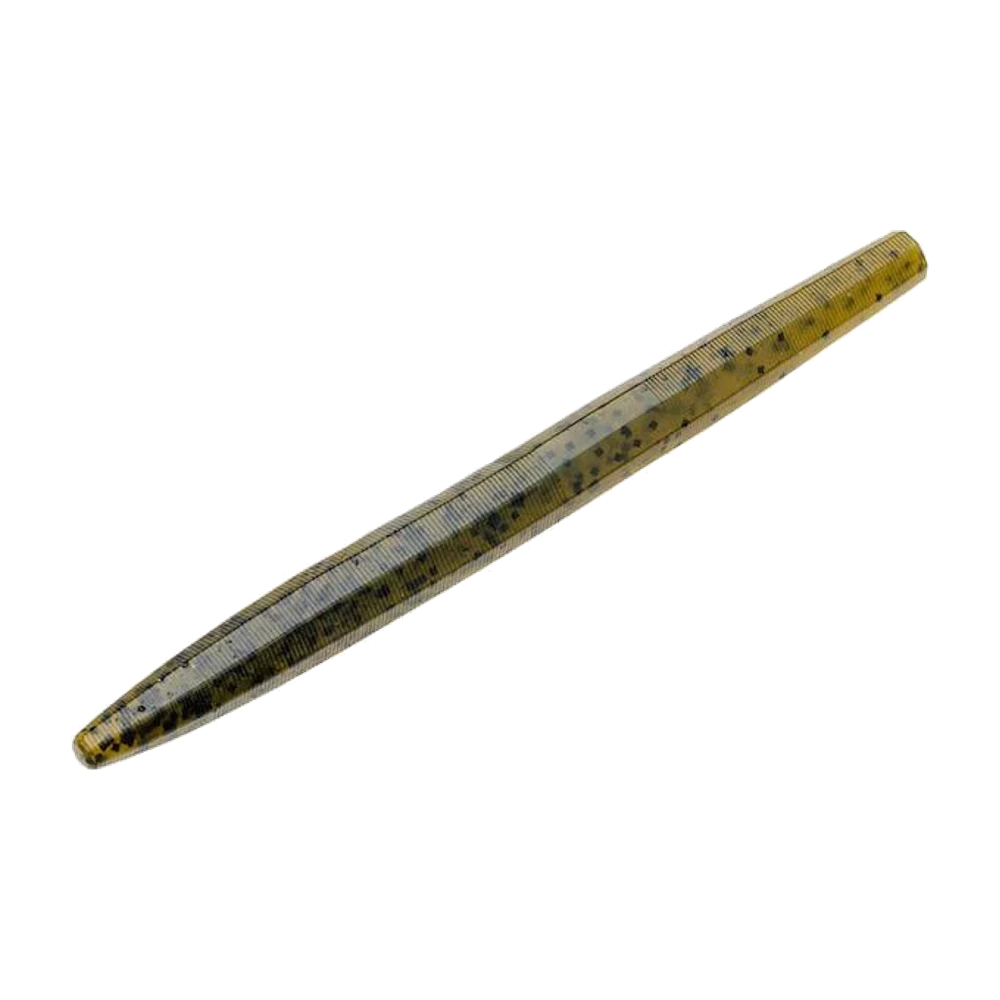
Strike King Ocho: the eight-sided stick worm that falls faster
Not sure this lure fits YOUR spot today? CarnaFish tells you in 10 seconds, from a photo.
When you fish a stick worm wacky, the scene is always the same: you cast against a piece of structure, you let it drop, and you wait. The bite comes during the fall, almost never anywhere else. So the whole thing hangs on one question — what happens during those five to fifteen seconds of descent?
On a perfectly round body the answer is simple: the lure undulates, the two halves flap slowly, and there is no other signal. It works, and it has worked for a long time. But on bass that have watched the same smooth cylinder go past all season, that visual silence becomes a handicap.
The Ocho changes one parameter and one only: its body is cut with eight flat faces instead of being cylindrical. Everything else — the density, the softness, the rigging philosophy — stays that of a stick worm. But those eight edges are enough to alter the fall and add a signal the round body does not have.
What the eight faces do
Three effects stack up during the descent.
- Brief, directional flashes. Every time the lure tips to one side, a whole facet turns towards the light and throws back a sharp glint, then vanishes. On a round body the light slides along continuously; here it switches on and off. That blinking is far more visible from the side.
- A slightly faster fall. The edges offer less lift than a curved surface: size for size, the Ocho drops a little more decisively. On active fish or in deep water you gain fishing time; on a slow fish it is sometimes a drawback.
- A more pronounced flap at both ends. The flat faces grip the water sideways and amplify the oscillation of the tips on a wacky rig, where a cylinder tends to spin on itself.
The body density stays high, which lets you cast a weightless lure properly — an essential condition for this family.
The retrieve: do nothing, but do it well
The technique is that of the wacky rig, which we cover elsewhere. What follows is about exploiting the Ocho's particular fall.
- Cast short and precise, against structure: the foot of a jetty, a stump, a lily edge. Distance is worth nothing here, precision is.
- Leave the line completely slack through the whole descent, never tightening it. A tight line turns a vertical fall into a pendulum and kills the undulation.
- Count the seconds and watch the line, not the lure. A bite reads as a sideways shift or as the fall stopping early.
- When it reaches bottom, do not lift straight away. Two to three seconds of stillness. The lure finishes settling, and the tips are still moving.
- One short twitch of the rod tip, just enough to hop the lure twenty centimetres, then let it fall back. Repeat two or three times before reeling in.
The slightly faster fall is easy to correct: a lighter wacky hook, or thicker line to brake the descent, lengthens the presentation time when the fish are lethargic.
On the water: with the Ocho, do not cast twice to the same place from the same angle. Move two metres along and repeat the same fall against the same piece of structure. The facet flashes are only visible within a narrow cone, and a bass sitting on the other side of the stump simply saw nothing of the first cast.
Settings by situation
| Situation | Size | Rig | Line |
|---|---|---|---|
| Clear water, wary fish | 10 cm | wacky, fine wire hook | 0.22-0.25 mm fluoro |
| Cluttered margin | 12.5 cm | weightless Texas | braid + 0.30 mm fluoro leader |
| Deep water, 3 to 4 m | 12.5 cm | wacky + O-ring | 0.25 mm fluoro |
| Dense weed | 12.5 cm | weightless Texas, point buried | straight braid |
The rubber O-ring around the body is not a gimmick on this model: the edges create wear points and the lure tears faster than a cylinder if the hook goes straight through the material.
Where it excels, where it is wrong
The Ocho is a lure for margins and precise spots, on water that does not move much.
- Vertical spots: jetty legs, submerged trees, walls. Any structure a free fall can run alongside.
- Educated fish in clear water, when the classic stick worm is no longer enough and you need an extra signal without leaving the family.
- Post-spawn periods, when bass stay glued to cover and refuse fast lures.
It is wrong in three cases. In noticeable current, a slack line becomes impossible to manage and the fall gets pushed off line. Searching a large area, you spend ten times longer per cast than with a crankbait. And in very cold water its more decisive fall works against you: there you want the longest possible presentation time, so a round body.

Not sure what to tie on?
Photograph your spot: CarnaFish reads the scene, cross-checks the conditions and gives you the zone, the lure and the retrieve. Free on iOS and Android.
Colours
Keep it simple. In clear water, a translucent tone with fine flake lets the facets work — that is the setting that shows off what the lure does differently. In coloured water, move to dark opaque: the flashes are no longer any use, silhouette is what counts, and a dark body cuts out better seen from below.
Ocho or Senko
The Yamamoto Senko 5 remains the benchmark of the family, with a round body, very high density and a slow, gliding fall that has no exact equivalent. Its strength is duration: the longer the lure takes to get down, the more eyes it passes.
The Ocho makes the opposite choice on two points: a slightly faster fall and an active visual signal. It becomes the better option when the water is clear and the fish have already refused several slow presentations, or when you need to reach 3 to 4 m without spending all day on it. On slow fish and in cold water, the shorter Senko 4 or the 5 stay ahead.
Our beginner's guide to bass fishing places these two options within a full season. And if you are unsure which rig to choose in front of a cluttered spot, CarnaFish analyses a photo of it and answers.
Key takeaways
- Eight flat faces: brief, directional flashes a round body cannot produce.
- Slightly faster fall than a cylindrical stick worm, size for size.
- Completely slack line during the descent, or the action disappears.
- O-ring recommended, as the edges wear faster around the hook.
- A precise-spot lure for calm water, unusable in noticeable current.
FAQ
What is the difference between the Ocho and a Senko?
The Ocho's body is cut with eight facets instead of being round. It drops a little faster and produces intermittent flashes as it tips over. The Senko bets on the opposite: the slowest possible fall.
Which rig works best for the Ocho?
The wacky rig on a wide gape hook is the main one: it frees both ends and exploits the flapping of the tips. The weightless Texas becomes preferable as soon as the spot gets really cluttered.
Do I need a rubber O-ring?
Yes, it is strongly recommended on a wacky rig. The body's edges create weak points and the lure tears faster than a cylinder if the hook goes straight through the material.
How long does the fall take?
Reckon roughly five seconds per metre with the 10 cm weightless, a little less with the 12.5 cm. Thicker line or a lighter hook slows the descent noticeably when the fish are lethargic.
Does the Ocho work in current?
Poorly. The technique demands a completely slack line, which is impossible to maintain as soon as there is any current: the fall gets pushed off line and turns into a pendulum. On those spots a weighted rig makes more sense.
What size should I start with?
The 12.5 cm covers the most situations on adult bass and casts better. Drop to 10 cm in very clear water, on smaller fish, or when the bites turn hesitant.
The full bass lure guideSeason-by-season strategy: which family of lure, when, and why.Go from theory to fish
CarnaFish reads your spot from a photo and gives you the game plan: zone, lure, retrieve. Free on iOS and Android.