Z-Man Kingpin Worm Sinking Formula: the Elaztech stick that finally sinks
Before tying this one on, it helps to know if the spot actually calls for it. CarnaFish reads the scene from a photo.
The standard complaint about Z-Man softs fits in one sentence: Elaztech floats. On a Ned rig that's an asset, because the bait stands up off the bottom. On a stick bait rigged wacky it's a real problem: the whole point of that lure type rests on a slow but steady fall, with both ends undulating on the way down. A stick that rises or stalls doesn't catch. The Kingpin Worm Sinking Formula is Z-Man's answer to that specific problem.
A sinking material, and why it changes everything
Z-Man developed a sinking version of its 10X Tough Elaztech, advertised with a fast sink and the same durability as the classic formula. That's no catalogue footnote: density is the variable that governs everything a stick bait does.
A stick that floats has to be weighted to go down, and the added lead kills the undulation. A stick that sinks goes down on its own, and all the energy of the fall goes into the movement of the body. With the Kingpin you get back the wobbling fall you expect from a classic salted plastisol stick, but in a material that survives ten times as many fish.
Keep in mind that "fast sink" is a relative phrase, not a published sink rate. The manufacturer gives neither a unit weight nor a descent time. Time the fall in two metres of clear water with the version you actually buy: that's the only reliable figure, and it drives the choice between the 3 in and the 5 in.
The symmetrical ringed body
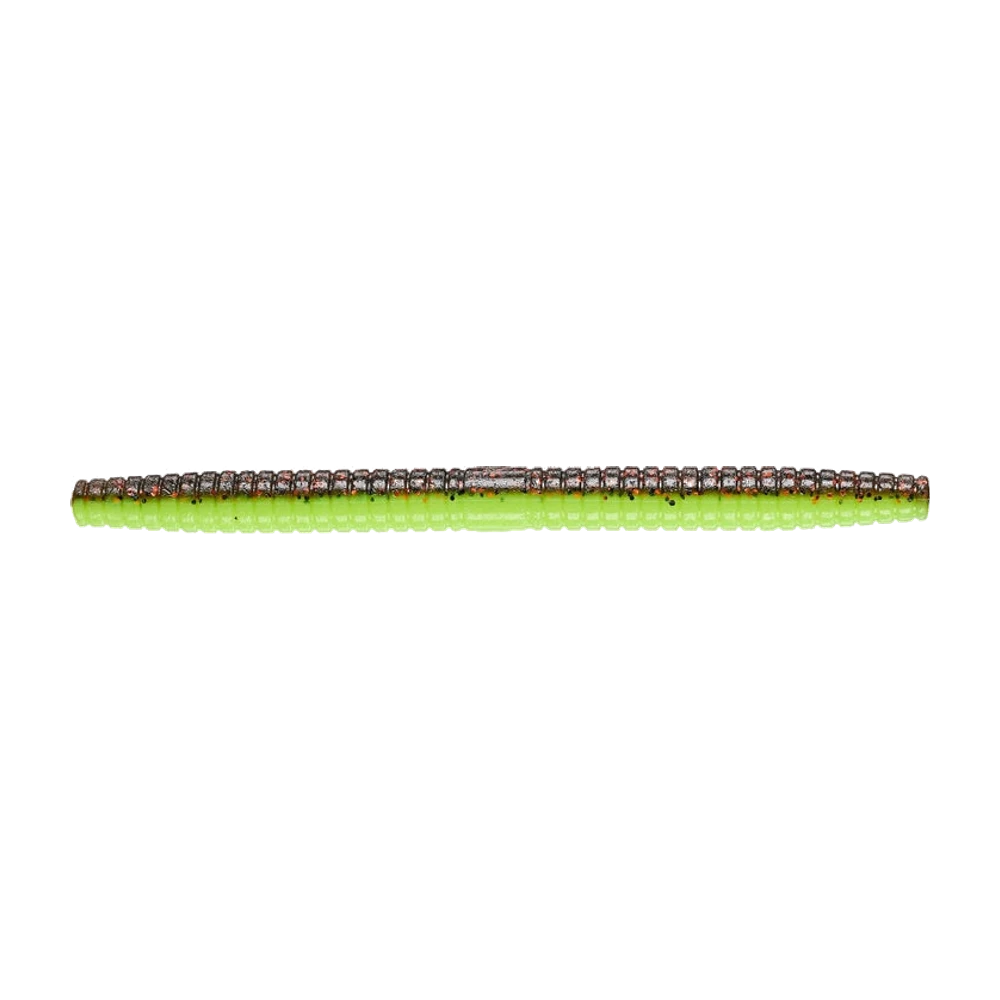
The Kingpin is ringed along its entire length and strictly symmetrical: both ends are identical, the same diameter, the same finish. That has three practical consequences.
First, you can't rig it the wrong way round, which matters when you're re-rigging blind at the end of the day. Second, when one end is too chewed up by hooksets, you turn the bait around and carry on. Third, the perfect balance of the body gives a steady fall: no end dropping faster than the other, so no line twist in the leader.
The rings themselves do two jobs. They increase drag in the water, which amplifies the wobble on the way down, and they give a wacky O-ring something firm to grip, so it stops sliding along the body.
On a wacky-rigged stick, the bite almost always comes on the first fall. If you let the lure go with ten metres of slack line, you won't feel it. Cast, close the spool, and watch the line as it sinks: a sideways run, or a sudden stop before the bottom, is a bite.
The three rigs, and what each one brings
Wacky
A 1/0 or 2/0 round-bend hook through the exact middle, ideally through a rubber O-ring so you don't tear the body. Both ends undulate freely for the whole fall. This is the most effective presentation on wary or pressured fish, and it's where the Kingpin makes the best use of its density.
Neko
A tungsten nail driven into one end, hook pinned near the front third. The bait goes down head first and plants itself almost vertically on the bottom, free end in the air, where you make it quiver in place. The neko rig demands a material that won't split around the nail, and that's exactly where Elaztech has the edge over salted plastisol.
Texas
In the 5 in size, on a 3/0 wide-gap hook with no weight or with a small bullet, the Kingpin becomes a cover bait you let drop alongside an obstacle. Less spectacular than wacky, but it goes through vegetation.
The manufacturer's copy lists all three rigs in one breath, in a slightly awkward phrasing that suggests they're equivalent. They aren't: wacky and neko exploit the density and the symmetry, while the Texas rig uses them far less.
The classic mistake
Reeling. A stick bait has almost no action under tension: retrieve it straight and you're dragging a piece of plastic. Cast, let it drop, lift it a few tens of centimetres, let it drop again, repeat. Over a full session, an angler who reels gets half the bites of an angler who lets it fall.
Two sizes, and a reading trap
The size chart runs to two lines: 3 in in packs of 8, and 5 in in packs of 6. The header really is Length Quantity, so the second value is a pack count and not a weight. In metric, that's roughly 7.6 cm and 12.7 cm.
The 3 in is a finesse size, best kept for educated fish, clear water and small perch that refuse a bigger profile. The 5 in is the reference size for bass: it casts better and stays readable from a distance. No unit weight is published for either version.
Not sure what to tie on?
Photograph your spot: CarnaFish reads the scene, cross-checks the conditions and gives you the zone, the lure and the retrieve. Free on iOS and Android.
Colours by water clarity
Z-Man only advertises a selection of its own freshwater colours, with no named list. Think in families of shades.
- Stained or green water: two-tone baits with a bright belly, like the chartreuse in the photo topped by a translucent brown back flecked with copper and black. The contrast between the two sides stays readable when visibility is short.
- Clear water, finesse fishing: natural flaked browns, green pumpkin or watermelon types, subtle and close to a real prey item.
- Low light or dark water: plain black, which cuts a sharper outline seen from below than any bright colour.
Alongside the other Z-Man softs
The Z-Man TRD Ned Rig is still classic Elaztech, so it floats: on a round head it stands up off the bottom, which the Kingpin does not. They're opposite tools, not competitors. For the fall, the Kingpin on a wacky rig is clearly the more relevant choice, precisely because its density is what does the work. One to sit on the bottom, the other to go down: keep both in the box.
A stick bait doesn't go just anywhere, it drops vertically alongside a precise piece of structure. That's exactly what CarnaFish makes easier: one photo of the spot, and the AI suggests the zone, the depth and the lure family that match the day's conditions. To build the logic behind finesse bass fishing, our guide to getting started on bass lays the groundwork.
What to remember
- The real contribution is the material: a sinking Elaztech, which finally makes the stick bait credible wacky-rigged with no added weight.
- The symmetrical body lets you flip the bait when one end wears out, and avoids line twist on the fall.
- Two sizes, 7.6 and 12.7 cm, in packs of 8 and 6. No weight is published: time the fall yourself.
- The bite comes on the fall. If you're reeling, you're not fishing this lure.
FAQ
What's the difference from classic Elaztech?
Density. Standard Elaztech floats, which is an asset on a Ned rig but a handicap on a wacky-rigged stick bait. The Sinking formula goes down, which makes the fall self-sufficient and gives the bait back its natural wobble.
How many baits are there per pack?
Eight in the 3 in version and six in the 5 in version. Watch how you read the retailer's chart: the second column really is a pack count, not a weight.
Which size should I choose?
The 5 in, about 12.7 cm, for bass in general: it casts better and stays visible from further away. The 3 in, about 7.6 cm, for educated fish, clear water and perch.
How much does a Kingpin weigh?
Z-Man publishes no unit weight, for either the 3 in or the 5 in. If you need that figure to pick a rod or a hook, weigh one yourself — it takes seconds.
Can you neko-rig it without tearing it?
Yes, and that's one of its strengths. Elaztech handles a tungsten nail and repeated hooksets far better than salted plastisol. An O-ring around the body is still a sensible precaution.
Should it be stored away from other soft plastics?
Yes, without exception. Elaztech, including the sinking version, reacts on contact with PVC plastisol and ruins both baits. A dedicated compartment or bag is enough.
The full bass lure guideSeason-by-season strategy: which family of lure, when, and why.Go from theory to fish
CarnaFish reads your spot from a photo and gives you the game plan: zone, lure, retrieve. Free on iOS and Android.