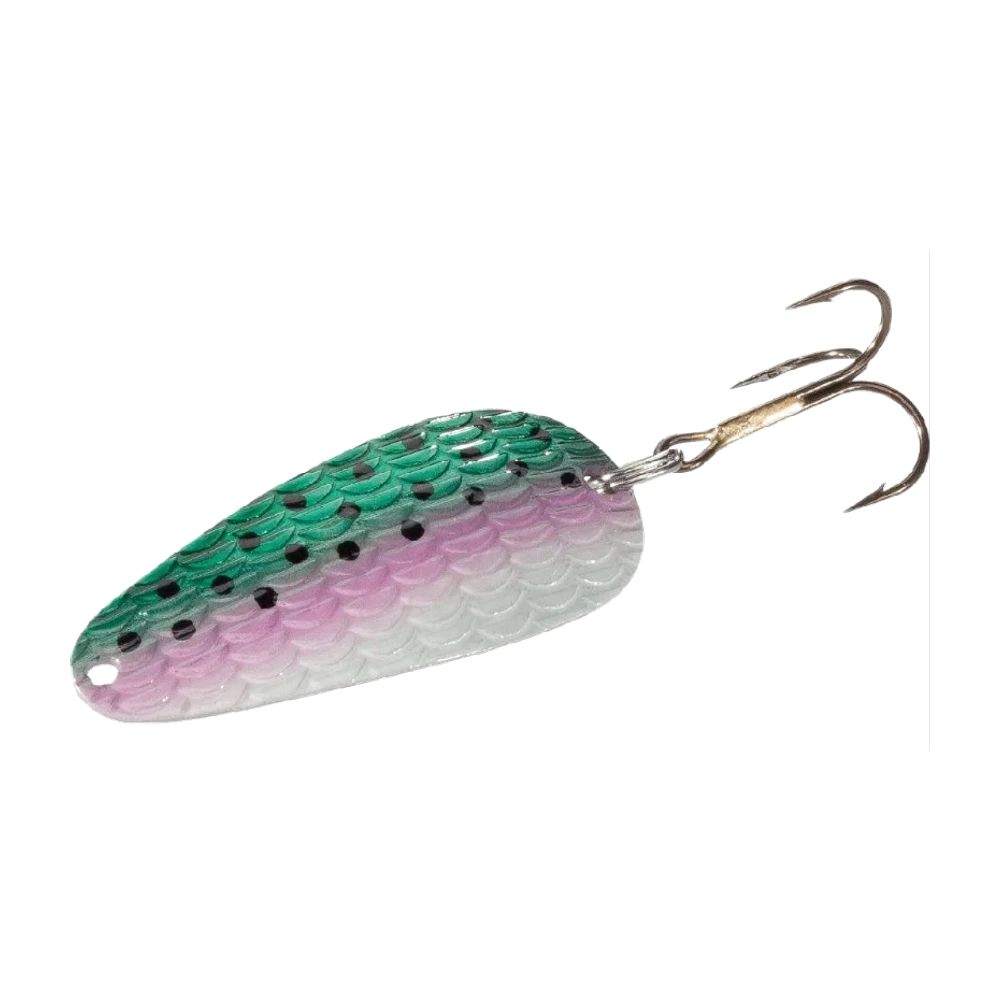
Thomas Cyclone: the solid brass spoon that keeps its flash as the light fades
Rather not fish it blind? Photograph your spot — CarnaFish cross-checks the conditions and points you the right way.
There is an hour on a trout river when everything changes in twenty minutes: the sun drops behind the ridge, the surface loses its reflections, and the chrome lures that were working at midday become grey objects crossing the water saying nothing. That is often the moment the fish finally start to hunt, and the moment most tackle boxes have nothing left to offer.
The Cyclone is built for that window. Its body is solid brass, not plated steel, and its surface is hammered rather than polished. Neither of those manufacturing choices changes the weight printed on the packet, but both change everything about what the fish sees when the light turns raking or the water takes on the colour of tea.
This is a spoon for difficult conditions, not a spoon for full sun.
Hammered brass against polished chrome
Polished chrome works like a mirror: it returns a sharp image of the light available. When there is plenty of light, that is spectacular. When there is none left, there is nothing to return.
A hammered brass surface works differently:
- It shatters the light into dozens of small points instead of one flash. Even weak ambient light produces a diffuse twinkle you can see from a distance.
- Brass leans yellow-orange, a wavelength that penetrates amber or tannin-stained water better than a cold white.
- The density of solid brass gives a 3 cm lure a weight that pressed steel of the same size could never reach. You cast a long way with a small object, which is exactly what you want on wary fish.
It is that last point that allows a tight, steady action at moderate speed: the mass steadies the spoon where a light plate would start slipping and blowing out.
Swinging it, spot by spot
On a wide river, the Cyclone is fished on the swing, not on a straight cast-and-wind.
- Cast across or slightly downstream, at about 45 degrees to the current.
- Do not start winding straight away. Let the current push the spoon: it describes an arc as it drops downstream, swimming on its own.
- Follow the arc with the rod tip, rod horizontal, keeping just enough tension to feel the wobble.
- At the end of the arc, when the spoon is straight downstream, let it hang in the current for five seconds. Plenty of bites arrive exactly there.
- Wind slowly over the last two metres before recasting; a fish often follows right to your feet.
- Move a metre downstream and start again. You comb the spot in successive bands.
On the water: the further downstream you cast, the higher and faster the spoon swims; the further upstream you cast, the deeper it drops and the more it slows. You change depth by changing the casting angle, not by changing lures. On any one spot, make three passes at three different angles before concluding it is empty.
Size and weight to suit the water
| Context | Weight | Suggested casting angle |
|---|---|---|
| Small clear river, 50 cm of water | 4.5 g | 30° downstream, firm retrieve |
| Medium river, steady current | 4.5 to 7 g | 45° across, classic swing |
| Big river, deep pool | 7 g | 45° upstream, let it sink 3 to 4 seconds |
| Lake or reservoir, fishing from the bank | 7 g | Long cast, slow fanned retrieve |
On this lure, going up in weight is mostly about buying distance and depth. The signature of the action barely changes between 4.5 and 7 g: that is good news, you can change weight without relearning the rhythm.
Its hours and its limits
Its favourite windows are dawn, dusk, overcast days and lightly stained water — exactly where the fish hunt and where classic bright tackle drops off. It is also very much at home on high-volume rivers where you need to cast far with a small lure.
It loses its advantage, on the other hand, in full sun on crystal-clear water, where its flash becomes too emphatic and spooks educated fish. It is also badly suited to a very narrow, shallow brook: its density takes it to the bottom before it has had time to swim. And on a lake with no current and no wind, it needs a firm enough retrieve to stay expressive, which rules out ultra-slow fishing.
Not sure what to tie on?
Photograph your spot: CarnaFish reads the scene, cross-checks the conditions and gives you the zone, the lure and the retrieve. Free on iOS and Android.
Rigging and line twist
A dense casting spoon working through an arc of current always picks up some rotation. A rolling swivel is not optional on this lure; put it thirty or forty centimetres up.
Line of 0.16 to 0.22 mm is the right range: fine enough not to choke the action, strong enough not to leave you stranded on the first rub against a boulder. A light snap is acceptable, provided it stays small: on a 3 cm lure, an oversized snap changes the nose balance and pulls the action off line.
Cyclone or Buoyant, two spoons from the same brand at opposite poles
This is the comparison that stops you buying the same thing twice.
The Thomas Buoyant relies on a low weight-to-volume ratio: it weighs little for its size, it swims high, it stays above obstacles and it forgives a slow retrieve. It is the lure for low, cluttered rivers.
The Cyclone does the opposite: plenty of mass in a small volume, a lower and tighter action, and the ability to cut across strong current without blowing out. The Buoyant flies over, the Cyclone goes through.
Against an Acme Phoebe the difference is sharper still: the Phoebe is a spoon for calm water and ultra-fine rigging, whereas the Cyclone takes 0.22 mm line and current in its stride. Our guide to river trout fishing works through reading spots on the swing. And if you are unsure which casting angle to adopt when you reach the bank, CarnaFish analyses a photo of the spot and answers.
Key takeaways
- Solid brass and a hammered surface: a diffuse twinkle that survives low light.
- The density lets you cast a 3 cm lure a long way and hold in current without blowing out.
- Fish it on the swing at 45°, and let it hang for five seconds at the end of the arc.
- You set the depth with the casting angle, not with the weight.
- Too emphatic in full sun on crystal-clear water, too dense for a small brook.
FAQ
Why a brass spoon rather than plated steel?
Brass is denser: for the same size the lure weighs more, so it casts further and holds in current better. Its warm tone also penetrates amber water better than the cold white of polished chrome.
What time of day should I take it out?
At dawn, at dusk and under a cloudy sky above all. The hammered surface produces a diffuse twinkle that stays perceptible in low light, when a mirror finish has nothing left to reflect.
How do I set the running depth?
With the casting angle. Downstream, the spoon swims high and fast; upstream, it sinks and slows. Make three passes at three different angles on the same spot before changing lures.
Do I need a swivel?
Yes, always. A dense casting spoon describing a long arc in current picks up rotation and ends up twisting the line. A rolling swivel thirty or forty centimetres from the lure settles the question without harming the action.
What is the difference from the Thomas Buoyant?
The Buoyant weighs little for its volume: it swims high, slowly, and suits low, cluttered rivers. The Cyclone is dense and compact: it swims lower and tighter, and cuts across strong current. They are two opposite uses.
Does it work in lakes?
Yes, fishing from the bank with long casts and a steady fanned retrieve. It is less comfortable on a very slow retrieve in dead water, where its density takes it towards the bottom before it can express itself.
The full trout lure guideSeason-by-season strategy: which family of lure, when, and why.Go from theory to fish
CarnaFish reads your spot from a photo and gives you the game plan: zone, lure, retrieve. Free on iOS and Android.