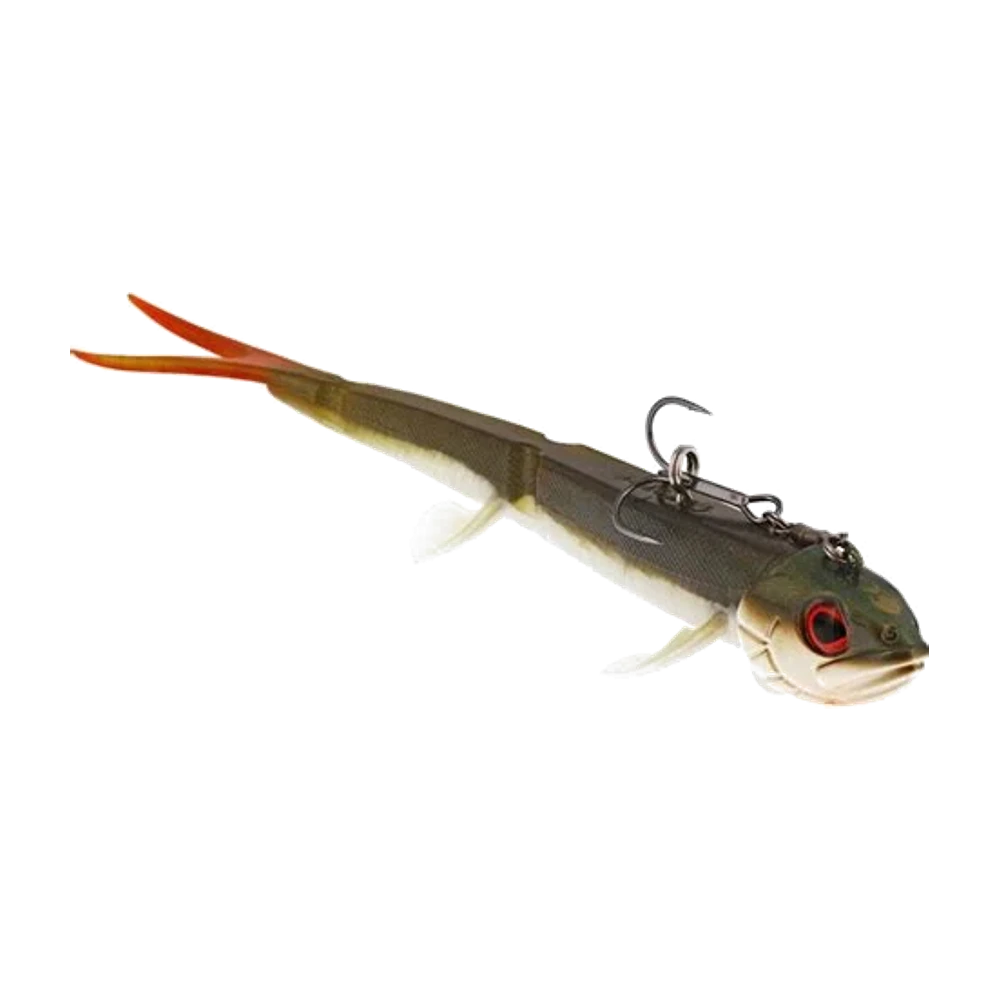
Westin TwinTeez: two tails to fish fast without losing the action
Rather not fish it blind? Photograph your spot — CarnaFish cross-checks the conditions and points you the right way.
There are days when pike are nowhere and everywhere at once. The water is around 14 °C, the fish are mobile, they aren't holding on any particular spot, and the only thing that works is covering huge amounts of ground. Except that a big soft lure retrieved fast usually rolls onto its side, spins, and turns into a useless propeller after three turns of the handle.
The TwinTeez's twin tail solves that precise mechanical problem. The two tails beat out of phase with each other: when one pushes to one side, the other compensates. The body no longer takes a single torque that makes it roll, and it holds its axis even when you wind hard.
That isn't a finishing detail, it's what allows a style of fishing that big single-tail shads can't deliver: searching fast with real volume.
What the twin tail actually changes
Three effects, all of them usable.
A speed range that extends upwards. Where a standard shad gives up above a certain rhythm, this one holds. So you can rake a flat at a good pace without giving up volume.
A more complex signal. Two beating tails produce two slightly offset frequencies rather than a single regular thump. On pike that have seen a lot of shads go past, that less mechanical signal generates fewer follows without a strike.
Better stability in a cross-current. The same stabilising effect works when the lure is pushed sideways by current or by wind bellying the line.
The trade-off is that the two tails create drag: for the same head weight, it sinks more slowly than a single-tail shad. You have to allow for that when choosing the head.
The fast-searching protocol
This is where it pulls furthest ahead of other big soft lures.
- Rig heavy. Allow 20-25 g more than you'd put on a single-tail shad of the same size, to offset the drag of the two tails.
- Cast long, fan out, and count the drop. Stay between 3 and 6 seconds of sink to keep to the upper layer.
- Retrieve at a good pace, faster than you'd instinctively go. You should feel both tails vibrating continuously.
- Cut dead every fifteen turns. A complete stop, the lure drops about a metre. That's the phase where a following pike makes its decision.
- Restart immediately with two fast turns, then pick the rhythm back up.
This speed-and-stop alternation is the key. On a lure that holds its action at high speed, the stop becomes the event, not the movement.
| Context | Jig head | Speed | Sink time |
|---|---|---|---|
| Flat at 2-3 m, mobile fish | 30-40 g | fast | 3-4 s |
| Edge of a drop-off | 40-60 g | medium | 5-8 s |
| Deep water, settled fish | 60 g and up | slow | to the bottom |
| Strong cross-wind | +20 g on the normal setting | medium | to contact |
On the water: when you cut dead mid-retrieve, never leave the rod pointing straight down the line. Swing it thirty degrees to one side during the fall. The lure then drops in an angled glide instead of falling straight down, and it stays in the field of view of the fish that's following — a pike loses sight of a prey that drops vertically beneath it.
The stinger isn't optional
On a lure of 15 to 27 cm, the main hook covers at best the front third of the body. A pike that takes across the body, and above all a zander that nips the back end, will never meet any iron.
The rig that works:
- A treble on a short wire trace, attached to the jig head's eye and hooked into the flank, two thirds of the way back along the body.
- Length adjusted so that the treble lands just before the tails begin. Too short and it's useless; too long and it flaps about and catches the body.
- A single hooking point, in the flank rather than the back, so you don't stiffen the body and restrict the tails.
For pike, wire is mandatory as the leader. A strong snap is needed too: a lure this heavy in flight opens light snaps in a handful of casts.
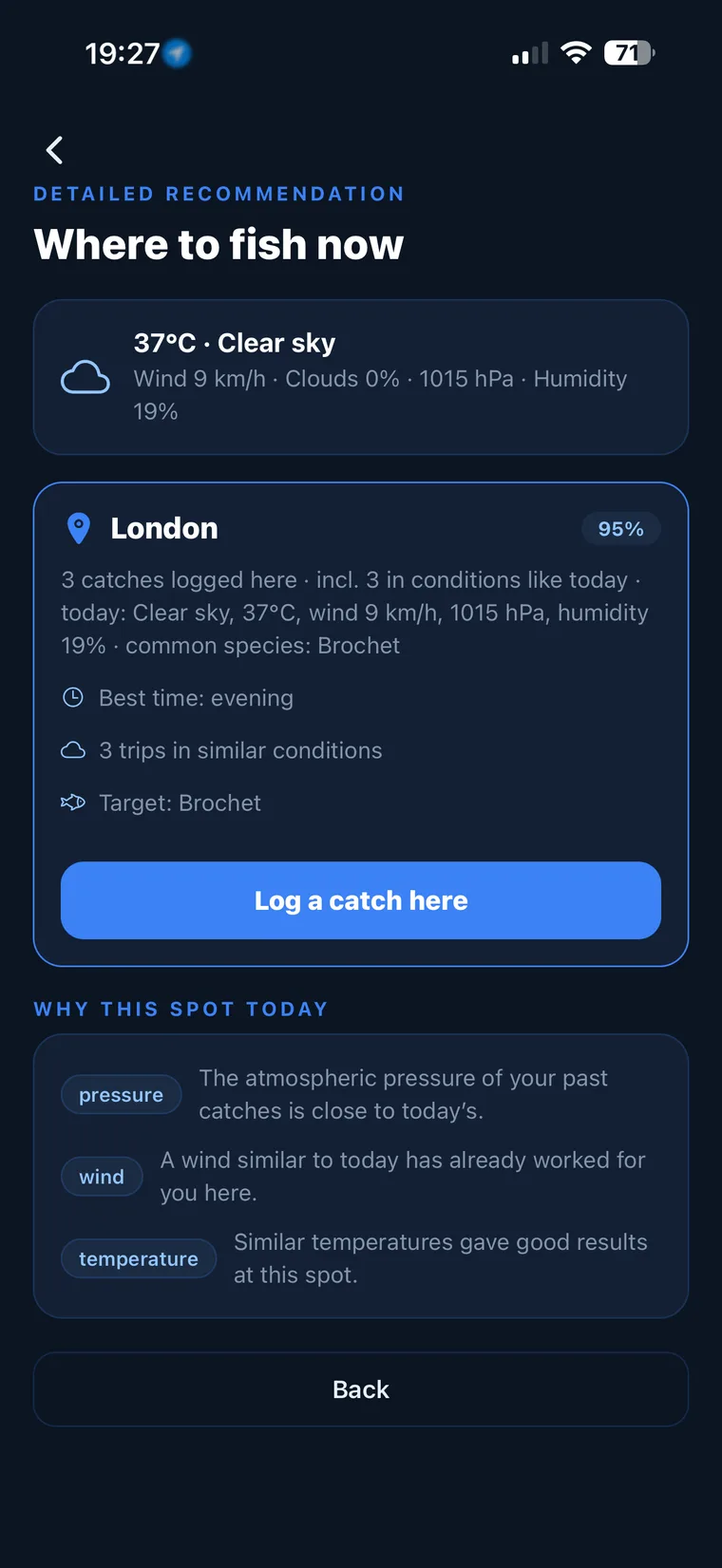
Not sure what to tie on?
Photograph your spot: CarnaFish reads the scene, cross-checks the conditions and gives you the zone, the lure and the retrieve. Free on iOS and Android.
Where it has no business being
- On difficult zander in cold water: the volume and the signal are too strong for a fish in slow motion. A compact shad will be far more productive.
- In weed: the two tails collect everything and you're picking algae off on every cast.
- On small waters: you cover the lot in ten casts and the volume ends up pushing the fish out.
- With light gear: under a rod rated 80-100 g, casting becomes dangerous and the hookset ineffective.
TwinTeez or a big single-tail shad
Against a big single-tail shad like the Fox Rage Big Eye Pro Shad XXL, the split is clear: the single-tail sinks faster for the same head weight and produces a heavier, slower thump, ideal when fish are settled on the bottom and you have to work a spot hard. The TwinTeez takes the lead as soon as the job is covering water quickly.
Against a pre-rigged swimbait with a rubber tail like the Rapala Peto, the contrast is sharper still, and the two complement each other: the Peto is built for very slow rhythms on a located fish, the TwinTeez for finding fish by raking fast. A box holding both covers the two ends of the season.
Our guide to choosing a pike lure places these approaches through the year. And if you're torn between searching fast or working a spot slowly when you arrive, CarnaFish reads a photo of it and answers.
Key takeaways
- The two tails beat in opposition: the body no longer spins, even at high speed.
- Rig 20-25 g heavier than a single-tail shad — the tails slow the drop.
- Search fast, broken by dead stops every fifteen turns.
- Swing the rod to one side during the fall to get an angled glide.
- A stinger is essential, hooked in the flank just before the tails begin.
FAQ
Why does the TwinTeez have two tails?
They beat out of phase and cancel the torque that would roll a standard shad. The body keeps its axis even at high speed, which allows a fast retrieve that's impossible with a single tail on a lure this size.
What jig head should you fit?
Allow 20-25 g more than on a single-tail shad of the same size, because the two tails slow the drop considerably. In practice, 30-40 g to search a flat at 2-3 m, 60 g and up to fish deep.
Is the stinger really necessary?
Yes, on a body of 15 cm and more. The main hook only covers the front third of the lure, and a pike taking across the body or a zander nipping the back end will meet no iron without one.
How fast should you retrieve it?
Faster than instinct suggests for a lure this size. You should feel both tails vibrating continuously, and cut to a complete stop roughly every fifteen turns: it's on that stop that a follow turns into a strike.
Is it suitable for zander?
In its smaller sizes and on active zander, yes. In cold water on fish in slow motion, the volume and the signal are too strong and a compact shad will be much more effective.
What rod should you use?
A rod rated at least 80-100 g depending on the size of the lure. With lighter gear, casting gets risky and the hookset lacks the reserve to drive a treble into a pike's jaw.
The full pike lure guideSeason-by-season strategy: which family of lure, when, and why.Go from theory to fish
CarnaFish reads your spot from a photo and gives you the game plan: zone, lure, retrieve. Free on iOS and Android.