X Zone Blitz Worm 11 in: the big ribbon that stands up on the bottom

Before tying this one on, it helps to know if the spot actually calls for it. CarnaFish reads the scene from a photo.
Late summer, a lake baked by three weeks of sun, and one single bite in two hours on sensibly sized lures. That is exactly the moment when pulling out a worm almost a foot long looks absurd — and when it works. Big fish settled on deep breaklines no longer move for a six-centimetre lure; they move for a meal that is worth the trip.
Twenty-eight centimetres, and that is not a typo
The X Zone Blitz Worm measures eleven inches, roughly 28 cm, and comes eight to a pack. To a European angler used to four-inch finesse worms it looks like a pike bait. It is in fact a pure bass lure, from an American school of fishing that accepts selection by size: you take three times fewer bites so that the ones you get are proper fish.
The logic holds up as soon as water temperature climbs. A good bass has an energy spent versus calories gained ratio to respect; the warmer the water, the faster its metabolism runs, and the more a large prey item makes sense. That is also why this format produces better in summer and early autumn than in March.
Two signal sources, not one
The body is ribbed across the whole front half, a run of pronounced ridges clearly visible in the photo. Those rings are not decorative: they grab water on every movement and produce a low, dull vibration, the kind a fish picks up through its lateral line before it ever sees the lure.
The ribbon tail does the rest. Long, wide and curled at rest, it takes up more than half the total length. A few centimetres of movement are enough to unroll it and set it waving again. That is what makes this type of worm so dangerous on the pause: even motionless from the angler's point of view, the lure keeps moving under the current or the slightest tremor in the line.
X Zone also claims something worth testing rather than taking on trust: the plastic blend is said to make the worm stand up off the bottom instead of lying flat, which few big ribbons do. In practice it depends heavily on the rig. On a shaky head the body does stand up vertically, tail in the air. On a conventional weighted Texas rig the effect is far less obvious. The plastic is also loaded with fine salt and a scent formula, which sits a little awkwardly with the buoyancy claim — salt makes the material heavier. Check it in a bucket before building a session around it.
On a big worm the bite almost never registers as a sharp knock. The weight disappears, or the line simply goes heavy for no reason. Give it a full second, drop the rod, then set with a long sweep: a bass takes these lures slowly, and an instant hookset leaves you with the tail in its mouth.
The belly line, a detail that changes your hookup rate
The Blitz Worm is moulded with a raised alignment line on the belly. It serves one purpose, but a crucial one on a lure this long: getting the hook in perfectly straight. A 28 cm worm rigged off-centre spins on the retrieve, twists the line and misses half its bites. With the guide line you aim at the ridge where the point exits and the question stops arising.
Weighted Texas rig, the default
Wide gap hook 4/0 to 6/0, tungsten bullet of 5-14 g / 3/16-1/2 oz depending on depth and wind. This is the do-everything rig: it goes through branches, drops straight and leaves the tail free to work on the fall. Use the widest hook the body takes without puckering the plastic.
Carolina rig, for covering bottom
Heavy sinker on the main line, swivel, then a 50-90 cm / 20-36 in leader with the worm on the end. The sinker ploughs the bottom while the lure trails freely above it, tail deployed. It is the most efficient rig on a wide bare breakline, where you have to cover ground without losing contact.
Shaky head, the most vertical version
A round 5-10 g / 3/16-3/8 oz head nose-hooked with the point brought back out through the back. Small shakes of the rod tip on the spot: that is where the body stands up most convincingly, with the ribbon waving vertically above the substrate. A target rig, not a search rig.
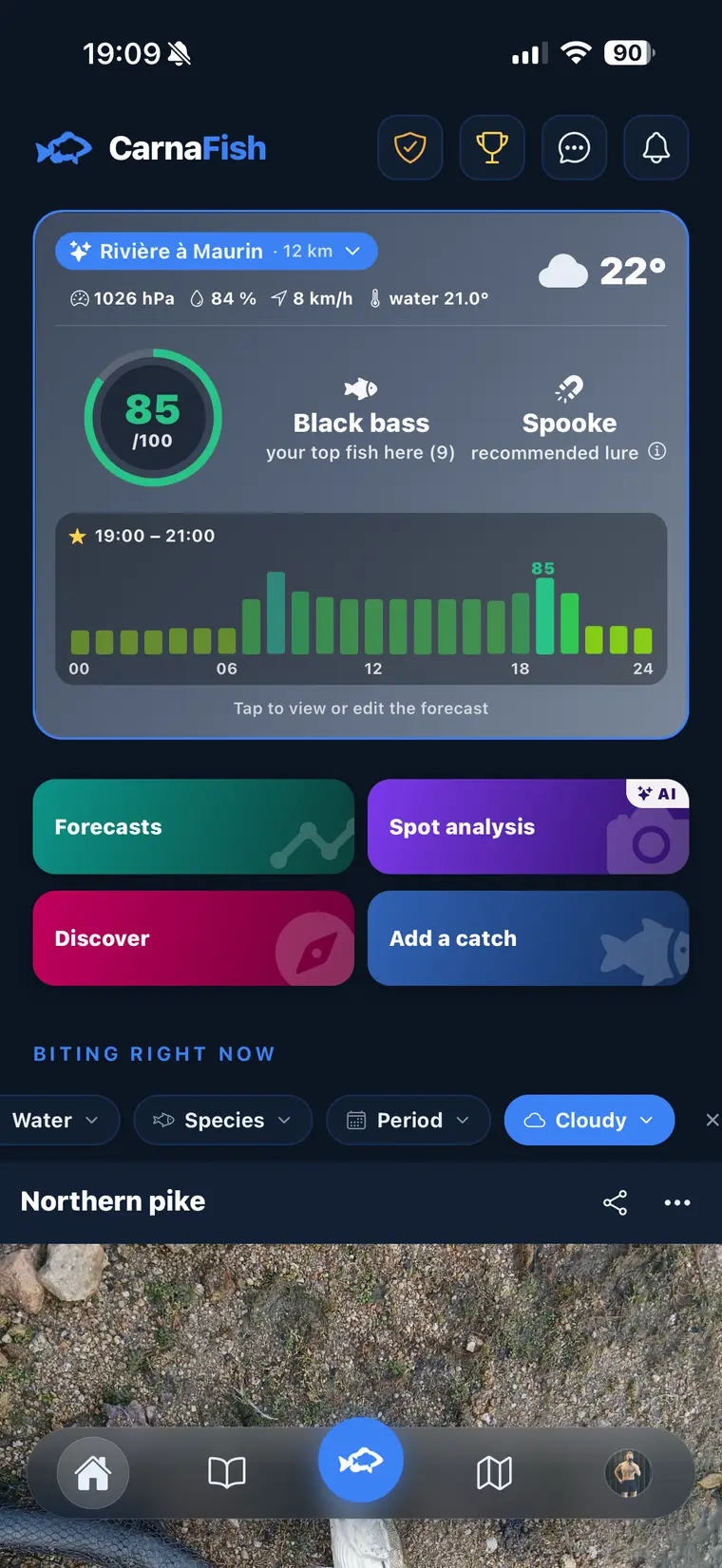
Not sure what to tie on?
Photograph your spot: CarnaFish reads the scene, cross-checks the conditions and gives you the zone, the lure and the retrieve. Free on iOS and Android.
The most common mistake: working it too hard
Anglers new to big worms instinctively want to move them, because a lure that size seems to call for action. The opposite is true. One long, slow sweep, then a five to ten second pause during which you touch nothing. The ribbon tail works on its own throughout that pause, and that is almost always when the line starts to move.
If you want to compare other takes on the ribbon tail, the Gambler 13 Ribbon Tail Worm pushes the size logic further still, while the Culprit Original Worm is the historic, slimmer version of the same idea. The 6th Sense Boosa Ribbon Tail Worm sits between the two in length.
Colours by water
- Stained water, dark bottom, heavy cloud: Black Blue Flake, the colour of the sample photographed. Black gives a sharp silhouette seen from below and the blue flake catches what little light there is.
- Clear water: Green Pumpkin, the go-anywhere tone that alarms nothing and reads as crawfish or larvae alike.
- Silt bottoms or lightly coloured water: Red Bug, a flaked red-brown that stands out over dark substrate without looking loud.
A lure this size is only worth using in the right place: on a breakline, a deep flat, a submerged bridge footing. That is precisely what CarnaFish helps with: one photo of the spot, and the AI suggests the zone and the presentation that suit the day. For the bass fundamentals before moving to big profiles, our beginner's guide to bass fishing sets the scene.
What to remember
- 28 cm is a selection choice: fewer bites, but bigger fish, especially in warm water.
- The ribbed body supplies the vibration, the ribbon tail supplies continuous movement on the pause.
- The moulded belly line is there to rig straight: a big worm rigged off-centre spins and misses bites.
- Delay the hookset by a second and sweep wide, never snap.
FAQ
Is a 28 cm worm really a bass lure?
Yes, it is a standard American big-fish format, not a pike bait. A one-kilo bass takes a ribbon this size without hesitation, especially in warm water. Expect fewer bites than with a finesse worm, though.
What hook size should I use?
A wide gap Texas hook from 4/0 to 6/0 depending on how you fold the body. Pick the largest gauge the lure accepts without puckering the plastic: on a lure this long, an undersized gap translates directly into dropped fish.
Does it really stand up off the bottom?
That is the maker's claim, and it holds best on a shaky head. On a conventional weighted Texas rig the effect is much less pronounced. Since the plastic is salt-loaded, test it in a bucket before building a session on that property alone.
How fast should I work it?
As slowly as you can bear. One long sweep, then five to ten seconds of doing nothing. The ribbon tail keeps undulating through the pause, and that is almost always when the bite comes.
How many worms per pack?
Eight pieces per pack in the 11 in version, which is generous for an unarmed soft plastic that takes damage on every fish. Slide the worm back up the shank after each catch rather than replacing it straight away.
Texas or Carolina, which should I pick?
Weighted Texas if you are fishing a precise piece of cover, a weed edge or a sunken tree. Carolina if you have to sweep a large area of bare bottom: the separated sinker keeps contact while the worm trails freely behind, which gives a far more natural presentation on a wide breakline.
The full bass lure guideSeason-by-season strategy: which family of lure, when, and why.Go from theory to fish
CarnaFish reads your spot from a photo and gives you the game plan: zone, lure, retrieve. Free on iOS and Android.