6th Sense Boosa 9.6 Ribbon Tail Worm: the 24 cm worm that moves water
One lure, endless conditions. CarnaFish reads your spot from a photo so you are not just guessing.
There is a point in late summer when bass stop reacting to anything that travels fast. They sit tight on the bottom, along a break, in a pile of dead wood or on the edge of deep vegetation, and they will no longer rise two metres for a small bait. What makes them move then is rarely subtlety: it is a big volume dropping slowly past their nose, sending out a signal they detect long before they see it. The 6th Sense Boosa 9.6 is built for exactly that situation — as long as you accept from the outset that a 24 cm worm is not a numbers bait.
A deliberately oversized worm
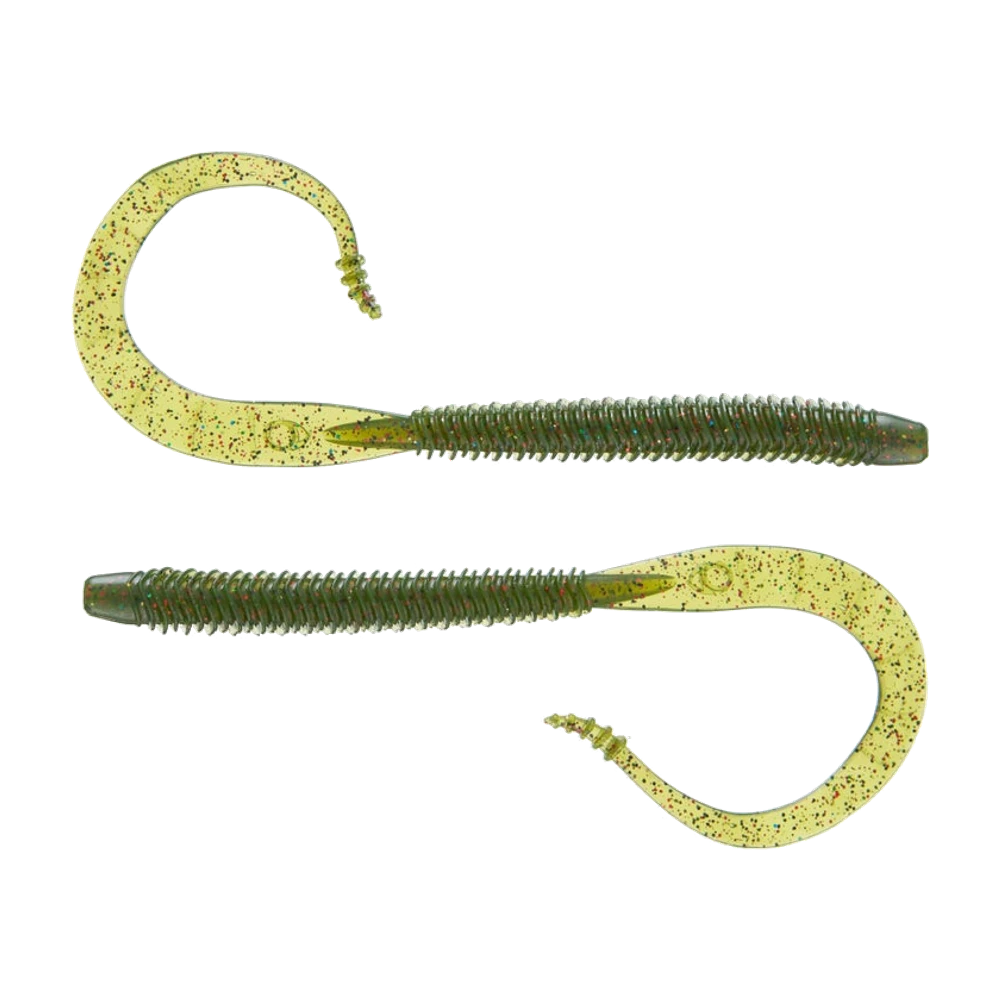
The Boosa measures 9.6 in, which is 24,4 cm, and the pack holds eight. That length puts it in the large-format worm bracket, above the 19 cm of a Culprit Original Worm and the 17 cm of a Zoom Magnum Finesse Worm. A good half of the bait is taken up by the ribbon tail; the other half is a thick body covered in very pronounced rings.
That size has one consequence worth knowing before you buy the pack: the Boosa sorts fish. A 30 cm bass hesitates a long time in front of a silhouette like that, and plenty of them give up. If you are after contact and a bite every ten minutes, this is the wrong tool. If you want the two or three biggest fish on water you already know, that is another story.
What the body ribbing actually does
The body of the Boosa is not smooth. It is covered in deep circular ridges, a ribbing the manufacturer describes as corrugated. That is not a styling decision, and it matters on three concrete counts.
First, those rings push water. Each ridge creates a small amount of turbulence as the bait sinks, and all that turbulence added together displaces noticeably more water than a smooth body of the same length. That is what lets the bait be picked up at distance through the lateral line, in stained water or over cluttered bottom where eyesight counts for little.
Second, the ribbing softens the movement. A thick, smooth 24 cm cylinder would be fairly stiff and would drop almost straight. The rings create that many hinge points: the body bends, snakes and undulates along its whole length on the drop instead of falling like a stick. It is the same principle as on a Berkley PowerBait Power Worm, pushed much further in relief.
Third, the grooves between the rings hold liquid scent better than a smooth flank, where the product is gone on the first cast. One point not to overread: the manufacturer's description talks about the body's ability to keep scent, not about scent or salt already built into the plastic. If you want the benefit, you have to apply it yourself.
The bulbous ringed tail, the real signal
The tail is long, flat, ringed as well, and it finishes in a swollen tip. It works at two very precise moments, and those are the two moments you have to fish.
On the drop it opens out and generates a secondary vibration, independent of the body's undulation. So you have two signals layered on top of each other at different frequencies: the body snaking slowly along its whole length, and the tail quivering faster behind it. That is a lot of movement for a bait you are not touching.
As the worm comes to rest on the bottom, the swollen tip keeps moving for a fraction of a second after the body has stopped: the bait dies, then moves one last time. On a fish that was watching the silhouette come down without committing, that final quiver is often what triggers it.
On the water: a bite on a worm this size almost always comes during the drop, or within two seconds of bottom contact. Count your drops, not your reel turns. And never set on first contact: a bass often takes a long worm by the middle or by the tail and has to reposition it. Drop the rod, take up the slack, and set a second later with a sideways sweep rather than a sharp pull upwards.
Three rigs for three ways of fishing
Weighted Texas rig
The benchmark rig. The manufacturer recommends a stout extra wide gap hook in 5/0 or 6/0, and that is not excessive: on a body this thick, a smaller hook leaves too much plastic between the entry point and the point itself, and you will pay for it in missed hooksets. A bullet weight of 7 to 14 g covers most situations, always taking the lightest weight that still lets you feel the bottom. The Texas rig with the point buried in the back is what allows this bait to go through dead wood and vegetation without hanging up.
Flipping
When the fish are under an identified piece of cover — a fallen tree, a dock, a floating mat — you move up to a heavier weight, 14 to 21 g, pegged against the bait so the whole thing enters the hole cleanly. You drop it in, you watch the fall on the slack line, and you pull out after two or three seconds if nothing happens. In a metre of water under dark cover, a big profile is found faster than a small one.
Dragging the bottom
The third use the manufacturer intends is dragging, pulling the bait slowly across the substrate. You move the worm with the rod, in steps of thirty to fifty centimetres, then let it sit for two to five seconds. On a gravel or sand flat with no visible holding spot, that is the most efficient way to cover ground with a bait this slow. The free rig genuinely helps here: the weight reaches the bottom first and the worm finishes its descent freely, which lengthens the drop phase, the one where the tail works.
The classic mistake
Overworking it. The natural reflex, with a 24 cm bait on the end of the line, is to give it amplitude so you can feel it work. That is exactly what makes it ineffective: every hard pull cuts the drop short and deletes the settling vibration. Two short moves per spot, then a fresh cast, beat ten pulls along the same path.
Not sure what to tie on?
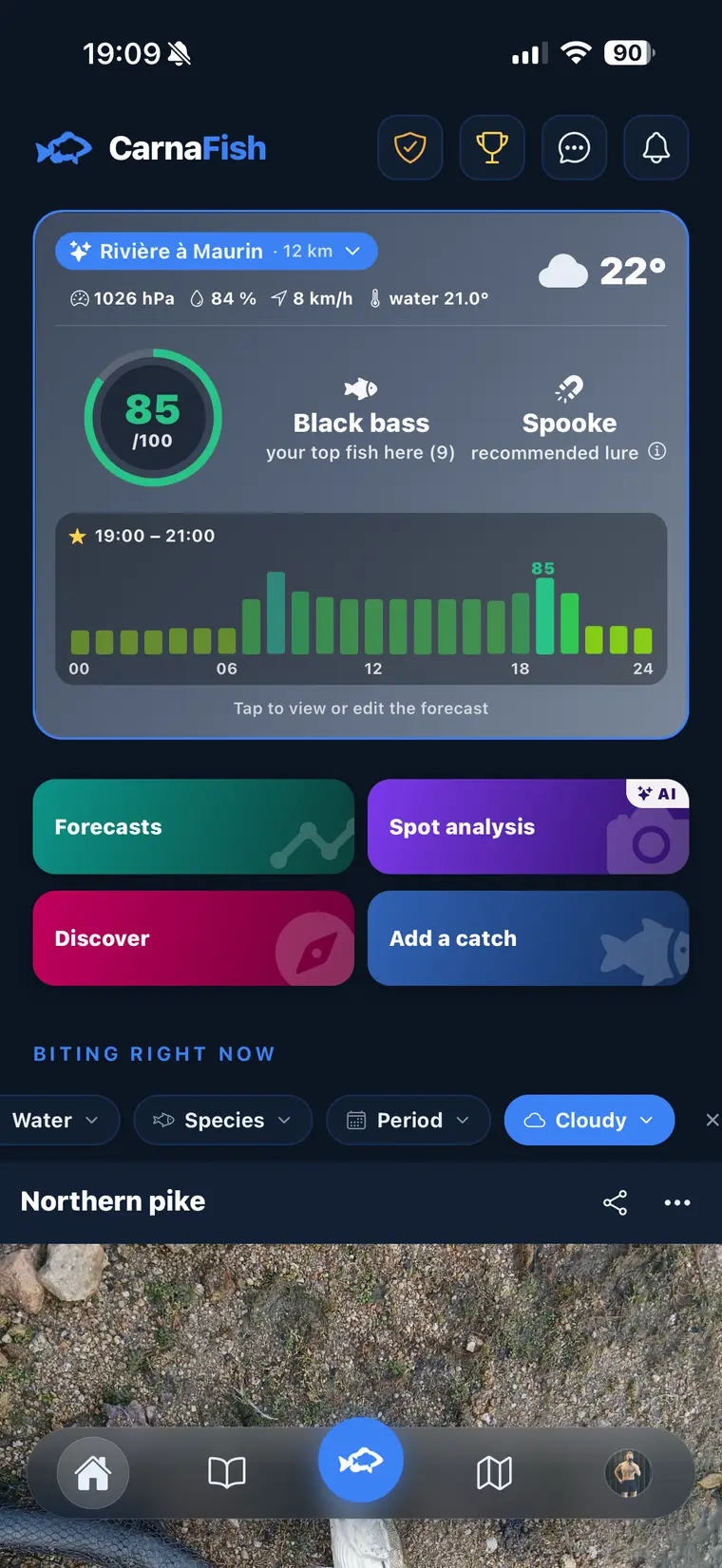
Photograph your spot: CarnaFish reads the scene, cross-checks the conditions and gives you the zone, the lure and the retrieve. Free on iOS and Android.
Colours by water clarity
The exact catalogue names are not documented here, so think in colour families rather than precise references.
- Clear water: the green pumpkin family, a translucent brown-green that stays believable when the fish sees the bait well and takes its time looking it over.
- Stained water: the plum or june bug family, dark purple tones that keep a readable silhouette without turning garish.
- Muddy water, dark bottom or low light: the black and blue family, which relies not on colour but on a clean silhouette contrast against the surface light.
Where it wins, where it loses
Its ground is warm water and fish holding between one and seven metres, from June to September, on cluttered hard bottom: drowned wood, stumps, breaks, deep weed edges. It also wins when you know there are good fish on a zone you have already covered with fast baits and had no response.
It loses clearly in cold water, where its slowness becomes inertia and bass no longer move for that kind of volume; a Zoom Trick Worm rigged weightless does better there. It also loses when you need to search fast, and on waters holding nothing but small fish, where the sorting effect works against you.
The right worm never replaces reading the spot, and that is precisely what CarnaFish is for: a photo of the spot, and the AI suggests the zone, the depth and the presentation that match the day's conditions. To work out which part of the year this kind of slow, big-volume fishing takes over, our season-by-season predator fishing guide sets the frame.
Key takeaways
- The heavily ribbed body pushes water and hinges: a signal detectable at distance and undulation along the whole length on the drop.
- The bulbous ringed tail adds a secondary vibration that carries on for a fraction of a second after the bait settles on the bottom.
- Stout extra wide gap hook in 5/0 or 6/0 as recommended by the manufacturer, and a delayed hookset with a sideways sweep.
- A bait that sorts upwards: few bites but big fish, and no point at all in cold water or when searching fast.
FAQ
What hook size for the Boosa 9.6?
The manufacturer recommends a stout extra wide gap hook in 5/0 or 6/0. On a body this thick, a smaller hook leaves too much plastic between the entry point and the point, and your hookset rate collapses. Strength matters as much as gap, because you are pulling these fish out of wood.
What weight should I use?
7 to 14 g on a standard Texas rig depending on depth and wind, 14 to 21 g when flipping dense cover. The rule is the same as on any slow soft plastic: take the lightest weight that still lets you feel bottom contact, because the drop is the phase that produces bites.
Does the Boosa contain salt or scent?
The manufacturer's description does not say so. What it does state is that the body rings hold scent better than a smooth flank — so a product you apply yourself will last longer. With no information available, it is better not to assume anything about the plastic's make-up.
How many pieces in a pack?
Eight worms of 9.6 in, around 24,4 cm each. A reasonable quantity for a bait this size, bearing in mind that a long worm often loses its tail to missed strikes.
Should I set the hook straight away on the bite?
No. On a 24 cm bait the bass very often takes it by the middle or the tail and has to reposition the worm in its mouth. Drop the rod, take up the slack for a second, then set with a long sideways sweep. If you miss two fish in a row, shorten the tail by two or three centimetres.
Is this worm suitable for pike or perch?
For perch, no: the volume is out of all proportion. For pike the profile could be of interest, but the Texas rig as it is fished here runs without a bite-resistant leader and will not survive the teeth — this bait remains designed and hooked for bass.
The full bass lure guideSeason-by-season strategy: which family of lure, when, and why.Go from theory to fish
CarnaFish reads your spot from a photo and gives you the game plan: zone, lure, retrieve. Free on iOS and Android.