Xcite Baits Sucka Punch: the creature bait with a hook slot
This lure shines under specific conditions. CarnaFish tells you in 10 seconds if today is one of them.
A mat of lily pads and pondweed covering a couple of hectares, not a centimetre of open water, and somewhere underneath it bass that have not seen a lure all day. Punching is a brutal and simple technique in principle: you break through the roof with a heavy weight and let the bait fall. The whole question is what can pass through that roof without collecting salad. The Xcite Baits Sucka Punch attacks that precise problem with an uncommon mechanical idea.
A side slit instead of a hook laid on top
On a conventional Texas rigged creature bait, the hook shank runs along the back or inside the body, but the eye and the bend of the point stick out, if only by a millimetre or two. That tiny ridge is enough to snag a weed stem at the wrong moment, and it is usually why you reel in a bait wearing a bundle of vegetation.
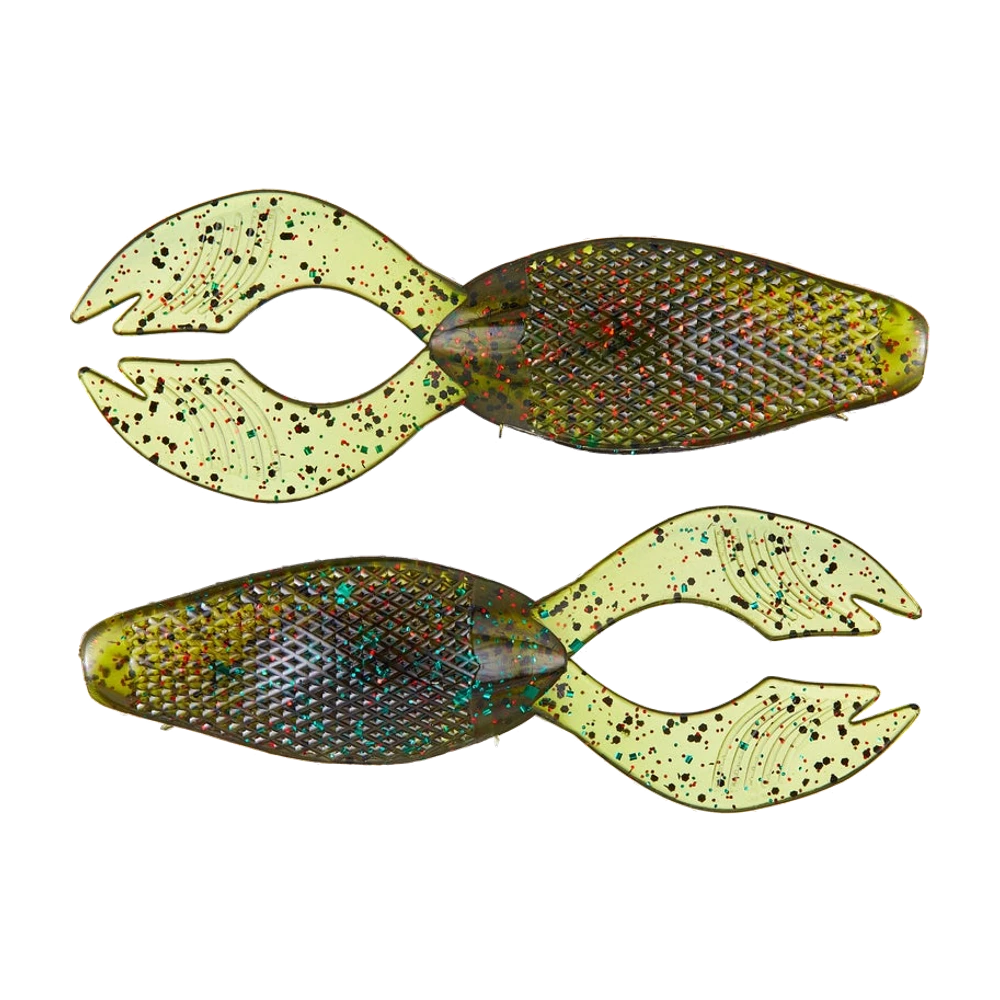
The Sucka Punch is moulded with a side slit running along the flank. The flipping hook is not skin-hooked: it slides entirely inside that slit, point included. The body closes over it and the bait goes back to being perfectly smooth. On the photo, the thick flat oval body, covered in heavily defined diamond scaling, clearly shows the line of the slit at mid-flank.
The benefit is marginal against thick stalks, where passage is mechanical anyway. It shows up in fine, filamentous vegetation, the stuff that grabs everything: veils of algae, drifting cut weed, root hair. There, a genuinely smooth bait comes back clean while a bait with an exposed hook comes back loaded.
The hookset is the trade-off. With the hook fully enclosed you need a wider, firmer set than with a standard Texas rig, because the point has to drive through the plastic before it reaches the jaw. Heavy rod, 50 lb braid at least, and no wrist sets: the whole arm does the work.
A body shaped to punch through, not to swim
The silhouette is distinctly flattened. That is not a styling choice: a flat body presents a reduced section on edge, letting it slide between two stems rather than having to push them apart. The bait therefore gets through the mat with less weight than a bulky round-section creature bait, which is a real advantage — a lighter sinker means a slightly less violent fall, so a more believable bait under the canopy.
The same flat profile serves for skipping. A low cast across the water to get under a dock or a low branch: the flat face bounces instead of digging in. It is a secondary use for the Sucka Punch, but it works well and it opens up spots nobody fishes.
The two flat ribbed claws are the only moving part. They kick sideways during the fall with a wide, slow motion rather than the fast flutter of a craw with thin antennae. Rigged vertically, claws upwards, the bait reads more like a baitfish tail than a crawfish — a useful detail on fish feeding on forage rather than crustaceans.
Rigging, spot by spot
Punching a thick mat
A 21 to 42 g (3/4 to 1 1/2 oz) weight depending on mat thickness, pegged against the bait with a bobber stop or a rubber bead. A 4/0 flipping hook buried in the slit. Short pitch, let the weight break through, follow the fall and wait. The bite comes within the first three seconds nine times out of ten: if nothing happens, lift out and start again a metre away rather than working the bait.
Flipping wood and stumps
A 10 to 21 g (3/8 to 3/4 oz) weight, same rig. The Sucka Punch drops along a stump or between roots without hanging up, and that is where the smooth body pays. Compare it with a Reaction Innovations Sweet Beaver, the benchmark of the category: the Beaver swims a little more on the fall, the Sucka Punch clears cover better.
Jig trailer
The flat claws make it a decent trailer on a punching jig, provided you trim the back of the body so the profile does not get bulky. An off-label use, but an effective one when you want volume without adding noise.
The mistake to avoid
Working the bait. The reflex of lifting the rod three times per spot comes from open-water jig fishing and it is counterproductive here. Under a mat the fish is posted, it sees the bait drop into its immediate field of view and it decides in a second. Every extra lift mainly raises the risk of a hang-up.
Not sure what to tie on?
Photograph your spot: CarnaFish reads the scene, cross-checks the conditions and gives you the zone, the lure and the retrieve. Free on iOS and Android.
Colours under the canopy
- Clear water, sparse mat: flaked green pumpkin, exactly the finish of the bait photographed here, translucent olive with red, black and turquoise flake. Discreet and believable as crawfish or as forage.
- Dark water or very thick mat: black and blue. Under thirty centimetres of vegetation it is night down there, and only a heavily contrasted silhouette reads.
- Stained water, medium light: a bright tone, chartreuse claws or a junebug body, to give a visual anchor in water that only passes a metre of light.
A specialist bait, and it owns it
The Sucka Punch is useless in open water. It does not swim, it does not vibrate, it has no retrieve action at all. It is a tool for one job: dropping fast and clean into cover other baits cannot escape. If your water has no grass mats and no dense wood, an all-round creature bait such as the Missile Baits D Bomb will see far more use.
Spotting from the bank which patches of cover deserve this treatment is exactly what CarnaFish helps with: a photo of the spot, and the AI suggests the zone to attack, the depth and a suitable presentation. For the rest of the bass fundamentals, our guide to getting started with bass fishing covers spots and tackle from the ground up.
Key takeaways
- The side slit lets you fully enclose the flipping hook: the bait comes back smooth even through filamentous weed.
- The flattened oval body punches through with less lead than a round-section creature bait, and skips well.
- Set wider and harder than on a standard Texas rig, since the point must first clear the plastic.
- A dense cover bait only: no reason to tie one on in open water.
FAQ
What weight should I punch with?
From 21 to 42 g (3/4 to 1 1/2 oz) depending on mat thickness, and 10 to 21 g (3/8 to 3/4 oz) for flipping wood. Its flat body gets through with slightly less lead than a bulky creature bait, so start with the lightest weight that genuinely penetrates.
How do you rig the hook in the slit?
Enter through the nose of the bait, exit on the flank at the mouth of the slit, then lay the shank down and slide the point inside the slit until it disappears. The body must stay straight, with no hump or fold.
Do you miss more fish with a fully buried hook?
The risk is real if you set softly. With a heavy power rod, 50 lb braid minimum and a full arm sweep, the hook-up rate stays comparable to a standard Texas rig.
Should the bait be worked after the fall?
Very little. Under a mat the bite lands in the first few seconds. Two short lifts are enough before you pull out and pitch a metre away: every extra move only increases the chance of a hang-up.
Is the Sucka Punch any use for pike or zander?
That is not what it was built for. It is a flipping and punching bait designed for bass in dense cover, a style of fishing with no direct equivalent for pike or zander in Europe.
How many fish does one bait last?
The body holds up better than a slender soft plastic because the hook does not tear it at an exit point, but the slit eventually opens up. Expect three to six fish, and keep the already-opened baits for the less cluttered spots.
The full bass lure guideSeason-by-season strategy: which family of lure, when, and why.Go from theory to fish
CarnaFish reads your spot from a photo and gives you the game plan: zone, lure, retrieve. Free on iOS and Android.