Big Bite Baits Yomama: the compact creature bait that punches mats
Rather not fish it blind? Photograph your spot — CarnaFish cross-checks the conditions and points you the right way.
A mat of lily pads or floating algae in midsummer is a closed door. Underneath it is dark, cool, and bass stay glued there all day. The problem is not knowing they are there: it is getting a bait in. A bait that is too wide bounces off the vegetation, one that is too soft folds over, one that is too long snags. Big Bite Baits built the Yomama for exactly that situation, around a deliberately compact profile.
Compact first, decorative second
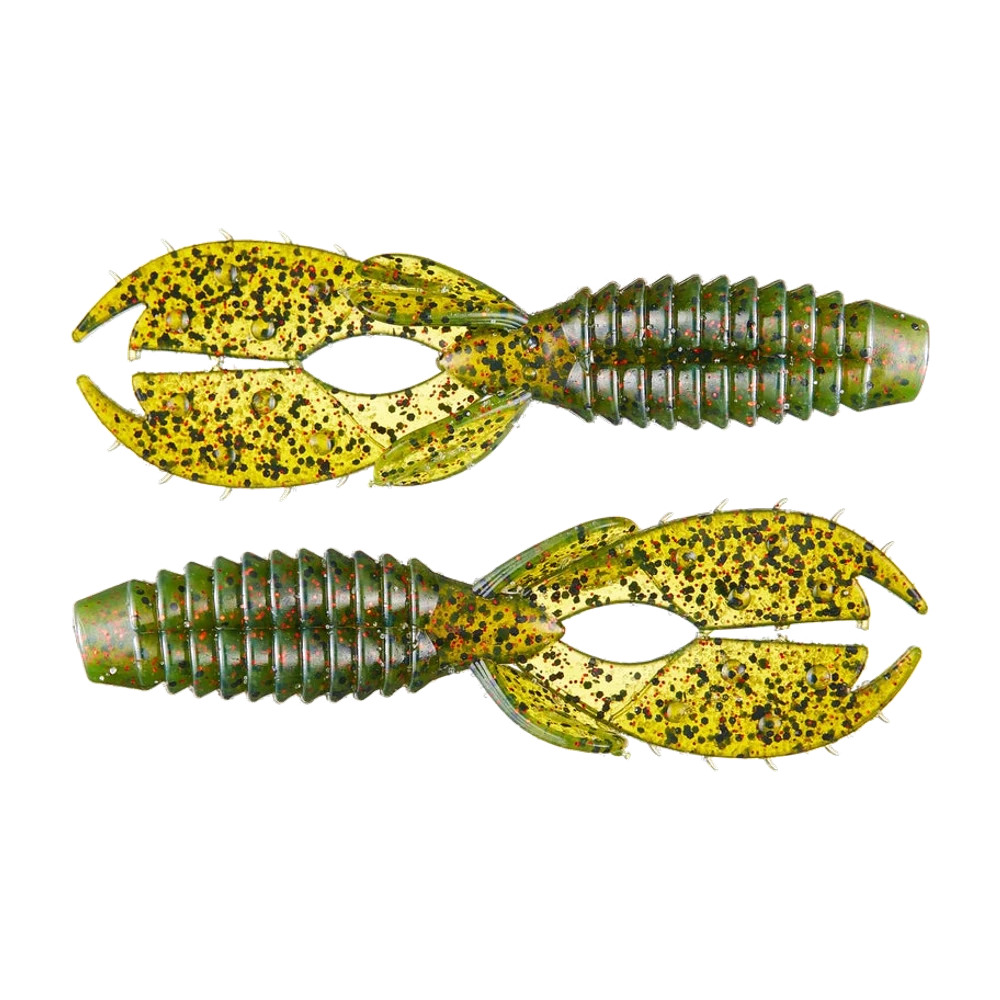
Most creature baits try to do too much: giant claws, four appendages, a flat tail and tentacles. The result looks superb in the bag and refuses to go through anything. The Yomama takes the opposite approach: the body is short and dense, the claws lie flat against it at rest, and the side appendages are thin.
In the water that gives you a bait that penetrates. Loaded with a tungsten bullet, the Yomama punches through a vegetation mat where a wide creature bait would bounce three times before dropping in. And it is once below the cover, as the bait enters free fall in the dark water, that the claws spread and the appendages start vibrating. The action does not begin before the entry, it begins after it. That is the whole point of the design.
The rear half of the body is ribbed, as the photo shows: those rings slow the fall slightly and send back a little signal from a bait that would otherwise be almost silent.
The central groove, a detail that changes your hookup rate
Big Bite moulded a channel running down the middle of the bait's back. It serves two purposes, and it is one of the few genuinely functional features you find on a soft plastic.
The first is rigging. Texas-style, you push the hook through the head, bring it out, rotate it and tuck the point back into the body. On a smooth bait you have to judge the axis by eye, and a two-millimetre error makes the bait swim crooked. With a moulded groove the point has a designated home: you set it in there and the rig comes out straight the first time, every time.
The second is the hookset. The plastic is thinner along the groove. When you set, the hook only has a thin layer to clear instead of driving through a solid body. In flipping, where you set hard on a fish already buried in weed, that difference is measured in fish landed.
If you tuck the point outside the groove "because it works anyway", you lose both advantages at once. Take the two seconds needed to put it back in the channel: that is the move that separates a correct rig from a right one.
Two sizes, two jobs
The Yomama comes in 3 in (7.6 cm, ten per bag) and 4 in (10.2 cm, eight per bag). Big Bite does not publish a weight, which makes sense for a bare bait whose load depends entirely on the rig.
The 7.6 cm is the size to reach for when fishing pressure is high or the water is clear. It rigs on a 2/0 or 3/0 hook with a light bullet, and it also works very well as a jig trailer, adding claw volume without lengthening the profile.
The 10.2 cm is the classic flipping size, rigged on a 4/0 or 5/0 with a 10-21 g bullet depending on how thick the cover is. It is the size that sorts fish: it interests fewer of them, but the average is clearly better. Early in the season or on water you barely know, start with the 7.6 cm to find out whether fish are present, then step up.
Not sure what to tie on?
Photograph your spot: CarnaFish reads the scene, cross-checks the conditions and gives you the zone, the lure and the retrieve. Free on iOS and Android.
How to fish it under cover
Punching
Heavy tungsten bullet pegged against the bait with a bobber stop, powerful rod, thick braid. You pick a hole in the mat, drop vertically and wait. The bite often comes in the first two seconds, before the bait even reaches bottom. If nothing happens after ten seconds, lift and aim at the next hole. Punching is fast exploration, not a waiting game.
Classic flipping
On drowned wood, low branches or a reed edge, you set the Yomama at the foot of the cover and follow the fall. Two or three ten-centimetre lifts, then reel in and move to the next target. A good flipping day means two hundred targets visited, not ten targets worked at length.
As a jig trailer
The 7.6 cm behind a Big Bite Baits McMoney Jig or another compact jig adds two mobile claws without widening the silhouette. It is a good answer when fish refuse a big flat-clawed trailer that slows the fall too much.
The classic mistake
Fishing the Yomama too slowly when punching. The natural reflex, after spending thirty seconds finding the right hole, is to leave the bait there for a minute. That is counter-productive: under a mat, a bass decides in seconds. If you get nothing, you are more likely to find an active fish in the next hole than to convince the one that has already seen you.
Second mistake: too fine a hook wire. On a bite under a mat, you set into vegetation and drag the fish through it. A standard hook opens up. Use a heavy-wire model, even if it penetrates slightly less easily.
Colour by water clarity
- Clear to lightly stained water: Green Pumpkin with black and red flake, exactly the colour shown here, which passes for a crawfish in the vast majority of waters.
- Under thick mats, in low light: Black and Blue, because the fish sees a backlit silhouette and nothing else.
- Clear water and bright sun: Watermelon Red, more translucent and less loud when light runs right through the water.
Flipping under cover means choosing the right mat before choosing the right bait — not all mats are equal, and the depth underneath changes everything. That is exactly what CarnaFish makes easier: a photo of the spot, and the app suggests the zone and the presentation suited to the moment. If you fish these areas from a small craft, our guide to float tube and boat fishing covers the approaches that avoid spooking shoreline fish.
On the same shelf, the Missile Baits D-Bomb remains the benchmark punching creature bait, the Zoom Brush Hog plays the multiple-appendage card, and the Strike King Rage Bug relies on far busier claws when you need signal.
Key takeaways
- Compact profile and slim appendages: it goes through cover instead of bouncing off it.
- Claws and appendages come alive after the entry, during the fall under the mat.
- The moulded central groove gives a straight rig first time and a cleaner hookset.
- 7.6 cm for clear water, heavy pressure or trailer duty; 10.2 cm for flipping and sorting bigger fish.
FAQ
Which Yomama size should I pick?
The 10.2 cm (4 in) for classic flipping and punching, the 7.6 cm (3 in) when the water is clear, fishing pressure is high, or when you want a trailer behind a compact jig.
Does Big Bite Baits publish a weight?
No. The description only gives lengths and the number of baits per bag. That is normal for a bare soft plastic, whose fishing weight depends entirely on the lead or tungsten bullet you rig in front of it.
What is the central groove for?
Two things: housing the hook point for a Texas rig that comes out straight first time, and reducing the thickness of plastic the hook has to clear on the set. It is the bait's most useful feature.
What bullet weight punches a mat?
Between 10 and 21 g depending on thickness. Start with the lightest that actually gets through: too heavy a bullet punches fast but then drops like a stone, giving the fish less time to react.
Do I need a special hook?
A heavy-wire wide-gap Texas hook, 4/0 or 5/0 for the 10.2 cm. Fishing under cover, the hookset happens against vegetation and a standard hook will eventually open on a serious fish.
Is the Yomama suitable for pike or perch?
It is a bass bait, built for cover fishing with a big Texas hook. Perch will find it too bulky, and for pike it lacks volume and vibration while costing you a wire leader that gets in the way of the rig.
The full bass lure guideSeason-by-season strategy: which family of lure, when, and why.Go from theory to fish
CarnaFish reads your spot from a photo and gives you the game plan: zone, lure, retrieve. Free on iOS and Android.