Dirty Jigs Tour Level No-Jack Punchin' Jig: punching through the mat
One lure, endless conditions. CarnaFish reads your spot from a photo so you are not just guessing.
A mat of lily pads and pondweed so thick you cannot see water any more. Underneath it, two degrees cooler, shade, and bass with no reason at all to leave. There are only two ways to reach them: go over the top with a frog, or punch straight through the canopy and drop something in front of their nose. The No-Jack Punchin' Jig belongs to the second school, and every design choice on it exists to serve that single move.
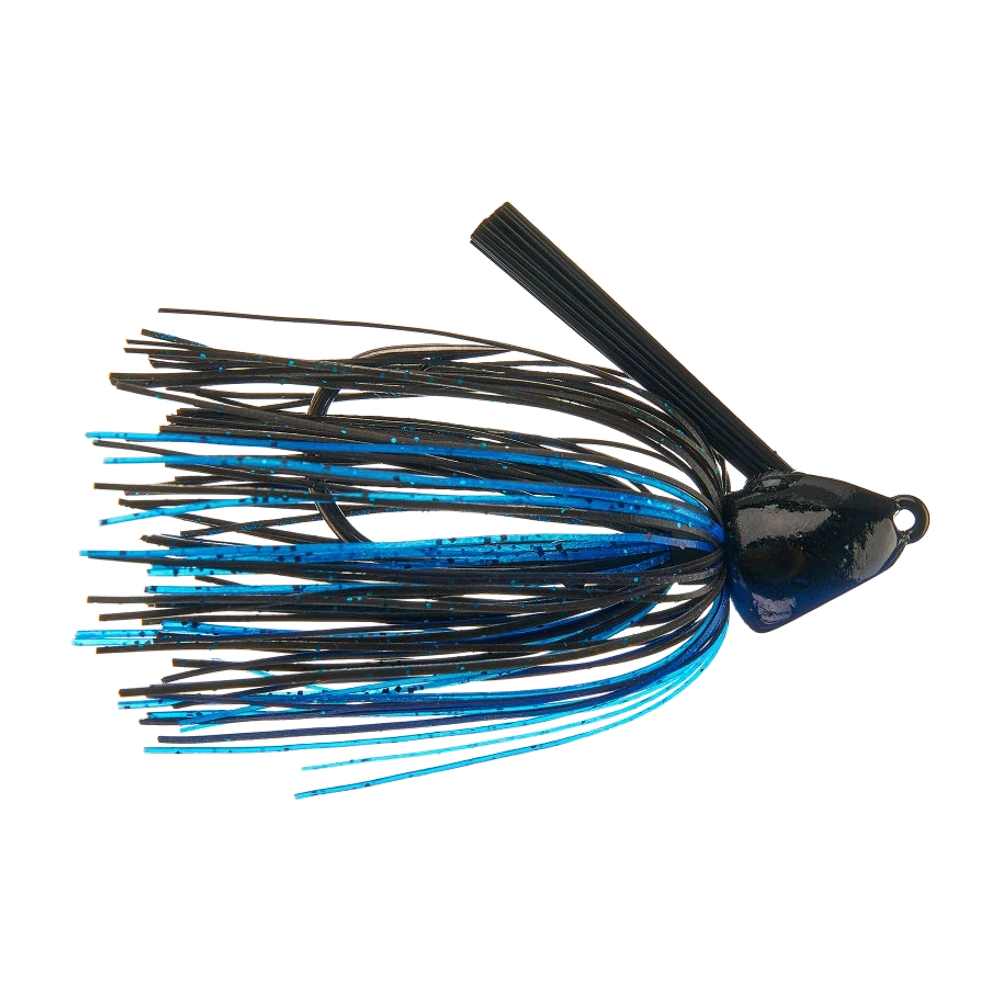
A head shaped for one job
The Dirty Jigs copy is unusually specific about geometry, which is just as well because that is where everything happens. The head is conical, pointed, with the line eye recessed rather than sticking out. The stated goal is plain: minimum drag as the lure forces its way through heavy vegetation. A protruding eye means a stem catching on it at every hole, and a jig that stops halfway instead of carrying on down.
The second point is less obvious and just as decisive: the underside of the head is flat. A round or oval head that reaches bottom tends to roll onto its side, and the skirt ends up crushed into the silt. A head with a flat belly settles and stays upright, hook up, skirt open, trailer in position. In punching, where the lure often sits motionless for ten or fifteen seconds at the bottom of a hole in the vegetation, that posture is the difference between a lure that gets seen and a lure that is asleep.
Dirty Jigs also states that it moved the hook placement on this head to free up maximum gap, and that it fitted its purpose-built Gamakatsu hook, the one it calls No-Jack, chosen so it will not bend open under a brutal hookset. The two go together: a big gap is worthless if the wire gives out while you drag a fish through two metres of weed.
The golden rule of punching: the hookset is non-negotiable. You are vertical, on braid, in the thick stuff. When you feel the bite, you set hard and you keep coming without giving back a single centimetre — that is the one moment where a hook that refuses to bend pays for itself.
What the manufacturer leaves out
No length, no weight, no weight range. On a punching jig that is the single most important number, because it decides whether the lure goes through the mat or stops on top of it. So we are not going to quote you a figure here: check the package. Just hold on to the selection rule — take the lightest weight that still punches. Too light and you sit on the leaves; too heavy and the lure shoots under the canopy before the fish has had a chance to see it, which throws away the whole point of the fall.
The dealer note also flags that the brand is moving from a two-tone painted head to a solid one, with both stocks running side by side until the older ones sell through. You may receive either scheme for the same color code: it is not a picking error.
The rig, from line to trailer
In punching, the whole set-up is working against you: the cover steals line, the fish gives you two seconds to pull it clear. Braid in 40 to 60 lb tied straight to the eye is the standard, with no fluorocarbon leader — abrasion against stems does far more damage than a wary fish fifty centimetres under an opaque mat. Heavy to extra-heavy rod, short rather than long, and a casting reel with a fast ratio so you can pick up line quickly.
If the mat resists, add a sliding bullet weight above the jig with a bead to protect the knot. You stack the masses to punch through, and once under the canopy the weight slides up the line and lets the jig fall more slowly on its own mass alone. It is a rig you see little of in Europe and it changes everything on genuinely thick mats.
The trailer, and what it tells you about the lure
Dirty Jigs explicitly recommends a list of Uncle Josh pork trailers — frogs, craws and chunks — plus a 3 in Kalin's Scrub. It is a recommendation of its era, pork having lost a lot of ground to silicone, but it points clearly in one direction: a compact, dense trailer, not a big appendage-heavy craw that would slow penetration. A Zoom Z Craw with its claws tucked along the body, or a Strike King Rage Craw rigged claws up, fill the role today. Avoid anything wide and flat while the mat is dense: you will feel it immediately on the way through.
The classic mistake
Fishing a punching jig the way you fish a bottom jig, which is to say dragging it. It does not work. Punching is hole fishing: you open a way through, you let it drop, you give it two or three small shakes on the spot, and if nothing happens within ten seconds you pull out and start again a metre further on. A good punching angler makes one to two hundred holes in a morning. The twin mistake is covering water too fast: the best holes are the ones you work, next to a hard edge, a change in density or a dip in the mat.
Not sure what to tie on?
Photograph your spot: CarnaFish reads the scene, cross-checks the conditions and gives you the zone, the lure and the retrieve. Free on iOS and Android.
Colors by the light under the canopy
- Thick mat, almost no light: black and blue, the color in the photo, which keeps a perfectly readable silhouette in the gloom — it is the default punching color and there is a reason for that.
- Sparse cover in clear water: green pumpkin, quieter, for thin mats where the fish genuinely sees detail.
- Early season, water warming up: brown and orange, playing the crawfish card at the time of year when it is the dominant prey on shallow flats.
A very specialised jig, and deliberately so
Be clear about the limits: this is not a do-everything jig. Away from a vegetation mat, its conical head brings nothing another model would not, and its very heavy hook becomes a handicap on a passive fish. For general cover fishing — wood, docks, rock — a Dirty Jigs Luke Clausen Compact Pitchin' Jig or the Berkley PowerBait Flippin' Jigs will cover far more situations. And if you would rather attack the mat with a bare soft plastic than a jig, a dense creature bait such as the 6th Sense Flipgill does the same work with an even slimmer profile.
Spotting the right mats, the hard edges and the holes that actually hold fish takes years of watching water — or one photograph. That is what CarnaFish is for: you photograph the spot, and the AI suggests the zone to attack, the depth and the presentation that fits the conditions. To build the foundations before you take on cover fishing, our beginner's guide to bass fishing sets the scene.
Key takeaways
- Conical head with a recessed line eye: built to punch a mat without hanging up, and that is its only reason to exist.
- Flat underside that stops the jig toppling on the bottom, so skirt and trailer stay visible through the pause.
- No-Jack Gamakatsu hook and maximised gap, for a hookset that goes in hard through thick cover without opening the wire.
- Neither weight nor length published: read the package and take the lightest head that still gets through your mat.
FAQ
What weight do I need to punch a pad field?
The manufacturer publishes no weight range, so you have to go by the package. The principle is the same whatever the model: the lightest weight that still goes through. If the lure sits on the leaves, step up; if it shoots under the canopy without you feeling the fall, step back down.
Do I really need braid?
Yes, and heavy braid. In punching, line rubs constantly against stems and the hookset has to travel through several metres of vegetation. Forty to sixty pound braid tied straight to the eye is the standard; fluorocarbon has no place here, abrasion destroys it within a few fish.
What is the flat underside of the head for?
It stops the jig rolling onto its side when it reaches bottom. Standing upright, hook up, it keeps its skirt open and its trailer in the attack position throughout the pause — which is exactly when a fish makes up its mind in punching.
Which trailer should I rig on it?
A compact, dense one that does not slow penetration. Dirty Jigs historically recommends pork trailers and a 3 in Kalin's Scrub; in modern silicone, a craw with claws tucked tight does the same job. Steer clear of big flat appendages while the mat is thick.
Does this jig work away from vegetation?
It catches fish, but with no particular edge: the conical head and the very heavy hook are answers to a specific problem. Over wood, rock or around a dock, a standard pitching or flipping jig will suit better and forgive soft bites more readily.
Can I punch for pike with this jig?
It is a bass jig, and punching is first and foremost a bass technique. A pike sitting under a mat may well hit it, but without a wire leader you lose the lure every other fish, and a wire leader inside a punching rig adds one more weak point.
The full bass lure guideSeason-by-season strategy: which family of lure, when, and why.Go from theory to fish
CarnaFish reads your spot from a photo and gives you the game plan: zone, lure, retrieve. Free on iOS and Android.