Xesta After Burner: the jig you retrieve fast, and why that works
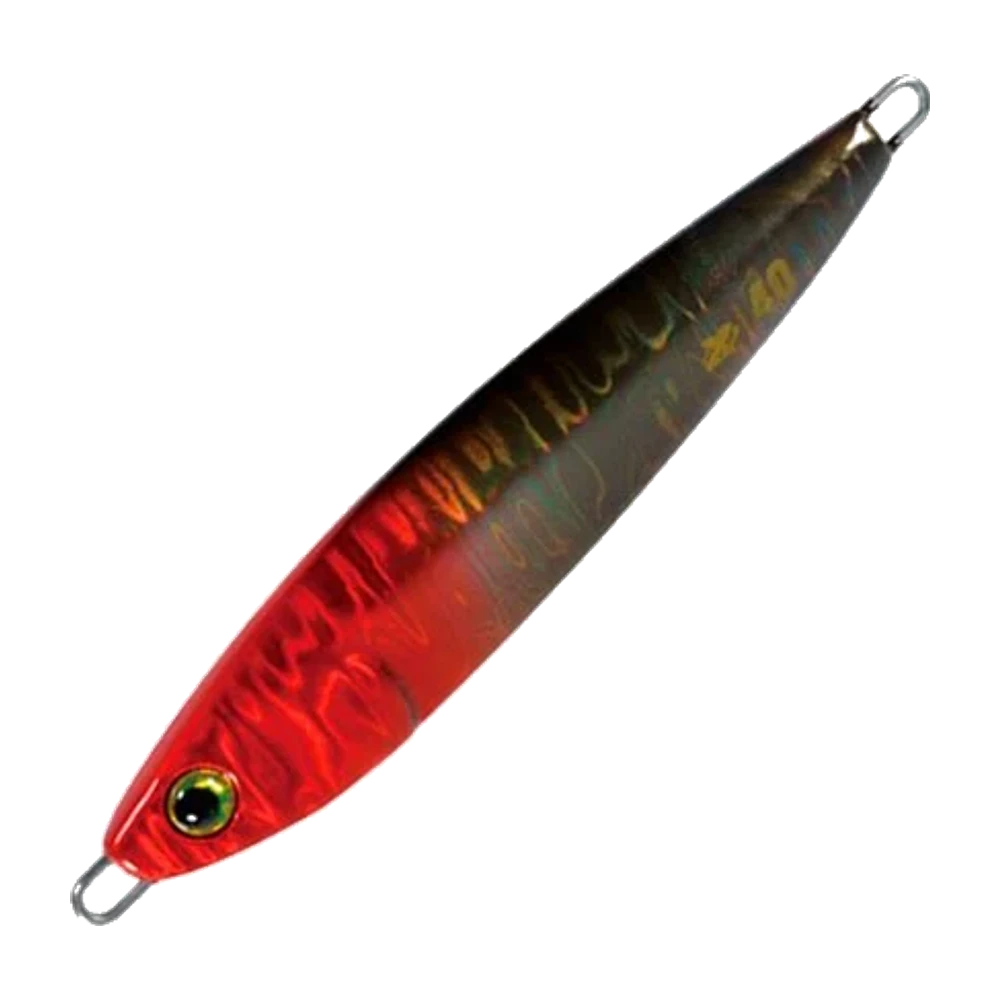
This lure shines under specific conditions. CarnaFish tells you in 10 seconds if today is one of them.
A shoal of mackerel pushes fry against the breakwater. Birds are wheeling, the water is boiling over twenty square metres, and you have maybe three minutes. You cast your jig into the middle, you let it sink the way you were taught — and it crosses the feeding zone in two seconds to go and work at eight metres, underneath fish that are all in the top metre.
That's the limit of an otherwise sound principle. Yes, on a flat jig a lot of bites come on the drop: that's the whole point of lures like the Major Craft Jigpara. But that principle applies to searching, when you're looking for fish spread through the water column. On active surface feeding, it becomes exactly the wrong answer.
The After Burner belongs to the other family: semi-long, rear-weighted jigs, designed to be retrieved fast and stay high. It isn't a jig you drop, it's a jig that flees.
Rear-weighted: what that changes
A jig whose mass is concentrated in the back third behaves differently from a centre-balanced jig, in both phases.
On the drop, it goes down tail-first and sinks fast, in a relatively straight line. It doesn't flutter — a flaw if you're looking for bites on the fall, an advantage if you want to cut quickly through a layer of water you don't care about to reach the one that counts.
On the retrieve, it's the opposite: the rear mass stabilises the lure like the fletching on an arrow. It comes up straight, with a tight roll, without turning sideways or spinning, even at high speed. That's precisely what most flat jigs can't do: past a certain threshold they come off their axis and start to spin.
That stability at speed has a direct visual consequence. A lure that rolls fast and regularly produces an almost continuous flash instead of separate glints. To a feeding shoal, that continuous signal looks like a fry darting straight, and it's the most reliable trigger there is.
The semi-long profile serves the same aim: enough length to offer a reflective flank, enough compactness not to be turned sideways by the current.
Jerk-and-wind: rod and handle together
The basic retrieve has nothing in common with working a crankbait. You coordinate two movements.
- Cast and count the drop according to the layer you're after: zero to three seconds on surface feeding, five to ten to search mid-water.
- Start with a hard acceleration of three or four turns to get the lure swimming immediately.
- Run the cycle: one sharp downward stroke of the rod tip, and one turn of the handle given exactly during that stroke. The slack created by the rod is taken up by the reel, never leaving a loose line.
- Don't pause while you're in the feeding zone. The jig has to keep fleeing.
- Over the last five metres, accelerate again. Bass often follow right to the foot of the breakwater and decide there.
Two cadences to master:
- One pitch: one rod stroke per turn of the handle. Regular, fast, this is the base cadence on feeding fish.
- Two pitch: two short strokes per turn. More staccato, more erratic, useful when fish follow without taking.
Reel pick-up, the parameter everyone ignores
This is the point nobody checks and yet it decides the speed you can actually reach. It isn't the size of the reel that counts, it's the line recovered per turn of the handle.
| Recovery per turn | Type | Use |
|---|---|---|
| Under 80 cm | Low ratio | Poorly suited: you can't build enough speed |
| 85-95 cm | Standard ratio | Versatile, fine for bass |
| Over 100 cm | High ratio | The right choice on surface feeding and mackerel |
A reel with low recovery forces you to grind like a lunatic, and you're finished after twenty minutes. With a metre per turn, the same speed holds for an hour without effort.
On the water: on a feeding shoal, never try slowing down because you're not getting bites. That's the freshwater reflex and it's wrong here. A mackerel or a bass pushing fry swims faster than you can wind: a lure that slows down drops out of the fleeing-prey register and becomes a suspicious object. If it isn't producing, go up another notch and change your casting angle to cut through the shoal instead of running alongside it.
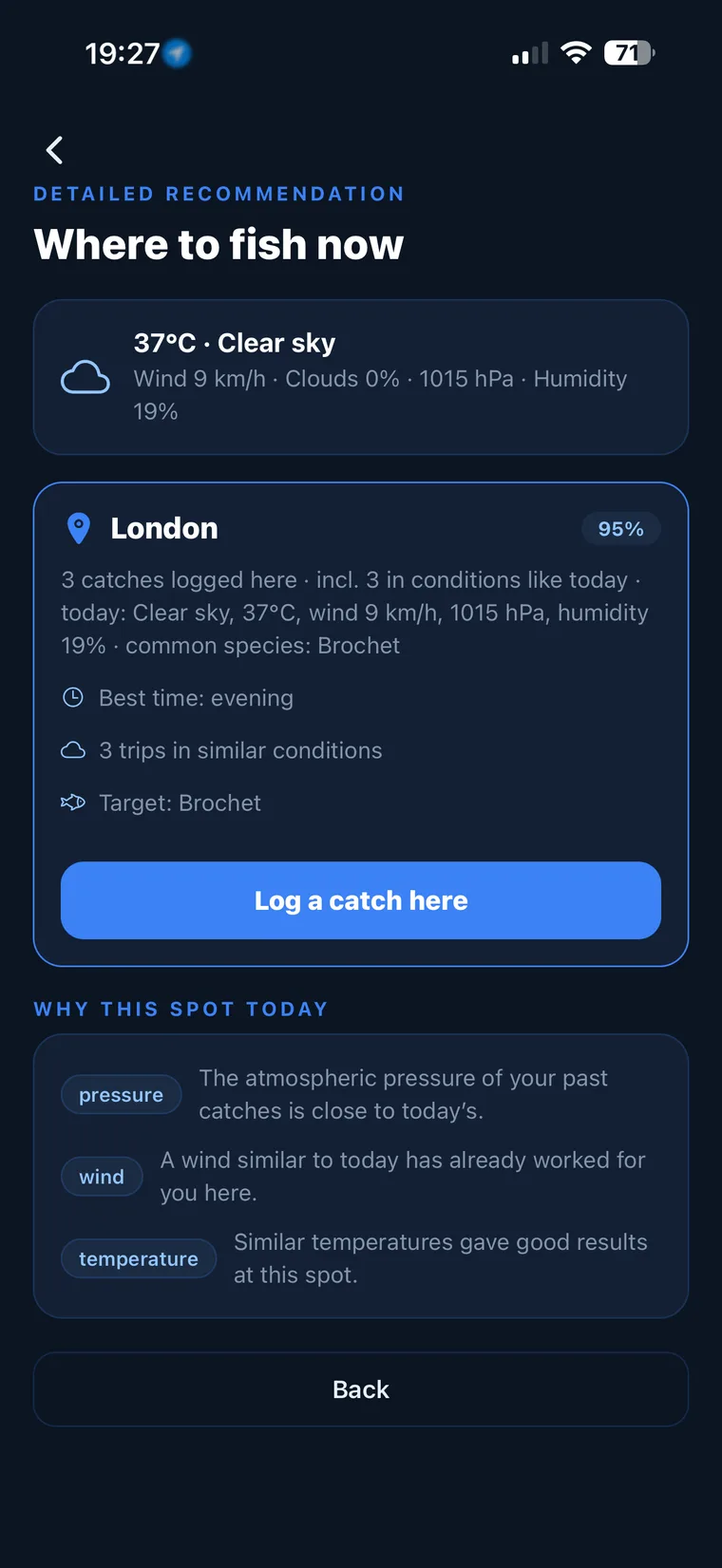
Not sure what to tie on?
Photograph your spot: CarnaFish reads the scene, cross-checks the conditions and gives you the zone, the lure and the retrieve. Free on iOS and Android.
Weight, rigging, and the mistakes that cost fish
Weight is chosen on wind and distance, since you aren't using the fall. Allow 20-30 g from the shore in calm conditions with fish feeding close, 30-40 g as an all-rounder off a breakwater, and 50-60 g when the wind is in your face or the shoal is working sixty metres out.
The front assist hook isn't optional. On a fast retrieve the fish attacks head-on or from the flank, at the front of the lure. A jig rigged only with a rear treble misses a significant share of the takes, and the treble also tends to foul the braid on the cast. Fit a short assist at the head, on a welded ring, and treat the rear treble as a supplement.
The leader is 0.30-0.40 mm fluorocarbon over a metre to a metre and a half. A good bass rubbing against the blocks of the riprap will break a direct braid connection.
Where this approach falls down: on bass sitting on the bottom in the middle of the day with no surface activity. In a heavy sea, where a fast retrieve lifts the lure out. And in very coloured water, where the flash — its main argument — no longer carries.
After Burner or a falling jig
The distinction comes down to a single question: are you looking for fish, or can you see them?
When you can see nothing and you have to explore the water column, the fall is your best tool. The Savage Gear Seeker ISO uses an asymmetric profile to glide and flutter on the way down, and it lets you count seconds to identify the active layer. In hard conditions — headwind, strong current — the Illex Dexter Jig relies on pure density to reach the bottom and hold it.
When you can see fish feeding, the logic flips. The job is no longer exploring but being in the top metre, fast, and crossing the shoal in flight. That's where the After Burner and rear-weighted jigs take the lead, because they handle a speed at which falling jigs come apart.
In practice a shore box holds both, and you change lure according to what the sea is doing rather than what time it is. Our guide to lure fishing for sea bass covers which stages of tide to favour. And if you're torn between attacking surface activity or sounding the hole next to it, CarnaFish reads a photo of the spot and answers.
Key takeaways
- Rear mass: a fast, straight drop and a stable, tight-rolling rise even at high speed.
- Stability at speed produces an almost continuous flash, read as a fleeing fry.
- Jerk-and-wind: one turn of the handle given during the rod stroke, never a loose line.
- Check your reel's recovery per turn: above a metre, you can hold the cadence for an hour.
- On feeding fish, never slow down when it isn't producing — speed up and change your casting angle.
FAQ
Do you really need to retrieve a metal jig fast?
On actively feeding fish, yes. A bass or a mackerel pushing fry moves faster than you can wind: a lure that slows down drops out of the fleeing-prey register. When searching, on the other hand, the fall remains the most productive phase.
What is jerk-and-wind?
It's the coordination of a sharp downward stroke of the rod tip with a turn of the handle given at exactly the same moment. The slack created by the rod is immediately taken up by the reel, which keeps the jig swimming without ever leaving a loose line.
What reel ratio should you choose?
Look at the line recovered per turn of the handle rather than the stated ratio. Above a metre per turn you can hold a fast cadence for an hour without exhausting yourself; below eighty centimetres you'll never reach the useful speed.
Assist hook or rear treble?
A short assist at the head is essential, because on a fast retrieve the attack comes head-on or from the flank. The rear treble is a useful supplement for mackerel, but it tangles in the braid more easily on the cast.
What weight from the shore?
Twenty to thirty grams in calm conditions with fish feeding close, thirty to forty as an all-rounder off a breakwater, and fifty to sixty in a headwind or when the shoal is working beyond fifty metres. The criterion is distance, not depth.
When does this approach not work?
On bass sitting on the bottom with no surface activity, in a heavy sea where a fast retrieve lifts the lure out, and in coloured water where the flash no longer carries. In all three cases, a falling jig worked slowly near the bottom will be more productive.
The full sea bass lure guideSeason-by-season strategy: which family of lure, when, and why.Go from theory to fish
CarnaFish reads your spot from a photo and gives you the game plan: zone, lure, retrieve. Free on iOS and Android.