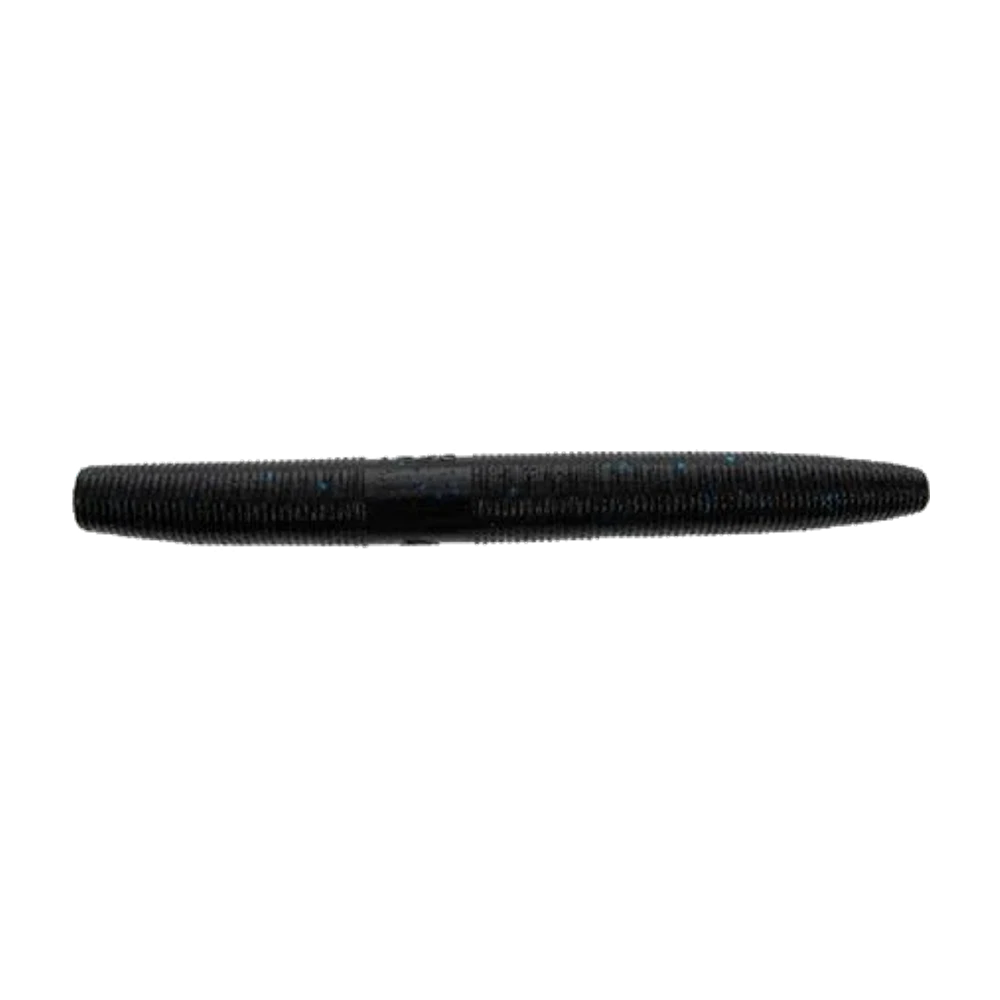
Gary Yamamoto Fat Senko: bulk to fall fast and filter for size
Not sure this lure fits YOUR spot today? CarnaFish tells you in 10 seconds, from a photo.
The standard Senko has one weakness, and it only shows up in two situations. The first is wind: a thin weightless stick worm takes so long to sink that the slack bows, the bait drifts sideways and you no longer know where it is or what it's doing. The second is depth: past three metres the fall becomes endless and you spend more time waiting than fishing.
The usual reflex is to add weight. Except a weighted stick worm no longer falls flat — it noses down, and the shimmy that makes the whole thing work disappears.
The Fat Senko solves the problem with material rather than lead. Same length, but a noticeably thicker body, so more mass and more salt, for a fall that stays horizontal while dropping far faster.
What the extra bulk buys you
Three effects stack up, and not all of them are obvious.
A faster fall that still lies flat. The extra mass is spread over the whole length rather than concentrated at the front. The bait keeps its horizontal attitude and simply drops quicker — you go from a very slow fall to one you can actually use deep and in wind.
A wider sweep from both ends. A thicker body carries more inertia. As the bait folds on the way down, the two ends trace a wider, slower arc, with an amplitude the slim model can't produce. The visual signal is clearly stronger.
A size filter. The bulk puts off a share of the small fish and the perch, which nip at it without being able to take it in. On water where a slim Senko only gives you dinks, the Fat Senko cuts your bite count but raises the average.
The three rigs that matter
Wacky rig, the default.
- Fit a rubber O-ring around the middle of the body, with the dedicated tool. Without it, you destroy a bait per fish.
- Pass a size 1 or 1/0 wacky hook under the ring, without piercing the plastic.
- Cast, let it fall on a semi-slack line, and touch nothing. The fall is the action.
- On bottom contact, two short 20 cm pulls, then let it drop back.
- Reel in and cast again: past three descents, the bait has done its job.
Weightless Texas, under cover. Wide-gap 3/0 or 4/0 hook, point tucked back into the back of the bait. This is the rig for pitching into low branches, under docks and through sparse weed: the fall stays slow and the bait barely hangs up.
Neko rig, in deep water. A 1 to 2 g nail in one end, wacky hook a third of the way along. The bait plants its nose on the bottom and the other end stands up, swaying. This is the rig for drop-offs and spots at five or six metres.
On the water: with a stick worm, the bite almost never comes while you're retrieving — it comes on the fall, and your only indicator is the line. Keep your eyes on the point where it enters the water and set the hook the moment it stops sinking early or moves off to one side. An angler watching his rod tip misses half his fish.
Rigging reference
| Situation | Rig | Hook | Weight |
|---|---|---|---|
| Clear margin, 1 to 2 m | Wacky + O-ring | Wacky 1 | None |
| Crosswind, 2 to 3 m | Wacky + O-ring | Wacky 1/0 | None, the bulk is enough |
| Under docks and branches | Weightless Texas | Wide gap 3/0 | None |
| Drop-off, 4 to 6 m | Neko rig | Wacky 1/0 | 1 to 2 g nail |
| Dense weed | Texas | Wide gap 4/0 | 3.5 g bullet if needed |
For line, 0.12-0.14 mm braid with a 0.25-0.30 mm fluorocarbon leader covers most cases. In very clear water, switch to straight 0.22-0.25 mm fluorocarbon: you give up a little power reserve and you gain bites.
Not sure what to tie on?
Photograph your spot: CarnaFish reads the scene, cross-checks the conditions and gives you the zone, the lure and the retrieve. Free on iOS and Android.
Where it makes the difference
- Windy spring days, when drift makes a slim Senko impossible to control.
- Drop-offs and flats between three and six metres, on a neko rig, where a standard stick worm takes far too long to get down.
- Heavy cover — stumps, docks, laydowns — where you need a decisive fall and a snagless rig.
- Warm water in late spring, on settled, wary bass that refuse anything with movement.
It is a poor fit:
- On heavily pressured fish in very clear, calm water, where a slim profile goes down much better: the standard Senko is the right tool there.
- For covering large areas: stick worm fishing is slow by design, this is not a search bait.
- In very cold water, below 10 °C, where even a fast fall is too much movement for sluggish bass.
- On small fish, which it discourages.
Fat Senko or standard Senko
The choice comes down to one question: do you need fall speed or subtlety? The Senko 5-inch and the 4-inch sink slowly and stand on their own in calm, shallow water. The Fat Senko applies the same logic faster and more visibly, which makes it better as soon as there's wind, depth or current.
If you want bulk plus a bit of genuine movement, a soft craw on a Texas rig gives you active appendages during the fall, with a completely different profile. And to hold a stick worm over a precise point without letting it drift, the drop shot is still the most controlled answer.
Our beginner's guide to bass fishing sets out the order in which to try these rigs along a margin. And if you're torn between wacky and Texas when you arrive at a cluttered spot, CarnaFish reads a photo of it and answers for you.
Key takeaways
- More bulk means more mass, but the fall stays horizontal: no need to add lead.
- The end sweep is wider than on a slim stick worm — a stronger visual signal.
- Always fit an O-ring when fishing wacky, or you lose a bait per fish.
- Watch where your line enters the water: the bite comes on the fall and it is silent.
- Too bulky for calm clear water under pressure, too slow for covering ground.
FAQ
What's the difference between a Fat Senko and a standard Senko?
The body is noticeably thicker for the same length, so heavier and more heavily salted. It drops faster while keeping a horizontal fall, with a wider sweep from both ends. In exchange, it is less subtle in clear, calm water.
Do you need to weight a Fat Senko?
Not in most cases: its bulk is enough to give you a usable fall. The one weighted rig genuinely worth having is the neko rig with a 1 to 2 g nail, for fishing drop-offs at five or six metres.
What hook for the wacky rig?
A size 1 or 1/0 wacky hook, passed under an O-ring set around the middle of the body. The O-ring isn't optional: without it, a single fish is enough to tear the plastic.
How do you detect a bite on the fall?
By watching the point where your line enters the water. If it stops sinking earlier than expected, moves off sideways or suddenly comes tight, set the hook immediately. Waiting to feel something in the rod means missing most of your bites.
Does it work on big fish?
That's one of its selling points: the bulk discourages a share of the small fish and the perch. You get fewer bites than with a slim stick worm, but the average size climbs noticeably.
Which colour should I choose?
Green pumpkin and watermelon cover most of it in clear water and over vegetation. In stained water or under a low sky, switch to junebug or black-blue, which give a far more readable silhouette against the light.
The full bass lure guideSeason-by-season strategy: which family of lure, when, and why.Go from theory to fish
CarnaFish reads your spot from a photo and gives you the game plan: zone, lure, retrieve. Free on iOS and Android.