Yo-Zuri 3DB Pencil 100: the stickbait that walks itself
Before tying this one on, it helps to know if the spot actually calls for it. CarnaFish reads the scene from a photo.
A windless September dawn, an edge of submerged grass, and that dull sucking sound of a fish feeding three metres off the bank. At that exact moment nothing beats a stickbait zig-zagging across the surface. The catch is that walking the dog is the technique that puts off more anglers than any other: get the setup wrong and the lure either tracks straight or just hops stupidly. The Yo-Zuri 3DB Pencil 100 is one of the forgiving ones, and that is its main quality.
What makes this pencil tolerant
Three construction details pull in the same direction. First, mass: 16 g (9/16 oz) for only 10 cm (4 in) is a lot, and that density translates into inertia that extends the glide after each twitch. The lure keeps sliding once you have already released, which gives a beginner time to time the next pull.
Second, the internal rattle. Yo-Zuri fits a moving ball system that rolls from one end of the body to the other on every change of direction. It makes noise, which is the marketing argument, but it also does something else: its travel shifts the centre of gravity towards the tail just as the lure pivots, which starts the next dart almost without help from the angler.
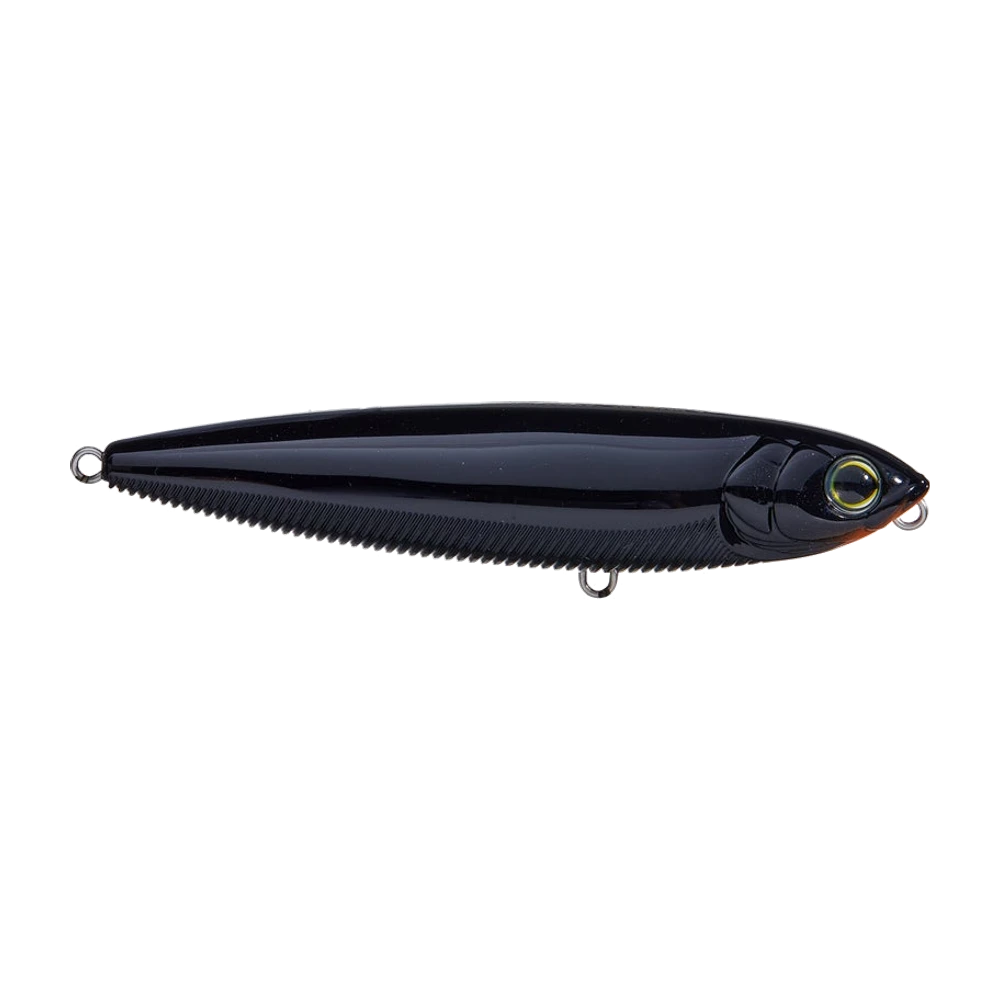
Third, the belly. On the photo of the bare lure you can clearly see the transverse ribbing running the whole length of the underside, from throat to tail. That textured surface grips water instead of sliding over it: the pencil leaves a trail of small turbulences behind it, visible and audible on a flat surface. That is the difference between a lure that passes by and a lure that announces itself.
The model photographed here is solid black with a gold eye, a black pupil and an orange throat. It is shown without trebles; the retail lure ships with two round bend black nickel treble hooks.
If the lure jumps out of the water instead of zig-zagging, the lure is almost never the problem. Drop the rod tip towards the surface instead of holding it high, and shorten the wrist stroke: walking the dog is steered with fifteen centimetres of travel, not fifty.
Setting the cadence
The base rhythm
Rod tip at the water, line slightly slack, one short sharp pull every half turn of the handle. The lure goes right, then left, in steps of roughly one body length. That is the setting for calm water and active fish.
Slowing down for wary fish
Same stroke, but leave a second between pulls. The pencil stays put and pivots almost on the spot rather than moving forward. On a fish that has already followed without striking, this is the change that tips it: you never leave its comfort zone.
Speeding up to cover water
Tighter pulls and a more continuous retrieve: the lure traces a narrow broken line, with less amplitude but much more rattle. Useful to search a long bank, or when a breeze ripples the surface and makes a slow rhythm inaudible.
The first mistake to fix
Tying the braid straight to the nose ring. A tight knot or stiff braid chokes the pivot and kills the zig-zag. A soft snap or a loop knot, plus thirty to forty centimetres of 12 to 20 lb fluorocarbon, and the action changes completely. The same rule applies to a Heddon Zara Spook or any lipless stickbait.
Where and when to use it
The pencil is a lure for calm and half-light. The first two hours after daybreak and the last hour before dark, on a surface that is flat or barely rippled, is its window. At midday under strong sun a topwater only produces in the shade thrown by trees, docks and platforms.
For bass, the best spots are the edges of submerged grass, shallow shelves next to a drop-off, and anywhere forage is getting pinned against an obstacle. The 10 cm size works well on average fish, where a 13 cm stickbait filters too hard.
For sea bass the same lure makes real sense along rocky plateaux on a rising tide, when fish are hunting on top. The 16 g allows a long cast even into a bit of headwind, which matters enormously when you have to reach a feeding spree that keeps moving. It is one of the few lures in the 3DB range that works as well in freshwater as in the sea.
The tackle that goes with it
A 2.00 to 2.20 m medium power rod with a tip that is not too stiff is plenty: you need to be able to give short pulls without the lure lifting off the surface. Thin braid for distance, thirty centimetres of fluorocarbon at the end, and a fast retrieve reel. That last point matters more than people think: between two twitches you have to take up slack without moving the lure, and a slow spool forces you to pull on it, which breaks the rhythm of the zig-zag.
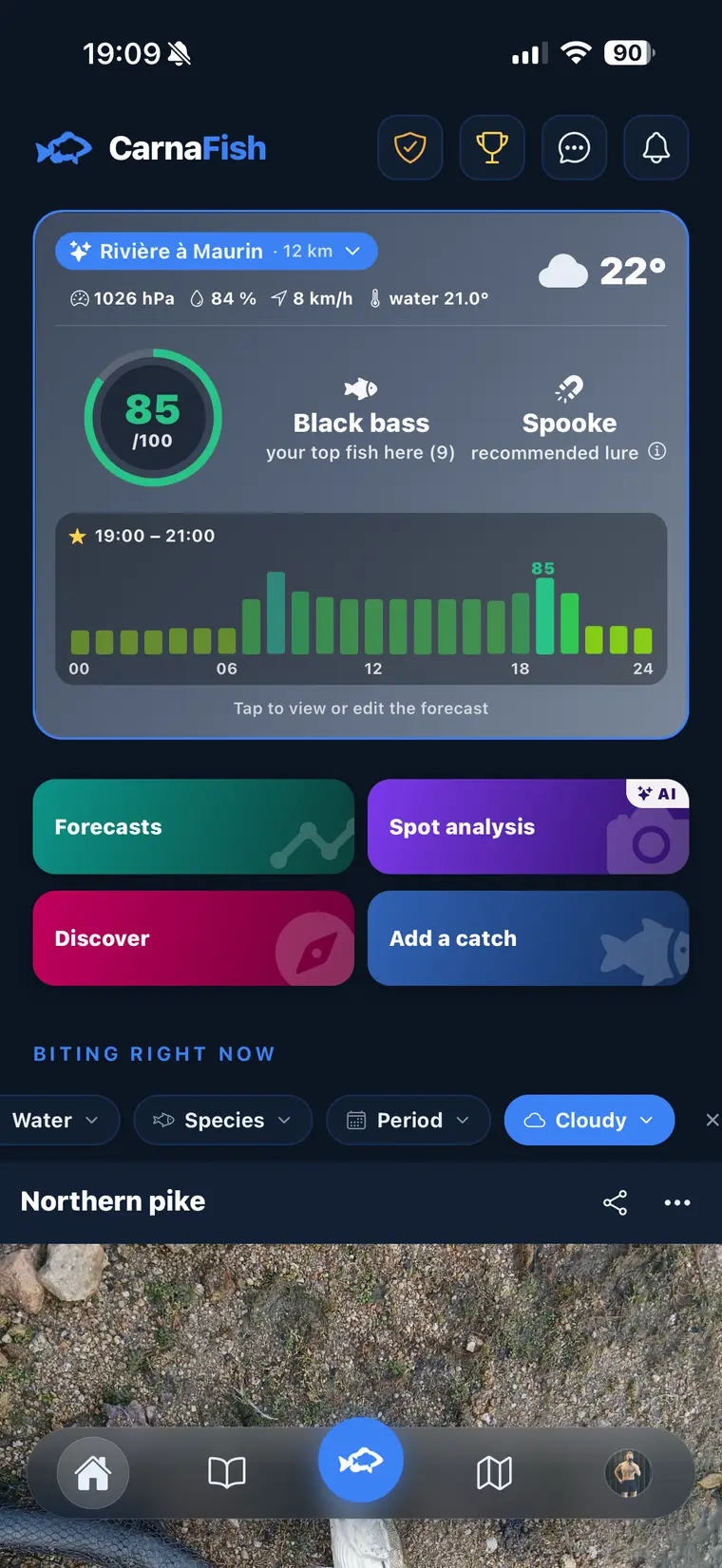
Not sure what to tie on?
Photograph your spot: CarnaFish reads the scene, cross-checks the conditions and gives you the zone, the lure and the retrieve. Free on iOS and Android.
Colours by light
- Dawn, dusk, into the light: the solid black of the model photographed. Seen from below, a fish only sees a silhouette against the sky — a true black reads better than a realistic finish.
- Clear water in daylight: a natural silver or ayu back, reproducing the flash of a baitfish without excess contrast.
- Stained water or rippled surface: a chartreuse or bright orange belly. The fish attacks from underneath, and the belly is what it sees first.
What it does not do
A stickbait does not go down. If the fish refuse to come up — cold water, harsh light, fish pinned to the bottom — no cadence adjustment will change that, and persisting costs fishing time. It also makes no splash: to call a fish from a distance in dirty water, a popper that throws water with its cup carries far further than a pencil.
Knowing whether fish are up or down before you even cast is exactly where CarnaFish helps: a photo of the spot, and the AI suggests a zone, a depth and a presentation that fit conditions. To build the rest of the bass toolkit, our guide to getting started with bass fishing covers spots and tackle from the ground up.
Key takeaways
- 16 g for 10 cm: a high density that extends each glide and makes walking the dog easier to learn.
- Internal rattle and ribbed belly: noise, yes, but above all a weight transfer that starts every change of direction.
- A snap or loop knot is essential, otherwise the zig-zag never starts.
- A dawn, dusk and flat water lure; no point persisting when fish will not come up.
FAQ
How do I walk the dog with this lure?
Rod tip at the water, line slightly slack, short regular wrist pulls every half turn of the handle. Think fifteen centimetres of travel, not fifty. The density of the 3DB Pencil extends the glide and gives you time to find the rhythm.
Why does my pencil hop instead of zig-zagging?
The rod tip is too high and the stroke too wide. Drop the rod towards the surface and shorten the motion. Check too that you have not tied braid directly to the nose ring: a tight knot blocks the pivot.
Do I need a fluorocarbon leader?
Yes, thirty to forty centimetres of 12 to 20 lb. Bare braid is too stiff and floats, which distorts the lure's path on every pull. Avoid wire on bass or sea bass though: it weighs the nose down too much.
Is the 3DB Pencil 100 suitable for sea bass?
Yes, that is one of its good uses. Its 16 g carries a long way, including into a breeze, and the 10 cm profile matches the forage sea bass chase on top along rocky ground.
What time of day does it fish best?
The first two hours of daylight and the last hour before dark, on calm water. In broad daylight it only earns its place in shade thrown by docks, trees and structures.
Should I change the factory hooks?
Not straight away: it ships with two round bend black nickel trebles that hold up well. Just watch for corrosion if you fish in salt water, and rinse the lure in fresh water after each session.
The full bass lure guideSeason-by-season strategy: which family of lure, when, and why.Go from theory to fish
CarnaFish reads your spot from a photo and gives you the game plan: zone, lure, retrieve. Free on iOS and Android.