6th Sense Catwalk: the walking bait that holds its line at speed
One lure, endless conditions. CarnaFish reads your spot from a photo so you are not just guessing.
There is one exact moment in summer when a lake tells you what to do: the surface goes glassy, a few isolated swirls show along a line of drowned timber, and nothing you pull under the water gets a reaction. That is the walking bait window. The trouble is that most stickbaits force a choice — either you walk them slowly and cleanly in one place, or you cover ground, and the moment you do the bait slides off sideways and loses its rhythm. The 6th Sense Catwalk was drawn around that compromise, and that is the whole point of the thing.
A keel under the belly, and nothing blows out
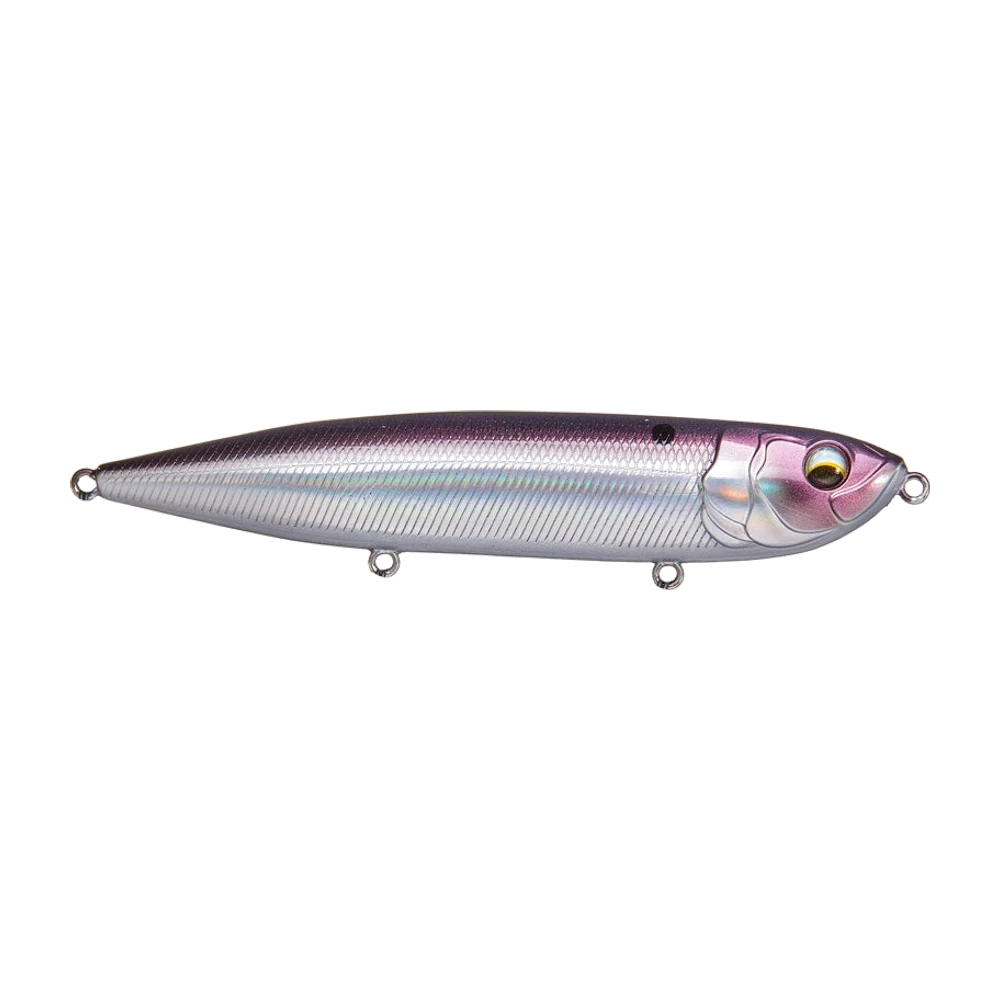
What makes the Catwalk different does not show in a side-on photo: you have to turn it over. The belly is not rounded like a classic stickbait, it is shaped into a keel, like a sailboat hull. That ventral ridge does its work the instant the bait slips under the surface film during a sweep: instead of lying flat and sliding off in an uncontrolled skid, it cuts and comes back on line.
In practice that changes two things. First, the bait stays under control when you raise the tempo — a stickbait that blows out at speed stops fishing and simply drags. Second, both sides of the zigzag keep the same width: you do not end up with a wide step to the left and a strangled one to the right, a classic fault that usually comes from a belly that is too round or a badly placed knot.
Before you judge any stickbait, make three casts at your feet and watch it work. If the left and right steps are not the same width, it is almost always the knot or the split ring choking the nose, not the lure. Fix that before you change colour.
Two rhythms, two ways to fish it
The Catwalk takes a fast sweep happily: rod tip low, reel turning continuously, wrist giving short sharp taps close together. The bait tears off tracing tight S shapes and covers a huge amount of water. That is the search mode, the one for a long bank or a shallow flat when you do not yet know where the fish are. An active bass will come up on this presentation from a long way off, and often very violently.
The other mode is the opposite: rod at ten o'clock, wider sweeps spaced much further apart, with one to two second pauses. The bait stays almost in place and zigzags over a hard feature — a sunken tree, the corner of a dock, a hole in a lily pad mat. This is what you reach for when fish are glued to cover and not committed. They will not travel ten metres, but they end up coming up on a bait that lingers over their heads.
The mistake is mixing the two without thinking. Pick one rhythm for a cast, hold it to the end, and change only on the next cast. That is how you find out which of the two is working on the day.
Where and when it catches most
Topwater fishing is a game of windows. The Catwalk gives its best early in the morning and late in the day, when the light is low and the surface barely rippled. A light chop does not hurt, it even helps: it breaks up the silhouette and makes fish less fussy. Under a steady wind with real waves, though, the bait loses its legibility and a popper or a subsurface lure takes over.
Seasonally it works as soon as the water warms up properly and on into autumn, for as long as the forage fish stay high in the column. Target vegetated banks, weed edges, deadwood, dock surrounds, and flats of one to three metres: a fish will happily rise two or three metres to eat on top when the water is clear.
A rig that does not choke the nose
A walking bait lives on the freedom of its nose. Loop knot or a small snap, never a tight knot bearing on the split ring: a choked nose cuts the width of the zigzag immediately. For line, braid is the right call — it floats, it does not form a belly under the bait, and it transmits every small wrist tap without damping it. Add a short fluorocarbon leader of 0.30 to 0.40 mm for abrasion and discretion, no longer than 50 to 80 cm so the connection does not sink.
The factory black nickel trebles are sharp and do the job; on a topwater, what matters most is their size and gape, because the strike often comes from the side and the fish does not always take the bait properly in its mouth. Plenty of anglers switch to the same size in a short shank, or hang a feathered treble at the rear to slow the bait on the pause. If you make that change, check that the Catwalk still sits correctly in the water: hooks that are too heavy upset the balance and the walk turns lazy.
The classic mistake: striking at the noise
This is the one that costs the most topwater fish, whatever the lure. You hear the explosion, you strike on reflex, and you pull the bait out of the fish's mouth before it ever really had it. The right reaction is to wait until you feel the weight in the rod, then sweep sideways into the fish rather than lifting hard upwards. On a bait like the Catwalk, where the strike often arrives at full speed, that half second of patience changes the hook-up rate for the whole day.

Not sure what to tie on?
Photograph your spot: CarnaFish reads the scene, cross-checks the conditions and gives you the zone, the lure and the retrieve. Free on iOS and Android.
Colour by light and water
- Clear water, full sun: a natural silver back, roach or shad pattern, discreet seen from below and not jarring when the fish has all the light it needs to study the bait.
- Overcast or lightly stained water: a solid white or chartreuse belly. On top, a fish mostly sees the underside of the bait, so visibility comes from the belly, not the back.
- Dawn, dusk, dark water: a black or very dark colour. Backlit, a clean silhouette stands out against the sky better than any bright colour.
What to keep it next to in the box
The Catwalk does not replace a Heddon Super Spook, still the benchmark big noisy stickbait for active fish, nor a Lucky Craft Sammy 100, which is finer and better suited to very clear water and educated fish. It sits between them: bulky enough to be seen, clean enough in its zigzag to take a slow presentation. If you want a noisier profile with a tail that churns water, a Strike King KVD Sexy Dawg covers a different register. And when the surface stops producing, the 6th Sense Provoke takes over just below.
Good topwater fishing starts with reading a bank properly: knowing where fish hunt high and where they will never come up. That is exactly what CarnaFish makes easier — a photo of the spot, and the app suggests the zone, the depth and the kind of presentation that suit the day's conditions. To lay down tackle and spot fundamentals, our beginner's guide to bass fishing is a good place to start.
Key takeaways
- The keel belly is the real reason this bait exists: it stops the lure blowing out when you speed the walk up.
- Two complementary rhythms: fast sweeping to cover water, slow walking in place over cover.
- Loop knot or snap is mandatory, braid with a short fluorocarbon leader.
- Never strike at the noise: wait to feel the weight, then sweep sideways.
FAQ
Do I need to know how to walk the dog to use the Catwalk?
The motion takes about half an hour to learn: rod low, short sharp wrist taps, and above all a reel that takes up just the slack between taps. The Catwalk is more forgiving than a classic stickbait because its keel belly puts it back on line, but you still need a steady rhythm.
What rod and line suit this bait?
A casting or spinning rod of 1.8 to 2.1 m, medium to medium-heavy, with a tip that is not too stiff so it cushions the strike. For line, thin floating braid plus a 0.30 to 0.40 mm fluorocarbon leader over 50 to 80 cm. Straight nylon works too, but it absorbs part of the wrist input.
Is the Catwalk suitable for pike?
A pike will happily hit a stickbait this size, but the factory hooks and the absence of a wire leader make the encounter risky for both lure and fish. If you are fishing a pike spot, add a proper leader, accepting that it will weigh slightly on the bait's surface balance.
How fast should I walk it?
Both extremes work, and that is the point of this model. Start fast to locate fish along a long bank, then come back slowly over the precise spots that gave a sign. What does not work is changing rhythm halfway through a cast.
Why does my stickbait step further one way than the other?
In the vast majority of cases it is the knot or the split ring choking the nose, or a slightly bent front treble throwing the balance off. Check those three things before blaming the lure.
What colour should I pick if I only buy one?
A white belly with a natural back. It is the most versatile combination, because on top a fish mostly judges the silhouette and the underside. Keep a black pattern in reserve for backlit fishing at dawn and dusk.
The full bass lure guideSeason-by-season strategy: which family of lure, when, and why.Go from theory to fish
CarnaFish reads your spot from a photo and gives you the game plan: zone, lure, retrieve. Free on iOS and Android.