Rapala Crush City Pig Stick: the salt-loaded stick that sinks fast
Before tying this one on, it helps to know if the spot actually calls for it. CarnaFish reads the scene from a photo.
The classic complaint about stick worms is how slow they are. You cast a weightless stick along a three metre drop-off, and by the time it reaches the bottom you have had time to admire the scenery. In a metre of water that slowness is a weapon. In four or five metres it is wasted time that costs you casts. The Pig Stick solves that in a simple way: it is loaded with salt.
Salt to sink, not for flavour
Rapala states an increased salt content, intended to add density to the body and speed up the rate of fall. The manufacturer specifies that the bait drops fast even rigged with no weight at all, while keeping a pronounced shimmy on the way down. That is a density statement, not a finishing detail: it is what separates the Pig Stick from an ordinary stick worm, and it decides which spots it is worth using on.
In practice it means you can fish a five metre drop-off on a weightless wacky rig without waiting forever, and above all that the lure stays alive throughout the fall instead of gliding limply. That is the exact opposite of a floating stick like the Rapala CrushCity Ned BLT, built to lift off the bottom: two baits in the same range, two opposite logics, and it pays to know which one is on the end of your line.
A moulded groove for a retaining ring
The second technical point stated is an integrated slot in the mould, designed to take a retaining ring of the VMC Crossover Ring type, so the bait lasts longer when wacky or neko rigged.
That is a real difference in use. A stick worm rigged wacky without a ring tears through the middle after two or three fish: the hook works directly in the material and the slit grows with every hookset. With a ring seated in a groove made for it, the hook no longer touches the body of the bait. You go from one lure per fish to around ten fish per lure.
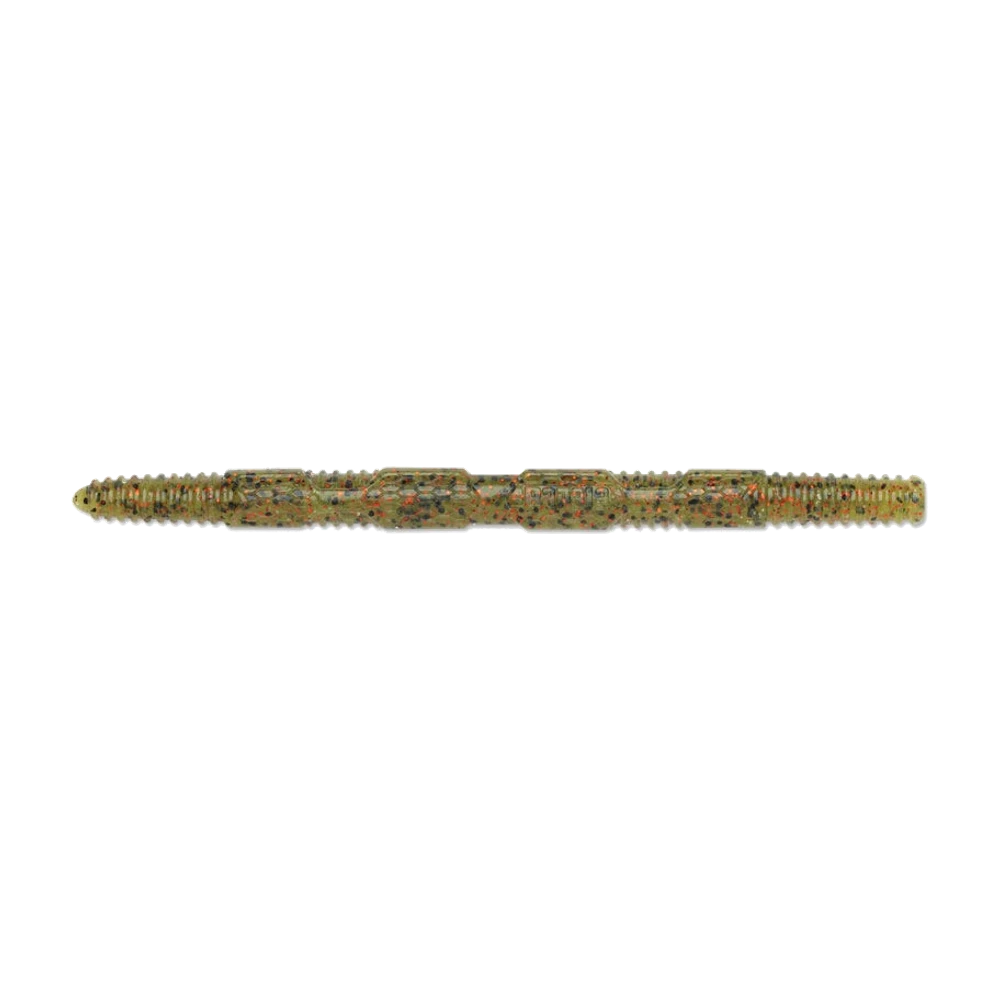
On the product photo the central area is easy to pick out: the fine rings running the whole length of the body stop in the middle to make way for moulded flat panels, separated by a narrower smooth band. That is an observation from a product photo, not a specification, but it matches a ring seat well. The two ends taper to a rounded point and stay ribbed right to the tip.
The wacky rig, and what to expect from it
Ring in place, a size 1 or 1/0 wacky hook passed under the ring, no weight. You cast, open the bail and watch the line. The bait falls folding at the middle, the two tips shimmying in opposition. The bite almost always happens during that fall: you do not feel it, you see it, on a line that moves sideways or stops too early.
Count the seconds of the fall on every cast. The day the lure stops three seconds before the usual count, that is not a shallow spot, that is a fish. It is the only way to detect a bite on the drop with a weightless stick.
The neko rig when you need to go down faster
Same ring seat, but the hook sits closer to one end and a lead nail goes into the opposite tip. The bait then drops nose first, plants itself almost vertically and quivers on the spot with every shake of the rod tip. This is the rig for vertical structure — drowned tree bases, dock edges, sharp breaks. Our neko rig page covers where to place the nail according to the density of the bait.
Where the Pig Stick wins, and where it loses
It wins everywhere the depth passes two metres and you still want a finesse presentation. Deep edges, drowned timber, submerged rock, gravel pit drop-offs: anywhere a slow stick would cost you half a day in endless descents.
It loses in very shallow water. In sixty centimetres over weed its density becomes a flaw: it touches down before it has worked, and a slower stick stays far better. It also loses in a crosswind, where a fast fall combined with a wind-pushed line makes bite detection genuinely hard.
One last thing to know: the weight of the bare lure is not published. The manufacturer size chart reads length and quantity — 12.7 cm, bag of eight — and the figure next to the length is a piece count, not a weight. If you want to match a jig head to the gram, you will have to weigh it yourself.
Not sure what to tie on?
Photograph your spot: CarnaFish reads the scene, cross-checks the conditions and gives you the zone, the lure and the retrieve. Free on iOS and Android.
Colors by bottom type and clarity
- Weed, lightly stained water: the olive green with red and black flake from the photo, which blends into the weed while keeping contrast points.
- Clear water over sand or gravel: translucent naturals, which create no hard silhouette when the fish has time to inspect the bait during the fall.
- Dark water, low cloud: black and blue, the clean silhouette that stays readable from below against the light.
Choosing between a sinking and a floating stick means nothing if you are fishing the wrong bank, and that is exactly what CarnaFish helps narrow down: one photo of the spot, and the AI suggests the zone, the likely depth and the type of presentation that fits. For the rest, our guide to getting started with bass fishing covers tackle and reading a spot.
What to remember
- The manufacturer states an increased salt load to add density: the bait sinks fast even with no weight.
- A moulded groove takes a retaining ring, which multiplies the life of the bait on wacky and neko rigs.
- Single 12.7 cm size; the figure next to the length in the chart is a pack count, not a weight, and no weight is published.
- A poor choice in very shallow water, where its density puts it on the bottom before it has worked.
FAQ
Does the Pig Stick really sink without weight?
Yes, that is the technical point Rapala puts forward: the salt content increases density and rate of fall, to the point where the bait drops quickly even rigged with no weight at all.
What is the groove in the middle of the body for?
It is moulded to take a retaining ring of the VMC Crossover Ring type. The hook passes under the ring instead of through the plastic, which stops the bait tearing on the hookset.
How is it different from a classic senko?
Rate of fall, essentially. A Yamamoto Senko 5 sinks slowly and flat, shimmying for a long time — a deadly behaviour in shallow water. The Pig Stick does the same thing faster, which changes the spots where it makes sense.
What hook size for the wacky rig?
A wide gap wacky hook in size 1 or 1/0 suits this 12.7 cm format. Smaller and the hookset becomes unreliable; larger and the hook unbalances the fall of the bait.
Can it be fished weightless Texas?
Yes, and it is a good compromise around cover: the density of the body makes up for the missing weight and keeps a fast descent while slipping through dead wood. Use a 3/0 to 4/0 Texas hook.
Is it a perch lure?
For big perch in deep water, yes, especially neko rigged on vertical structure. But the 12.7 cm format is sized for bass first: for fine perch fishing, a shorter stick such as the Z-Man TRD Ned Rig fits better.
The full bass lure guideSeason-by-season strategy: which family of lure, when, and why.Go from theory to fish
CarnaFish reads your spot from a photo and gives you the game plan: zone, lure, retrieve. Free on iOS and Android.