Neko rig: one nail in the worm's head and everything changes
Rather not fish it blind? Photograph your spot — CarnaFish cross-checks the conditions and points you the right way.
Some days the fish is there — visible on the sounder, or given away by a follow — and nothing will make it commit. The shad goes past too fast, the Texas rig slides over the bottom without saying anything, the drop shot works a touch too high. The fish looks and leaves.
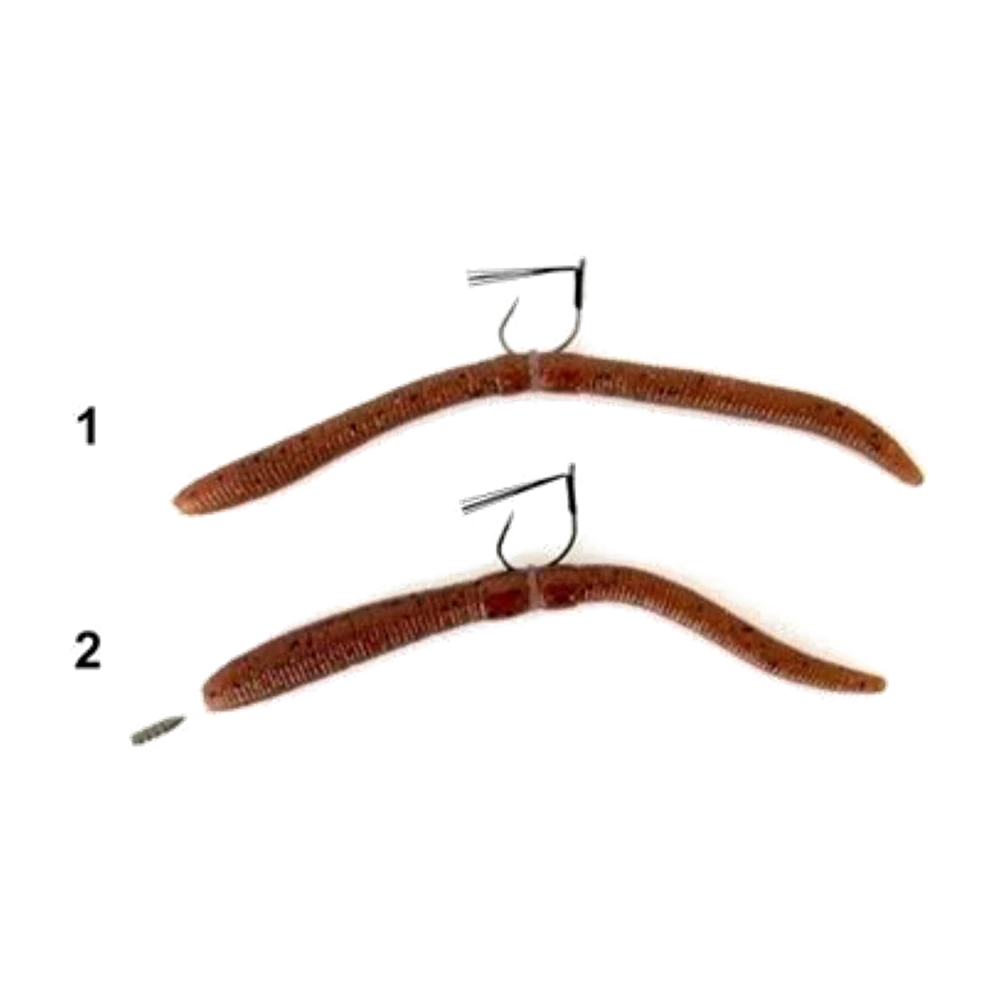
The Neko rig exists for exactly that situation. The idea fits in one sentence: you slide a small tungsten nail into the head of a soft worm, and hook it through the middle, perpendicular to the body. The worm no longer falls flat; it noses down, touches the bottom head-first and stands there vertically, tail in the air, quivering.
This is not a cosmetic variation on the wacky rig, but a presentation that fills a slot nothing else covers: a bait standing vertically, in permanent contact with the bottom, able to move without travelling a centimetre.
Why the weighted head changes everything
An unweighted worm sinks flat and settles on its side. Once on the bottom it is dead: it will not move again until you pull on it. With a nail in the head, three things happen.
- The fall becomes angled and head-heavy. The worm drops nose down, tail trailing behind, with a lateral sway. That is already a bite phase.
- Bottom contact is a single point. Only the tip of the nose touches; the rest of the body is lifted and standing in the layer of water closest to the bottom, exactly where inactive fish sit.
- The slightest rod movement reaches the tail. You shake the rod tip, the worm trembles on the spot. The anchor point does not move, the tail dances. No other rig does that.
That behaviour is what anglers are after when they reach for the Neko once nothing else is producing.
Tying a Neko rig properly
Once you have the knack, the rig takes thirty seconds.
- Pick your worm. A straight, dense, supple model of 10 to 15 cm. Senko-style worms, finesse worms and stick baits all work. A worm that is too stiff will not quiver.
- Fit an O-ring at the front third of the worm, roughly 40 % of its length from the head. An O-ring tool makes this trivial; failing that you can stretch the rubber on by hand.
- Push the tungsten nail into the nose of the worm, along its axis, right up to the head of the nail. Barbed nails hold far better than smooth ones.
- Pass the hook under the O-ring, point facing towards the head of the worm. That orientation gives the best hookup rate.
- Check the balance by dropping it in the margins: it should nose down decisively without spinning on itself.
The O-ring is not a luxury: hooked straight through the plastic, a worm tears apart on the second fish. With the ring, the same worm takes ten to twenty.
Nail weight: the adjustment that matters
This is the parameter that decides whether your Neko fishes or says nothing at all. Too light and you cannot feel the bottom and the worm will not stand. Too heavy and it buries itself in the silt or tips flat.
| Situation | Nail | Worm |
|---|---|---|
| Under 2 m, calm water, wary fish | 0.9 to 1.3 g | 10 to 12 cm |
| 2 to 5 m, hard bottom or gravel | 1.3 to 1.8 g | 12 to 13 cm |
| 5 to 8 m, or light current | 1.8 to 2.7 g | 13 to 15 cm |
| Steady wind, drifting from a boat | 3.5 g and up | 13 to 15 cm |
On the water: if the worm will not stand up, the nail is not always to blame. Check the tension in your line first. A tight line pulls the worm horizontal even with 2.7 g in its nose. The Neko is fished on a slightly slack line, rod held high, with contact re-established only at the moment you work it.
A less known tweak: you can put the nail in the tail instead of the head. The worm then stands nose up, and it is the head that quivers. On fish that have already seen ten standard Nekos go past, that simple change of orientation sometimes restarts the day.
The retrieve: shake, do not drag
The reflex, when you first meet this rig, is to fish it back like a Texas rig with pulls. That is the commonest mistake.
- Cast and let it drop on a controlled slack line. Watch the line. A large share of the bites come on the drop, and they show up as the line moving off to the side.
- Wait for bottom contact, then do nothing for five seconds. The worm rights itself on its own.
- Shake the rod tip on the spot, wrist only, two or three centimetres of movement. Five to ten seconds. The nail stays on the bottom, the tail dances.
- Give line back, two seconds of complete stillness.
- Drag twenty to thirty centimetres to move the anchor point, then start again from step 2.
On a precise spot — a stump, a jetty piling, a drop-off — you can spend five minutes on one square metre. That is exactly what this rig was designed for.
The bite is rarely violent: a heaviness, or the line drifting gently sideways. Set the hook by reeling fast and sweeping into it, without a big rod stroke.
Not sure what to tie on?
Photograph your spot: CarnaFish reads the scene, cross-checks the conditions and gives you the zone, the lure and the retrieve. Free on iOS and Android.
Where it excels, and where it is useless
The Neko is a spot rig, not a searching rig. It comes into its own over hard or lightly cluttered bottoms (gravel, flat rock, isolated deadwood), in clear to barely stained water, and above all on educated or inactive fish: late summer, very cold water, heavily visited fisheries. It works just as well vertically under the boat as from the bank at short range.
It is wrong in three cases: dense weed beds, where the open hook fouls every cast — go for a Texas rig instead; very silty bottoms, where the nail vanishes and the worm lies down; and fast searching, where you will burn a lot of time to cover a few dozen square metres.
Neko rig or wacky rig
The two are constantly confused, yet they work in two different layers of water. The wacky rig is a fall rig: with no weight, the worm sinks horizontally, quivering at both ends, and everything happens during that slow descent. Once on the bottom it has little left to offer.
The Neko rig, on the other hand, only becomes interesting the moment it touches the bottom. The fall is faster and less seductive, but what follows is a fishing phase in its own right, and it can last several minutes.
In practice: shallow water and fish sitting high, wacky. Fish pinned to the bottom, or more than three metres of water, Neko. And if you want a dedicated hook with a weed guard to work in wood, look at the VMC Neko Rig, designed for this rig specifically.
Our beginner's guide to bass fishing places this rig among the other finesse approaches. And if you are unsure which nail weight to fit when you reach the bank, CarnaFish analyses a photo of the spot and answers.
Key takeaways
- The nail in the head makes the worm nose down and holds it standing on the bottom.
- The O-ring is not optional: without it the worm tears apart in a handful of fish.
- Pick the nail by depth: 0.9 to 1.3 g in the shallows, up to 3.5 g on a drift.
- You shake it on the spot, and only drag to move on to the next square metre.
- A precision spot rig for hard bottoms — useless in dense weed or for searching fast.
FAQ
What exactly is a Neko rig?
It is a soft worm weighted with a tungsten nail in the head, with a hook passed through perpendicularly at the front third. The bait plants itself nose down on the bottom and stands vertically, which lets you make it quiver on the spot without moving it.
What nail weight should I use?
Between 0.9 and 1.3 g in under two metres, 1.3 to 1.8 g down to five metres, and 1.8 to 2.7 g deeper or in current. On a windy drift from a boat, going up to 3.5 g keeps you in contact.
Is an O-ring really necessary?
Yes, as soon as you want the worm to survive more than two fish. Hooked straight through the plastic, it splits at the hole. With the ring, the same worm takes ten to twenty fish.
What is the difference with the wacky rig?
The wacky works during the fall, horizontally and with no weight. The Neko works once it has landed, vertically, thanks to the nail. One is a shallow mid-water rig, the other a bottom rig.
Can you fish a Neko rig in weed?
Poorly, with a standard open hook. You then need a model with a weed guard, or you switch to a Texas rig. In isolated deadwood or over rock, the open hook stays workable and hooks up far better.
Does the Neko rig work for perch?
Very well, scaled down: an 8 to 10 cm worm, a 0.9 to 1.3 g nail, a finer hook. It is a serious weapon on perch sitting at the base of structure, in late summer as much as in winter.
The full bass lure guideSeason-by-season strategy: which family of lure, when, and why.Go from theory to fish
CarnaFish reads your spot from a photo and gives you the game plan: zone, lure, retrieve. Free on iOS and Android.