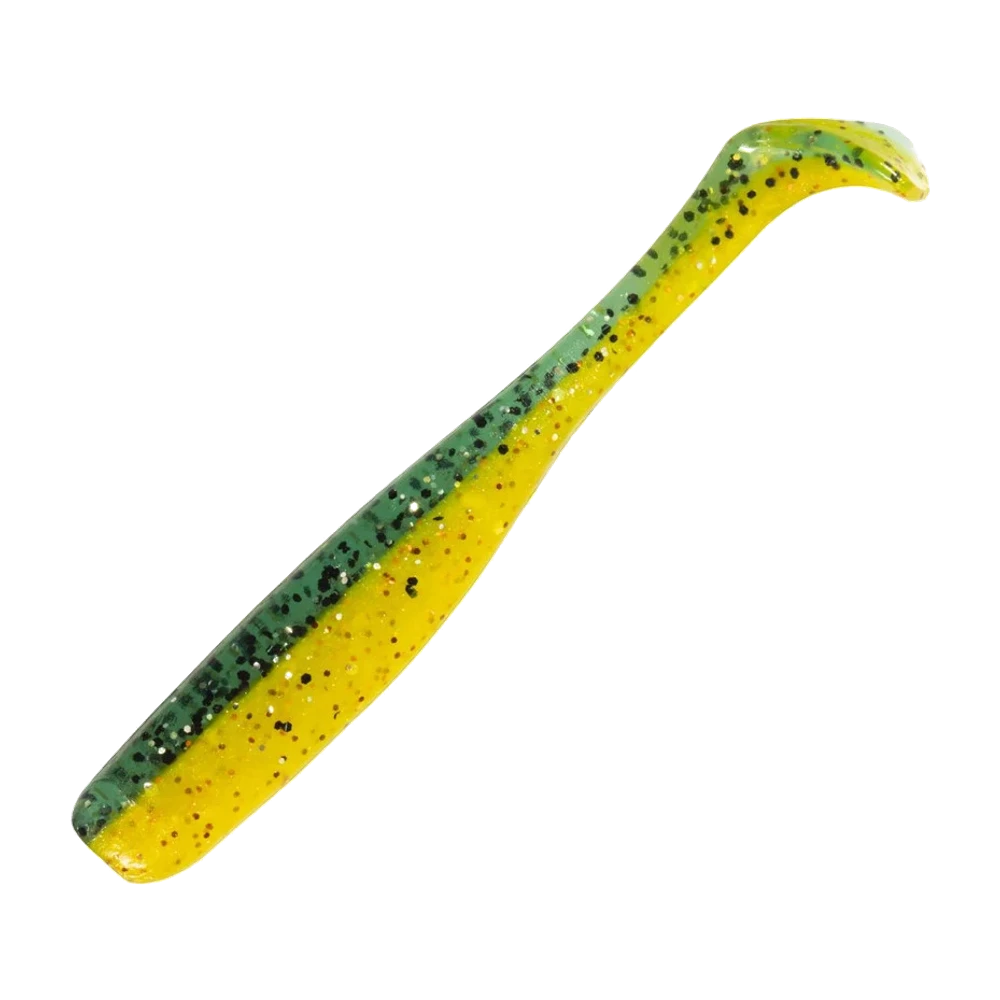
Z-Man Slim SwimZ: the little shad that refuses to lie down on the bottom
One lure, endless conditions. CarnaFish reads your spot from a photo so you are not just guessing.
You are fishing a gravel margin on a light jig head, you drop the shad on the bottom, you hold a three-second pause — and during those three seconds your lure is lying on its flank in the silt, invisible, inert. That is the black hole of shad fishing: the moment the lure touches bottom is also the moment it stops existing for the fish.
The Slim SwimZ solves that through material. The body floats. Sat on a jig head, it does not slump: it stands up, tail toward the surface, and stays in that position as long as you do not move. The pause becomes a posture rather than a disappearance.
What the buoyancy changes in practice
Most plastisol shads sink slowly. On a jig head they follow the lead and end up flat. The Slim SwimZ does the opposite: the lead anchors the head, the body rises, and the lure settles at roughly forty-five degrees, tail clear of the substrate.
That position produces three effects you notice from the first session:
- The lure stays visible even when still. Over a clean bottom the standing profile cuts out; over a cluttered one it sticks out of the debris instead of drowning in it.
- The tail keeps living. The slightest current, the slightest tension on the braid makes the paddle breathe. You do nothing and yet something is moving.
- Hooksets are cleaner. The hook points upward, clear, instead of being pinned against the bottom by the weight of the body.
The material behind that effect, ElaZtech, has its own rules of use — extreme durability, but sensitivity to standard plastisol and to badly chosen accessories. We cover all of that on the Z-Man TRD CrawZ page; no need to repeat it here, just remember that this lure gets stored separately and lasts a very long time.
The retrieve: pull little, wait a lot
The reflex with a shad is to retrieve. With this one, the retrieve is only a way of repositioning the lure between two pauses.
- Cast and let it drop on a tight braid. On a 2 to 3 g head, count the seconds: you learn the depth of the spot and you detect bites on the drop, which are frequent.
- Wait three to five seconds once on the bottom. Do absolutely nothing. That is when the lure rights itself and the tail starts to breathe.
- Two slow turns of the handle, just enough to lift the lure twenty centimetres and let it drop back.
- Another pause, longer than the previous one if nothing has happened.
- Keep going all the way to your feet. The last bites often come right under the bank, as the lure rises up the margin.
On the water: if you feel your weight touch bottom and you strike within the second because "something knocked it", you miss half the perch. On this lure, allow two seconds of float after contact — the real bite almost always comes afterwards, once the body has stood up and the tail has started moving.
A useful summer variation on active fish: a very slow straight retrieve at mid-depth, with no pauses at all. The tail starts at a speed where most paddles stay mute, which lets you fish a precise layer without speeding up.
Choosing the weight: the table that avoids mistakes
Head weight decides everything: the drop speed, the resting angle, and the layer of water you work.
| Situation | Size | Jig head | What you get |
|---|---|---|---|
| Shallow margin, under 2 m, clear water | 6.3 cm | 1.5 to 2 g | Gliding drop, very pronounced resting angle |
| Flat or drop-off, 2 to 4 m | 7.5 cm | 3 g | The most versatile compromise |
| Moderate river current | 7.5 cm | 4 to 5 g | Contact kept without the lure lifting |
| Vertical under the boat, 5 m and more | 7.5 cm | 5 g minimum | Line control, but the posture effect fades |
| Locked-up fish, cold water | 6.3 cm | Drop shot, 5 to 7 g lead | The lure holds a fixed height indefinitely |
Beyond 5 g you progressively lose what makes the lure interesting: the lead gets too heavy for the body to stand up properly. If your spot demands more weight, you may as well go for a bulkier standard shad.
The rigging that costs nothing and changes everything
Two details make the difference on this model.
The hook must be wide gap. The body is thicker than it looks behind the head. A narrow-gap hook ends up blocked by the plastic on the hookset, and you drop perch — a fish that opens its mouth wide.
The head must go in straight. On a material this elastic it is tempting to force it: the lure springs back into shape, so you assume it is fine. Except that if the head is slightly off line, the body takes a permanent twist and the tail beats at an angle. Push it in on the axis, even if that means pulling it off and starting again.
Not sure what to tie on?
Photograph your spot: CarnaFish reads the scene, cross-checks the conditions and gives you the zone, the lure and the retrieve. Free on iOS and Android.
Where it is good, where it is not
The Slim SwimZ is a lure for tight situations.
- Clear water and wary fish. The slim profile and low-amplitude action get through where a wide paddle spooks.
- Perch sat on the bottom, over gravel, boulders, low weed. This is its home ground.
- Late-autumn bass on deep spots, on a very slow pull.
- Already-fished spots where everyone else is throwing standard shads.
It is, however, unsuited to covering big areas quickly: it does not put out enough vibration to call a fish from a distance. It is also weak in heavily stained water, where a strong-signal lure — a blade bait or a thick paddle — remains superior. And forget it for pike: teeth cut a body this slim in one attack, and the light rig does not forgive.
Slim SwimZ or a standard paddle-tail shad
Against a Keitech Shad Impact 3, the difference is not subtlety — both are discreet lures — but behaviour at rest. The Keitech lies down and relies on its scent and extreme softness; the Slim SwimZ stays standing and relies on posture. On a fish that follows without biting, the second often wins because it keeps offering a target during the pause.
Against a Z-Man TRD Ned Rig, it is the way it moves that differs: the TRD glides and tumbles, with no vibration at all; the Slim SwimZ puts out a continuous beat as soon as it moves forward. In very cold water the TRD comes out ahead; as soon as the fish accept a little movement, the Slim SwimZ covers ground faster.
Our guide to perch fishing with lures places both approaches within the season. And if you are unsure what weight to rig when you arrive at an unfamiliar margin, CarnaFish analyses a photo of the spot and answers.
Key takeaways
- The body floats: on a jig head the lure stands up instead of lying down on the bottom.
- The pause is the main retrieve — three to five seconds minimum, doing nothing.
- 1.5 to 5 g maximum: beyond that, the posture effect disappears.
- A wide-gap hook is compulsory, and the head must go in perfectly on the axis.
- A finesse lure for clear water, not a searching tool and not a pike lure.
FAQ
What jig head for the Slim SwimZ?
1.5 to 3 g for most situations under 4 m, up to 5 g in current or over deep bottoms. Beyond that, the lead stops the body standing up and you lose the lure's main advantage.
Does the Slim SwimZ really float?
The bare body does, yes. Rigged on a jig head it obviously sinks, but the rear section rises, which gives that characteristic nose-down posture when the lure is still on the bottom.
Which size should I choose, 6.3 or 7.5 cm?
The small size for perch in clear water and for difficult fish, the large one for bass, slightly stained water and whenever you need a bit of casting distance. When in doubt, the large size catches perch too.
Can it be fished on a drop shot?
Yes, and it is one of its best uses. The floating body holds horizontal above the lead instead of hanging down, and the tail works on line tension alone, with no input from you.
Does it stand up to repeated attacks?
On perch and bass, very well: that is the point of the material, one lure takes plenty of fish. On pike or a well-armed zander, the slim body tears like any soft plastic.
Does it need storing separately?
Yes. The material reacts badly to prolonged contact with standard soft plastics. Keep it in its original bag or in a dedicated box, never mixed in with the rest of the tackle box.
The full perch lure guideSeason-by-season strategy: which family of lure, when, and why.Go from theory to fish
CarnaFish reads your spot from a photo and gives you the game plan: zone, lure, retrieve. Free on iOS and Android.