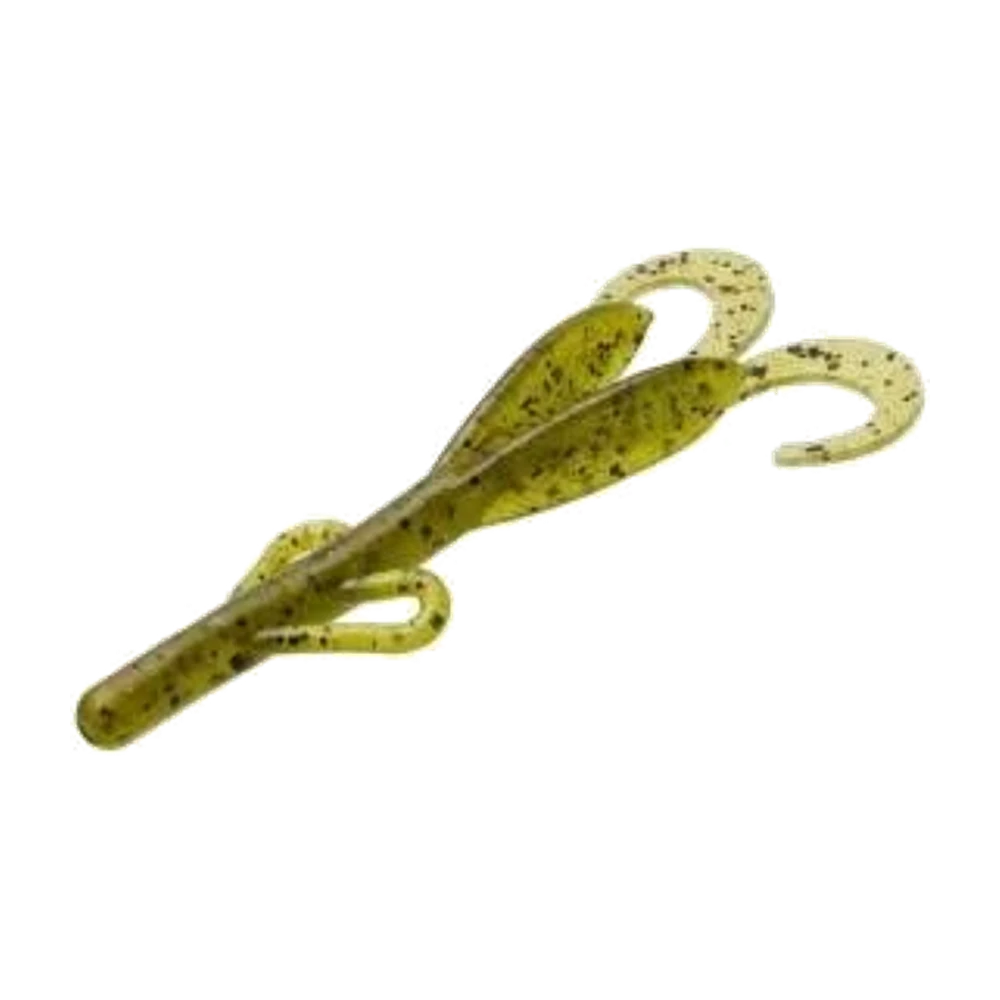
Zoom Baby Brush Hog: the scaled-down creature for pressured water
Rather not fish it blind? Photograph your spot — CarnaFish cross-checks the conditions and points you the right way.
There comes a point, on heavily visited waters, where the fish stop attacking without losing interest. You see follows. You feel solid knocks that never turn into anything. The lure is spotted, examined, and refused at the last instant.
In that specific case, changing lure family is often a mistake. What the fish has validated — the profile, the movement, the behaviour — is working. What it refuses is the size. And the right correction is to keep exactly the same lure, smaller.
The Baby Brush Hog is built for that. Same profile, same appendages, same paddles, but a markedly reduced volume. It is not another lure: it is the same argument said more quietly.
What the reduced volume really changes
Downsizing produces four concrete effects, three of which are rarely mentioned.
The fall slows at equal weight. A smaller body offers less buoyancy, but also far less mass. The result: with a 7 g bullet, the Baby drops noticeably more slowly than a full-size model with the same bullet. You gain presentation time without lightening the weight, so without losing sensitivity.
The appendages become proportionally more mobile. The arms and paddles have been shortened, but their relative thickness drops more than their length. So they wave more easily, under a weaker pull. On very slow fishing, that is decisive.
The hook can be smaller. A 3/0 is enough, against a 4/0 or 5/0 on the standard model. A smaller, finer hook penetrates better on a soft bite — exactly the kind of bite produced by the wary fish you are trying to convince.
The lure becomes available to other fish. Big perch, which ignore a 15 cm creature, hit this one properly. On a mixed water, you multiply your opportunities instead of limiting yourself to adult bass.
The retrieve: two rhythms, depending on what you are after
Weighted Texas rig, along cluttered margins
- Put the cast right against the cover, not beside it.
- Let it drop on a semi-tight line, following the line with your eyes. Most bites come here.
- Wait three seconds on bottom contact, motionless.
- A short thirty-centimetre pull, rod from ten to eleven o'clock, slowly.
- Set it back down and wait two seconds. The appendages keep moving after the lure has stopped.
- Three to five cycles per spot, then move on.
Carolina rig, over open flats
The principle of the Carolina rig applies as it stands: weight on the main line, bead, swivel, then a 60 to 100 cm leader. The Baby Brush Hog comes into its own here, because it floats slightly above the bottom between two pulls and its appendages work constantly in the current created by the weight moving. Pull in long, slow, horizontal movements, and hold a three-second pause at the end of each one.
On the water: when you switch from a full-size creature to its downsized version, do not reduce the weight at the same time. It is the natural reflex and it is a mistake. Keep the same bullet weight: you keep your casting accuracy and your sensitivity, and you take advantage of a fall already slowed by the smaller volume. Changing two variables at once stops you knowing which one worked.
Setting the weight
| Context | Tungsten bullet | Hook | Line |
|---|---|---|---|
| Margin 1 to 2 m, light weed | 5 to 7 g | 3/0 wide gap | 0.30 mm fluoro |
| Timber structure, 2 to 3 m | 7 to 10 g | 3/0 | 0.25 mm braid + 0.35 mm fluoro |
| Dense weed to punch | 10 to 14 g | 3/0 heavy wire | 0.30 mm braid |
| Carolina over a flat, 3 to 5 m | 14 to 21 g on the main line | 3/0 | Braid + 0.28 mm fluoro leader |
On a Texas rig in weed, peg the bullet with a stopper: a free weight separates from the lure during the fall and destroys the coherence of the presentation.
Where it excels, and where it is beside the point
- Heavily fished waters: that is its whole reason for existing. Club ponds, urban reservoirs, high-pressure beats.
- Clear water in broad daylight, when a fish has all the time it needs to examine what goes past.
- Post-spawn and late summer, periods when fish are fussy and circle lures without committing.
- Mixed bass-and-perch waters, where the smaller size opens up a second class of catches.
It is, on the other hand, badly suited to heavily stained water, where a small volume does not put out enough signal to be found: there, a big profile that displaces water remains superior. It is also useless for covering water fast — a Texas-rigged creature is slow by nature, and if you do not yet know where the fish are, a spinnerbait or a crankbait will tell you ten times quicker. Finally, on genuinely big, active fish, you are deliberately giving up your size filter: in that case, go back to the standard format.
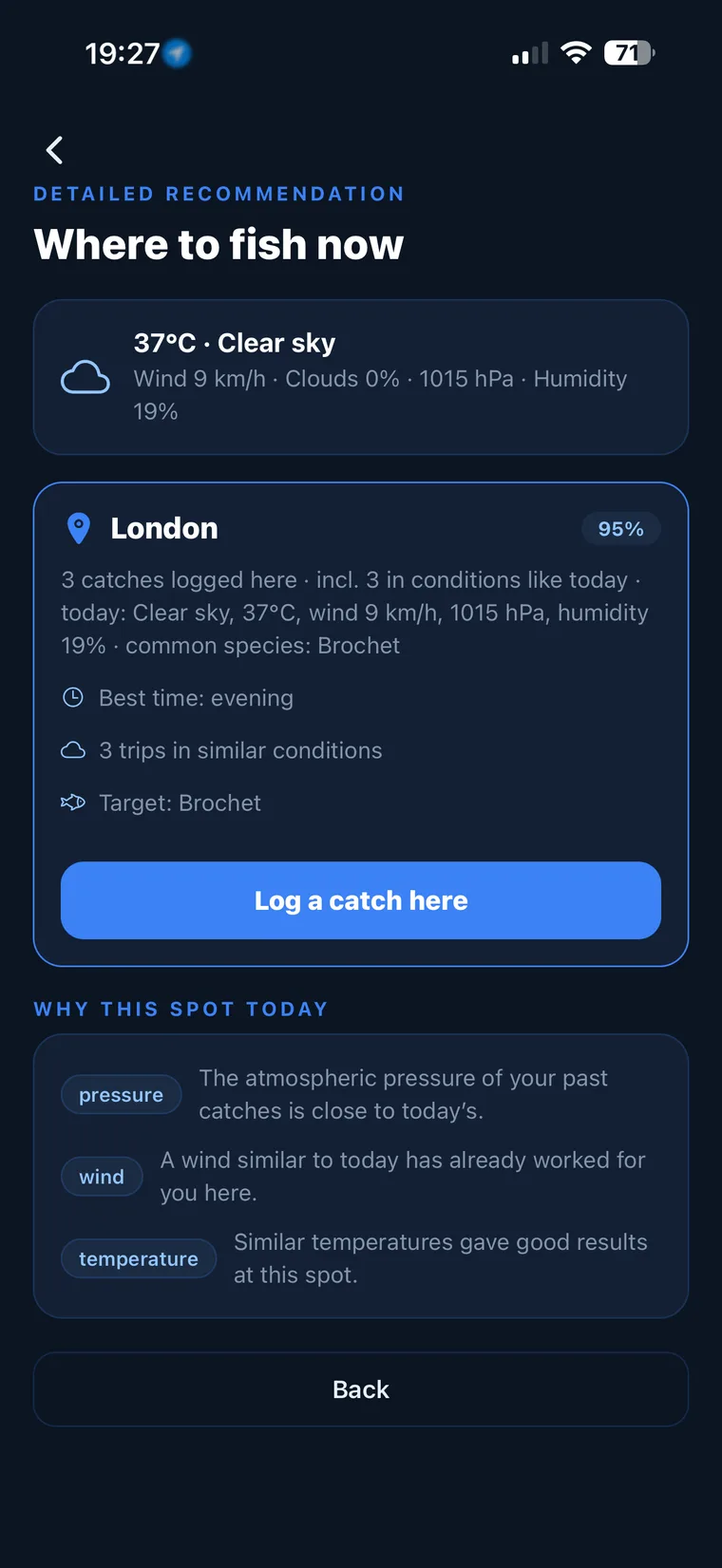
Not sure what to tie on?
Photograph your spot: CarnaFish reads the scene, cross-checks the conditions and gives you the zone, the lure and the retrieve. Free on iOS and Android.
Baby Brush Hog or Brush Hog: when to downsize
The question is settled on the water, not in the shop. The Zoom Brush Hog is still the default choice: more volume, more water displaced, better size filtering on big fish, and better penetration into dense weed thanks to its mass. On a lightly fished water or in coloured water, there is no reason to downsize.
The switch to the Baby is decided on one precise signal: repeated follows and soft bites that never convert. If you are catching fish normally, stay on the standard. If fish come, look and leave three times in a row, downsizing often converts immediately.
There is another route to the same problem, and it is complementary: instead of reducing the size, reduce the commotion. A Zoom Finesse Worm on a light rig offers a minimal profile and a subtle movement. The Baby Brush Hog's logic is different: it keeps the rich movement and reduces only the volume, which often makes it more effective when fish are wary but not apathetic.
Our beginner's guide to bass fishing places these rigs within a full season. And if you are torn between attacking a margin with bulk or with finesse when you arrive at an unfamiliar water, CarnaFish analyses a photo of the spot and answers.
Rigging details
The orientation of the rear paddles matters: mounted flat relative to the body, they clap against each other during the pull; mounted crooked, they make the lure spin. Check the alignment after every fish.
The hook size must not be oversized. A 4/0 in a 10 cm body leaves too little material to hold the Texas position, and the lure slides down the shank at the first bit of cover.
Zoom's plastic is salted and fairly soft, which helps a fish hold it but shortens its life. Reckon on one lure per two or three fish when fishing cover, and stock up accordingly.
Key takeaways
- Same profile and same appendages as the standard model, for a markedly smaller volume.
- The fall slows at equal weight: keep the same bullet when you change size.
- A 3/0 wide-gap hook, finer, which penetrates better on soft bites.
- You switch on one precise signal: repeated follows and soft bites that never convert.
- Beside the point in heavily stained water, for covering water fast, and on big active fish.
FAQ
When should I switch from the standard Brush Hog to the Baby?
When fish follow, bite softly and fail to commit, several times in a row. If you are catching normally, stay on the standard model, which filters for bigger fish and penetrates dense weed better.
What bullet weight should I use?
5 to 7 g on a shallow margin, 7 to 10 g on timber structure, and 10 to 14 g to punch through dense weed. When moving from the standard model to the Baby, keep the same weight rather than lightening it.
What hook size for the Baby Brush Hog?
A 3/0 wide gap. A 4/0 leaves too little material in a 10 cm body to hold the Texas rig, and the lure slides down the shank at the first bit of cover.
Can it be fished on a Carolina rig?
Yes, and it is one of its best uses over open flats. With a 60 to 100 cm leader it floats slightly above the bottom between two pulls and its appendages work continuously.
Does it catch perch?
Yes, unlike the full-size model. The smaller size makes it attackable by big perch, which makes it a good choice on mixed waters where bass and perch live side by side.
How long does one lure last?
Around two or three fish when fishing cover. Zoom's salted plastic helps a fish hold on but tears fairly quickly: stock up if you are fishing a full day.
The full bass lure guideSeason-by-season strategy: which family of lure, when, and why.Go from theory to fish
CarnaFish reads your spot from a photo and gives you the game plan: zone, lure, retrieve. Free on iOS and Android.