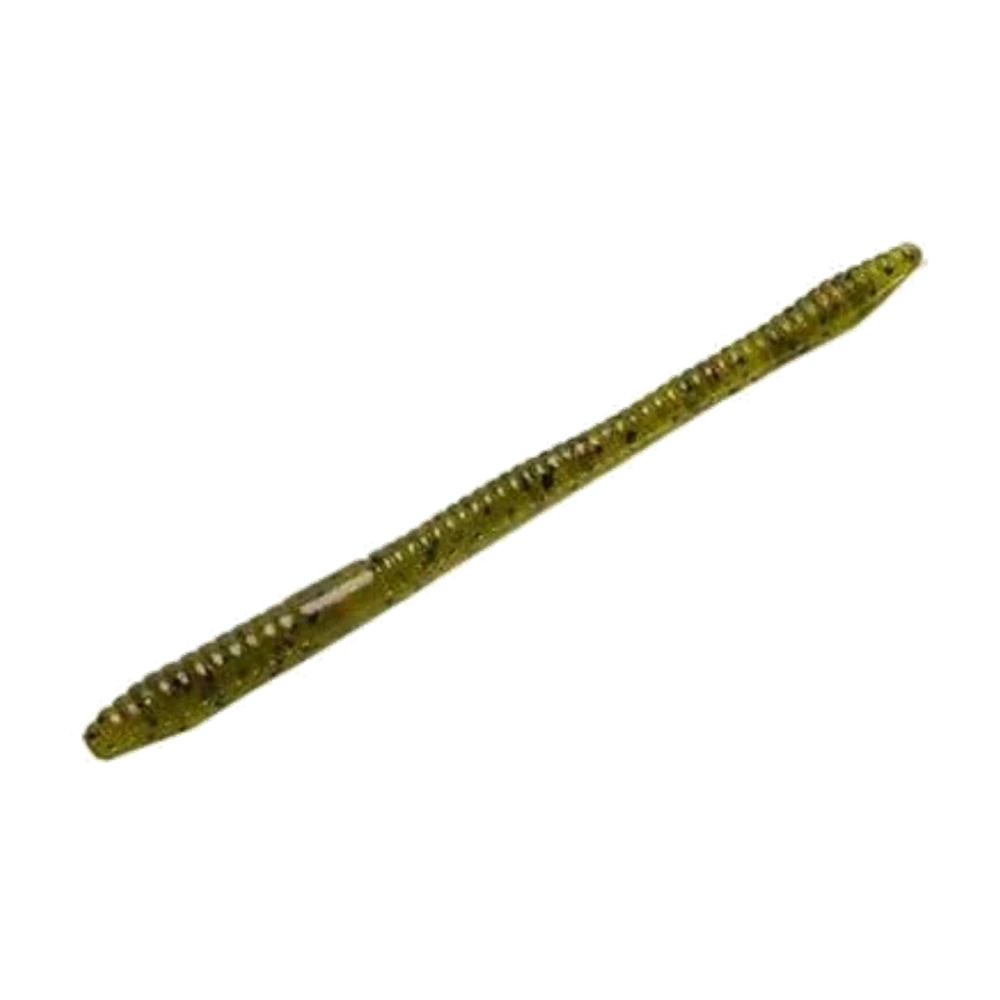
Zoom Finesse Worm: the bait that works while you do nothing
One lure, endless conditions. CarnaFish reads your spot from a photo so you are not just guessing.
On a spot you know is good — a laydown, a dock piling, a lily pad edge — you spend an average of ninety seconds. You cast three or four times, you get nothing, you move on. That is what almost every angler does, and it is what leaves the most fish in the water.
A bass sitting under a stump in the middle of a summer afternoon is not absent, it is motionless. It will not chase a crankbait, it will not come up for a topwater, and it will not react to three quick passes. It will, however, eventually take a prey item that stays in its field of view for a full minute without leaving.
That is exactly what a finesse worm is for. It is not a bait you work, it is a bait you let be there. And the difficulty is not technical, it is mental. You have to accept doing nothing for lengths of time that feel absurd.
Why a slim worm rather than a fat one
The Finesse Worm is thin and tapered. That is not a styling choice, it answers three constraints.
- It undulates under its own weight. A thick worm needs to be dragged to move; this one quivers with the faintest breath of current or micro-tension in the line.
- It hooks cleanly on a fine-wire hook. Less material, better conversion rate, especially on soft bites.
- It gets past wary fish. In clear water or on heavily fished areas, a big bulky worm gets inspected and refused.
Its weakness is the mirror image: in heavily stained water or over large areas to cover, it does not announce itself enough.
The shaky head, the benchmark rig
A shaky head is a jig head with an offset eye, rigged with the worm hooked Texas style. The result: the lead sits on the bottom, the worm stands upright, and the tail waves above it like a worm digging in.
The rig has two virtues. It is nearly snag-free — the buried hook limits hang-ups in wood and rock. And it presents the bait permanently, including during your pauses, which is precisely what you are after.
| Situation | Shaky head weight |
|---|---|
| Margins, under 1.50 m, no wind | 3 to 4 g |
| 2 to 4 m, clean bottom | 5 g |
| 4 to 6 m, or light wind | 7 g |
| Strong wind or current | 9 to 10 g |
Stay as light as you can. A heavy shaky head lays the worm down instead of standing it up and kills most of the effect.
The retrieve: count, don't crank
- Cast a metre past the spot, never on top of it. A direct splash on the zone puts the fish on guard.
- Let it sink on a semi-tight line while watching the slack. Many bites come in this phase, showing up as line moving off to one side.
- Once it is on the bottom, do nothing for ten seconds. Actually count them. The tail keeps moving.
- Shake the rod tip on the spot, three or four seconds, without moving the lead.
- Pause ten seconds again.
- Move the bait thirty centimetres, then start the cycle over. On a good spot, run four or five cycles before reeling in.
A full cast should last one to two minutes. If you take twenty seconds, you are not fishing this bait.
On the water: on a spot you think is good, count pauses, not casts. Four quick casts are worth less than a single cast with five ten-second pauses. A bass sitting tight does not react to repetition, it reacts to how long the bait stays there.
The other useful rigs
The drop shot, when the fish are not on the bottom but suspended above a structure. The worm stays at a fixed height and quivers without ever touching down. See the drop shot rig.
The wacky, hook through the middle of the body, weightless or with a nail weight. The worm falls folded in two, both ends flapping against each other. It is the most visual rig on the fall, deadly under a dock. See the wacky rig.
The weightless Texas, for really cluttered zones: slow descent, clean passage through branches. See the Texas rig.

Not sure what to tie on?
Photograph your spot: CarnaFish reads the scene, cross-checks the conditions and gives you the zone, the lure and the retrieve. Free on iOS and Android.
When to tie it on and when to forget it
It comes into its own in the dead hours, mid-afternoon in summer, when nothing else works. On heavily pressured waters, where the fish have seen every noisy bait go past. And in the post-spawn, when fish are tired and refuse to chase.
It is unsuited in three cases. In heavily stained water, where it does not signal itself. On large areas to cover with little time: too slow, you will not cover anything. And in strong wind, where you lose contact with a light rig — switch to a heavier setup, or change bait family entirely.
Finesse Worm or Senko
The Yamamoto Senko is thicker and denser. It lives off its fall: a shimmy of both ends on the way down, then not much once it lands. It is a fall bait, to be recast often.
The Finesse Worm works the other way round: the fall is more discreet, but the bait keeps working once it has settled, especially on a shaky head. The two do not replace each other — the Senko for fish that react to the drop, the slim worm for the ones you have to wear down. The Zoom Trick Worm sits in between, with a longer body that shines on a weightless Texas rig.
Our beginner's guide to bass fishing covers reading the spots that justify this patience. And if you are unsure how much time a structure deserves when you reach the bank, CarnaFish analyses a photo of the spot and answers.
Key takeaways
- A cast should last one to two minutes: count the pauses, not the casts.
- The shaky head stands the worm up and keeps it working even at rest.
- Use the lightest lead you can, a heavy shaky head lays the bait flat.
- Many bites come during the descent: watch your line.
- Pointless in stained water, in strong wind, or when you need to cover ground fast.
FAQ
What is a shaky head and how do you use it?
It is a jig head with an offset eye, on which the worm is Texas-rigged. The lead sits on the bottom and the worm stands upright. You shake the rod tip without moving the lead, alternating with ten-second pauses.
How long should a finesse worm sit in one place?
Ten seconds minimum per pause, and four or five pauses per cast on a good spot. A full cast lasts one to two minutes. Reeling in after twenty seconds means you are not really fishing this bait.
What colour for the Zoom Finesse Worm?
Green pumpkin and watermelon cover most situations in clear to lightly stained water. In darker water or low light, a junebug or black tone gives a sharper silhouette.
What weight should I choose?
The lightest that still lets you feel the bottom: 3 to 4 g on the margins, 5 g down to 4 m, 7 g beyond that or in light wind. Too heavy and the lead lays the worm down and kills the vertical waving.
Does this worm catch perch?
Yes, especially on a drop shot for perch holding near structure. Use a smaller hook and do not hesitate to trim the worm down by a third.
What is the difference with a Senko?
The Senko is thicker and works mostly on the fall, which means recasting often. The Finesse Worm keeps undulating once it is on the bottom, which lets you work a spot far longer without moving.
The full bass lure guideSeason-by-season strategy: which family of lure, when, and why.Go from theory to fish
CarnaFish reads your spot from a photo and gives you the game plan: zone, lure, retrieve. Free on iOS and Android.