Zoom Curly Tail Worm: the thin worm whose tail turns on nothing
Not sure this lure fits YOUR spot today? CarnaFish tells you in 10 seconds, from a photo.
There are baits you agonise over, and baits you fish simply because they are there, twenty to a bag, at the bottom of the box. Zoom's Curly Tail Worm belongs to the second group, and that is exactly why it deserves to be taken seriously: a thin four-inch worm with a curling tail, one you will happily throw into a brush pile without doing the mental arithmetic on what it costs to lose. Plenty of anglers think it looks too plain on the peg. Then they count their bites at the end of the day.
A thin profile and a tail that asks for nothing
Zoom describes the Curly Tail as a thin, finesse-focused worm, built for days when fish are keyed in on smaller forage. That is a brand statement, not a measurement, but it matches what you hold: a slim body ending in a looped tail that takes up nearly a third of the total length.
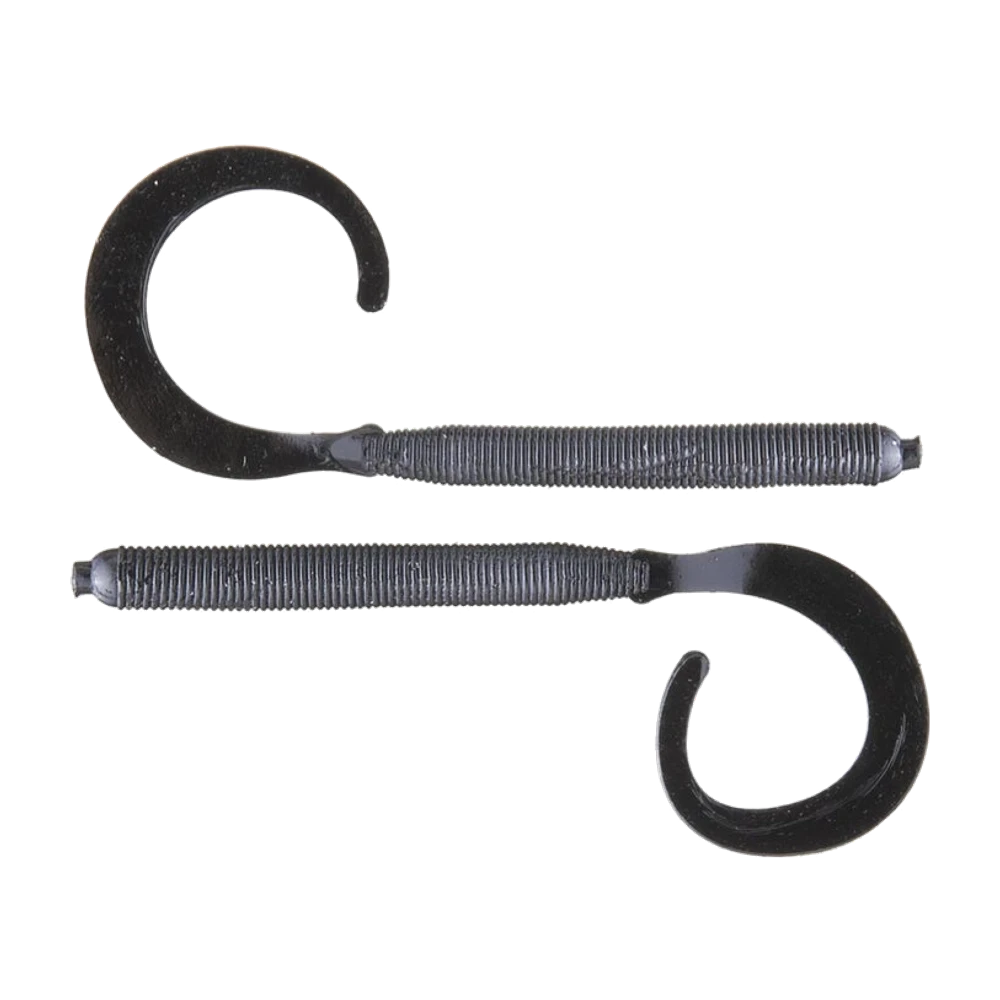
In the product photo, the ribs cover almost the whole body, packed tightly against each other, while the tail stays smooth and flat. That layout explains the bait's behaviour better than any sales copy: the ribs multiply the surface in contact with the water and slow the descent, while the flat paddle of the tail, thin and broad at once, curls the instant the bait moves a centimetre.
The consequence is counterintuitive. On a big ribbon-tail worm like the Culprit Original Worm, you need a minimum of pull before the tail engages. Not here: the simple glide of the worm settling back after a hop is enough to set the loop turning. So you don't need to work the bait for it to send a signal — if anything, you need to do nothing at all for that signal to stay readable.
Four rigs, four different jobs
Zoom names four rigs outright: light Texas, darter head, drop shot and shaky head. Four slow presentations, none of which involves a straight retrieve — which tells you a great deal about the family this worm belongs to.
Light Texas rig
A 2-5 g / 1/16-3/16 oz bullet, a thin-wire 1/0 or 2/0 worm hook, and the bait goes anywhere: flooded branches, pad edges, rock. The tail turns on every drop between two pieces of cover, which makes this a fall presentation rather than a dragging one. Give it slack after each release: on a tight line the tail stops turning and the bite never shows.
Darter head
Probably the most relevant rig for a European angler. A pointed-nose 3-5 g / 1/8-3/16 oz jighead, the worm nose-hooked straight, and you get exactly what a perch attacks: thin silhouette, low volume, a tail that works at minimum speed. A simple drag-and-glide over gravel or riprap is enough.
Drop shot
The Curly Tail takes a nose-hooked drop shot well, but you should know what you are buying. Its tail does not behave like a straight tail's: instead of undulating softly when the line shivers, it curls hard and releases. The signal is stronger, which suits lightly stained water or an active fish better than a wary bass in gin-clear water, where a tapered-tail Zoom Finesse Worm stays more discreet.
Shaky head
Screw-lock head, worm straight, and you shake the rod without moving the bait forward. The tail turns on the spot while the body stands nose down. It is the slowest of the four and the one that demands the most faith: sometimes it takes thirty seconds over one square metre before anything happens.
What the spec line does not say
The whole spec table runs to four characters: 4" 20. The header reads "Length Quantity" — four inches long, twenty pieces per bag. The second number is packaging, not mass; reading it as a weight would turn this into a 20 g worm, which makes no sense at all.
Four inches is 10.16 cm exactly. The round number is a trade name, so think in terms of "about ten centimetres", not millimetres.
Two pieces of information are missing, and it is worth knowing before you buy. Zoom publishes no weight — normal for a bare soft plastic, but it means you cannot predict the fall rate any other way than by trying it. And the description mentions neither salt nor buoyancy, while the brand states both explicitly on other baits in its range: so there is no basis for claiming this worm sinks or floats on its own. Run the bucket test before building a presentation on that assumption.
The most useful fact is the one the description throws away at the end of the line: twenty per bag. At that count the worm costs small change apiece, and that genuinely changes how you fish. You cast into the dead wood, you keep working the rock that snags, you let it sit. That is often what separates a decent day from a good one.
Rig one on a 3 g darter head and forget about it for twenty seconds at the foot of a riprap bank, rod resting on your thigh. The tail keeps turning on the micro-currents while you do nothing. Three quarters of the perch taken on this worm come from those dead moments, not from the animation.
Not sure what to tie on?
Photograph your spot: CarnaFish reads the scene, cross-checks the conditions and gives you the zone, the lure and the retrieve. Free on iOS and Android.
Where and when it earns its keep
The Curly Tail Worm is a bass bait first: that is what it was drawn for, and slow work around structure is where it gives its best. In Europe it has a second career the description never mentions, as a perch bait — a curling tail on a thin ten-centimetre body, rigged light, is a classic presentation on canal riprap, bridge pilings and harbour walls.
The best window runs from late summer into autumn, when the year's fry are everywhere and predators refuse bulky profiles. It carries on into cold water: at 8-10 °C, a bait that signals without needing to be moved forward beats a shad you have to retrieve to switch on. One caveat — don't take it to a pike spot without a leader: a thin worm on a single hook does not survive the attack.
The classic mistake: too much weight, too much action
Out of search-fishing reflex, you clip on a 10 g head to "feel the bottom", and the tail no longer has time to turn on the drop: the bait falls straight, like a piece of plastic. Then you compensate by working the rod harder, which crushes what the loop was doing. The right move is the opposite: take the lightest weight that still lets you feel bottom, and shrink your hops until they look like shivers. If you are wondering whether you are slow enough, you probably aren't.
Colour by water clarity
Zoom advertises "a range of proven colors" without naming a single one, so there is no trade reference to quote and you are better off thinking in tone families.
- Clear water: translucent flake finishes, which pass light and stay credible under hard sun.
- Stained water: green-pumpkin browns, natural enough not to alarm, opaque enough to register at a metre.
- Dark water or low light: black — the one in the photo, deep, with fine flake — or junebug. Against the light, a clean silhouette beats a bright colour.
A good colour call never replaces reading the spot properly, and that is exactly what CarnaFish is for: a photo of the spot, and the app suggests a zone, a depth and a presentation suited to the day's conditions. To work out where to place this kind of worm on a canal or a gravel pit, our guide to perch fishing with lures covers the holding spots and the rigs that go with them.
Key takeaways
- The tail turns as soon as the bait glides, with no pull required: this worm works on the fall and at rest, not on a straight retrieve.
- Four slow rigs named by Zoom, and the darter head is the most relevant one for perch in Europe.
- The spec line reads
4" 20: 20 is the piece count per bag, not a mass; no weight and no buoyancy are published. - Twenty per bag is the hidden argument — cheap enough that you dare fish the snaggy water.
FAQ
What weight should I use with the Zoom Curly Tail Worm?
Between 2 and 7 g / 1/16 and 1/4 oz depending on depth and current, staying with the lightest that still keeps contact. Too heavy a head drops the worm straight and cancels the tail's work on the fall, which is the whole point of the bait.
Does this worm work for perch?
Yes, it is one of its best uses in Europe. On a 3-5 g darter head, a thin ten-centimetre worm with a curling tail is exactly the profile a perch looks for on riprap or a bridge piling.
Does the Curly Tail Worm sink on its own?
Zoom doesn't say, and the description mentions neither salt nor buoyancy for this model, unlike other baits in the range. Run a bucket test before building a presentation on the assumption that it floats or sinks.
How long is this worm really?
The trade name says four inches, which is 10.16 cm. In practice, think "about ten centimetres": the metric figure is a conversion of a round imperial number, not a measured value.
How many worms come in a bag?
Twenty, and that matters more than it looks. The pack count makes the bait cheap enough that you accept losing a few in the dead wood, which is exactly where the fish sit.
Should I pick a straight-tail worm instead?
They do different jobs. A tapered-tail Zoom Finesse Worm is more discreet and suits a wary fish in very clear water; the Curly Tail puts out a stronger signal and takes over as soon as the water stains or the fish turn active.
The full bass lure guideSeason-by-season strategy: which family of lure, when, and why.Go from theory to fish
CarnaFish reads your spot from a photo and gives you the game plan: zone, lure, retrieve. Free on iOS and Android.