Zoom U Tail Worm: the worm whose tail works while standing still
Not sure this lure fits YOUR spot today? CarnaFish tells you in 10 seconds, from a photo.
A rocky bank, five metres of water, and a fish that has already refused everything that moves. That is the moment you stop searching and drop a worm on a shakey head straight down the edge, then make it tremble in place for thirty seconds without moving it a centimetre. Zoom's U Tail is cut out for that exercise: the tail comes alive long before the bait travels anywhere.
A U tail is not a ribbon tail
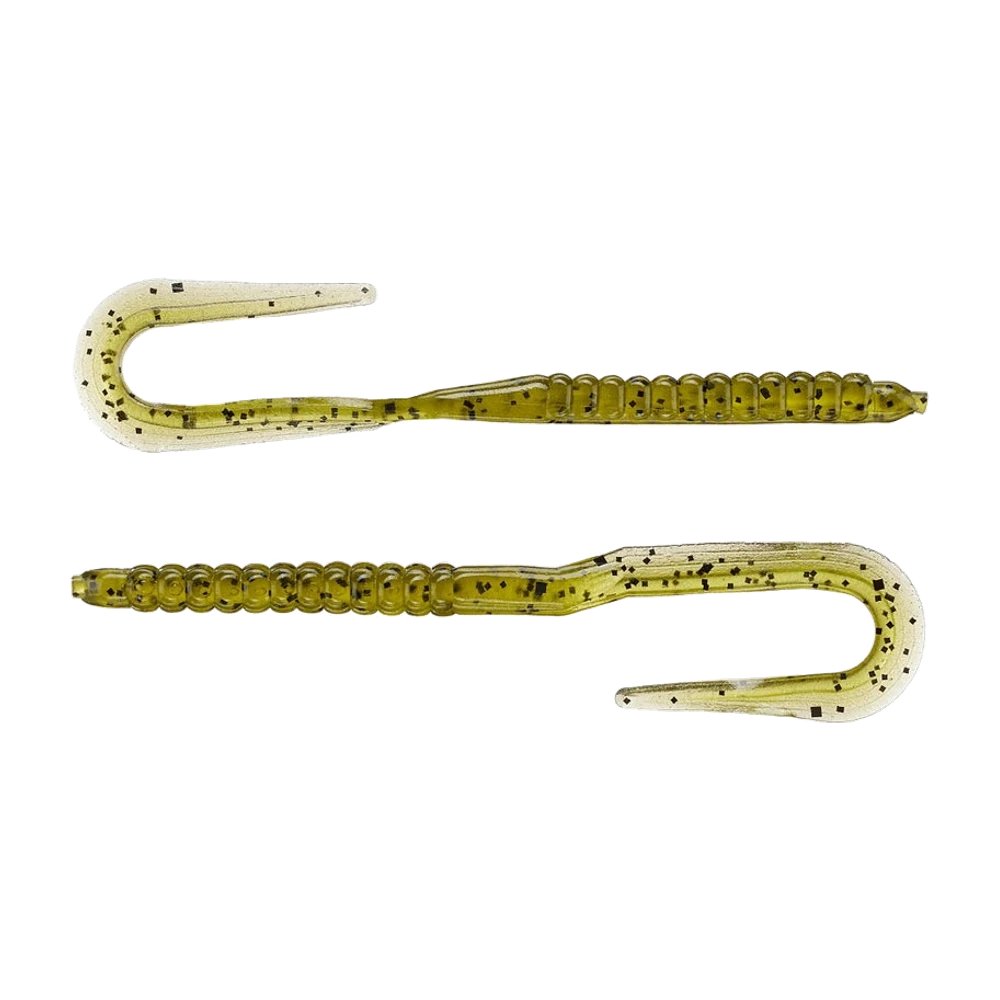
This is what separates this worm from most of its rivals, and it is worth looking at the photo rather than the product sheet. The U Tail's tail is not a ribbon that coils into a spiral like a grub or a classic ribbon tail. It is a flat blade, wide and thin, moulded into a half circle: it leaves the body, turns through 180 degrees and ends in two free tips facing each other.
The hydrodynamics are not remotely the same. A coiled ribbon needs forward motion to spin on itself: speed creates the rotation, and the rotation creates the vibration. A folded flat blade only needs a minimal displacement of water to flap on both of its strands, in one plane. In practice that means you can keep the tail alive by shaking the rod tip with the rod low, without a single turn of the handle. Zoom puts it in its own words, describing a tail that flaps and flickers on the slightest movement, and that is exactly what it does on the water.
The front two thirds of the body are ringed, with tight, well-defined circular grooves. Those rings are not there to vibrate — they are far too small for that. They make the body more flexible in bending and they trap micro bubbles on entry, which gives the worm a visual trail during the first seconds of every descent.
What 6-3/4 in actually measures
Zoom quotes 6-3/4 in, about 17 cm, and that is the only published dimension. No weight is given. The length also deserves one reservation: the description does not say whether it is measured with the worm laid out straight or as moulded. In the photo, the folded tail clearly shortens the silhouette compared with a straight worm holding the same amount of plastic. Treat a 17 cm U Tail as taking up roughly the room of a 13 to 14 cm straight worm — that matters when you choose a hook and when you judge what the fish actually sees.
The second figure in the table, the 20, is a number of pieces per pack. It is packaging, certainly not a weight: the trap is a classic one on soft plastics, where the second column of the table is almost always a quantity.
The three rigs Zoom puts forward
Shakey head
This is where the worm makes most sense. A 3 to 10 g shakey head, the worm pierced straight, and an action that amounts to shaking the rod tip in place while the weight stays in contact. The worm sits at an angle, tail up, and both strands of the U quiver continuously. On a rocky bank or a cobble flat, it is one of the few presentations that holds an inactive fish's attention in one spot for more than ten seconds. If the swim is heavily fished and bites stay tentative, a shorter format like the Zoom Finesse Worm takes over on the same head.
Lightly weighted Texas rig
A 3 to 7 g tungsten pegged against the bait, a wide-gap hook, and you have a rig that sinks slowly and clears moderate vegetation. The difference from a straight worm like the Zoom Trick Worm lies entirely in the fall: the U Tail comes down wavering, the Trick Worm lands flat and waits.
Split shot
The most underused of the three in Europe, and probably the most effective on difficult fish. A split shot 40 to 60 cm up the line, an unweighted worm on the end: the shot drags the bottom while the worm follows freely a few centimetres above it, the tail working without ever carrying the weight. It is slow, it looks like nothing, and it catches fish nothing else touches.
Always count three seconds longer than instinct tells you before you recast. With a U Tail, half the bites come during complete stillness, and most anglers restart their action just before the fish makes up its mind.
Salt, and what it changes
Zoom states that the worm is poured with a measured amount of salt, and argues that fish hold it longer. That is a brand claim and it cannot be verified at the water's edge. Two effects of salt are tangible, though. The plastic is denser than water: even unweighted, the worm sinks, which makes it a poor candidate for a floating surface presentation. And the material is softer, therefore more fragile: a thin 17 cm body tears at the collar after one or two fish. The twenty-piece pack is not a free marketing gesture, it is a necessity.
Not sure what to tie on?
Photograph your spot: CarnaFish reads the scene, cross-checks the conditions and gives you the zone, the lure and the retrieve. Free on iOS and Android.
Colours and water clarity
No colour is named in the description, only a house range. The sample photographed is translucent olive green with brown and black flake spread along its whole length, with no contrasting back — an observation from a product photo.
- Clear to lightly stained water: exactly that flaked olive green, from the green pumpkin family. It is the default choice on just about every European water.
- Hard bottom with crayfish present: the reddish browns, which match the dominant forage over that kind of substrate.
- Dark water or low light: black, possibly lifted with blue, for a clean silhouette rather than a colour that is genuinely seen.
The mistake that ruins it
Working it too hard. The natural reflex, with a bait you cannot feel, is to exaggerate the movement for reassurance. But a flat tail folded into a U stalls the moment you pull sharply: it flattens against the body, loses its flap and the worm becomes an inert piece of plastic crossing the swim. The right move is a tremble of the wrist, not a sweep of the rod. If you feel resistance in the blank, it is already too much.
The other mistake is trying to search water with it. This is not a locating bait: on an unknown swim, start with something that covers ground, find the active zone, and only then bring out the U Tail to work it in slow motion.
Knowing which part of a swim deserves that slow treatment is the real question, and that is exactly what CarnaFish makes easier: a photo of the spot, and the AI suggests the zone, the depth and the kind of presentation that suit the day's conditions. For the basics on tackle and swims before tackling finesse rigs, our beginner's guide to bass fishing sets the scene.
What to remember
- The flat U-folded tail flaps on the spot, with no retrieve: this is a presentation bait, not a searching bait.
- The 6-3/4 in figure does not say whether it is taken laid out or folded: in practice it takes up about the room of a 13-14 cm straight worm.
- The
20in the table is a pack count, not a weight, and no mass is published at all. - Salt makes the worm sink and makes it fragile: plan on the full pack for a serious day.
FAQ
What is the difference between a U tail and a ribbon tail?
A ribbon coils into a spiral and needs forward motion to spin, and therefore to vibrate. The U tail is a folded flat blade that flaps in one plane from the tiniest displacement of water, even with the bait standing still. One searches, the other works on the spot.
What shakey head weight should I use?
Between 3 and 10 g depending on depth and wind. Stay on the lightest that keeps you in contact: too heavy a head pins the worm to the bottom and kills the tail quiver, which is the whole point of the rig.
How much does a U Tail Worm weigh?
Zoom does not say. The size table stops at the 6-3/4 in length and the twenty pieces per pack. If you need the figure, put one on a kitchen scale.
Is it a good worm to start finesse fishing with?
Yes, because it forgives slowness: even badly worked, it keeps moving as long as the rod trembles a little. Beginners are far more often undone by too much action than by too little.
Does the worm float unweighted?
No. The plastic is salt-loaded and therefore denser than water, so the worm sinks even rigged bare. For a surface presentation you need a worm designed to float, such as the Zoom Trick Worm.
How many fish does one body last?
One or two, rarely more. The collar tears where the hook passes through, and a body this thin does not forgive dropped fish. Slide the worm back up the shank as soon as it slips and you gain a few casts.
The full bass lure guideSeason-by-season strategy: which family of lure, when, and why.Go from theory to fish
CarnaFish reads your spot from a photo and gives you the game plan: zone, lure, retrieve. Free on iOS and Android.