Zoom Fat Albert Grub: the chunky trailer that bulks a jig up
This lure shines under specific conditions. CarnaFish tells you in 10 seconds if today is one of them.
A jig that has stopped producing is rarely the jig's fault. More often it is the trailer: too thin, too soft, too quiet to make up for water that has coloured up since morning. Zoom's Fat Albert Grub is built for exactly that moment — a short, thick grub ending in an outsized looped tail, threaded behind a jig, a spinnerbait or a buzzbait to put back volume and signal without changing anything else about the rig.
A chunky grub whose tail does half the work
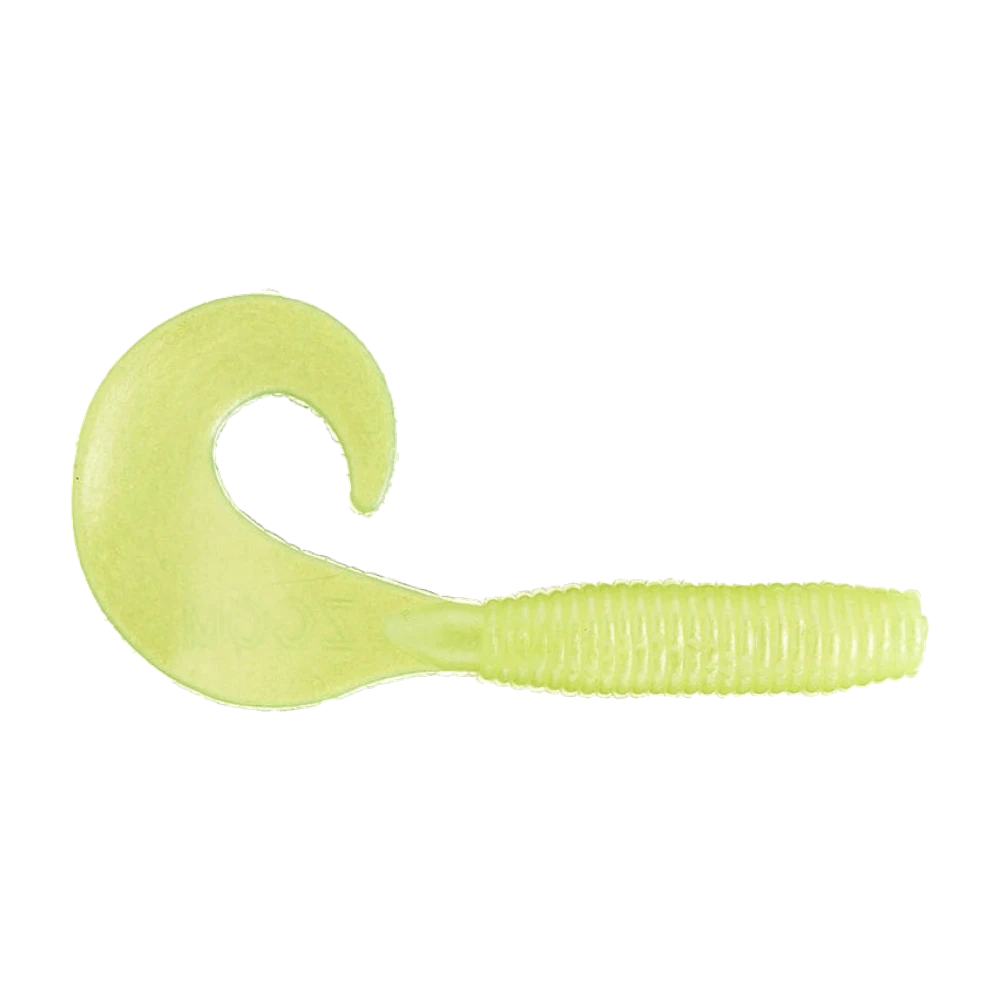
Zoom calls the Fat Albert a thick-profile grub with a high-action tail, and for once the copy matches what you see. In the product photo, the looped tail takes up almost as much length as the body: it is broad, flat, clearly larger than you would expect on a three-inch grub, and the brand's logo is moulded into it in relief.
The body carries wide, deep ribs — nothing like the fine, tightly packed ridges of a finesse worm such as the Zoom Curly Tail Worm. Those ribs do two things Zoom mentions: they visually thicken the profile and add texture, meaning something for a fish's jaws to clamp on. In the water they also churn a little, adding quiet turbulence right in front of the tail.
The brand says the tail kicks as soon as the bait hits the water. That is believable given the surface area: a loop this wide needs no speed to engage, the descent alone sets it turning.
As a trailer: what changes with each host lure
This is the use Zoom puts first, and it is what justifies the stubby body.
Behind a jig
A bare jig is a skirt and a hook. Add a Fat Albert and you get three things at once: volume, a tail that works constantly, and a slower fall. That last point is the most useful and the least discussed — a big-tailed grub slows a 10 or 14 g jig on the drop, which gives the fish time to watch it come down. On a football jig dragged over hard bottom the tail also turns during the pull, where a craw-style trailer tends to sit inert between hops.
Behind a spinnerbait
Here the job changes: not braking but lengthening and thickening. A mid-size spinnerbait gains two or three centimetres of silhouette, which makes it credible when the forage is bigger than the blades suggest. Watch the balance, though: a trailer that overhangs too far makes the lure roll at speed. Thread the grub on dead straight, with no twist, and retrieve a touch slower.
Behind a buzzbait
Buzzbait fishing remains a niche in Europe, but if you do it, the Fat Albert earns its place: the extra volume helps the lure climb to the surface faster and stay there at lower speed. That is exactly what a bare buzzbait lacks early and late in the season, when fish won't commit to a fast pass.
Soft and salted: the benefit and the bill
Zoom makes a point of its super-soft, salt-impregnated plastic and draws a commercial conclusion from it — fish hold on longer. The claim is plausible, but it comes with a trade-off the description never spells out.
Very soft plastic tears faster, and salt makes it worse by weakening the material around the hook point. On a trailer that matters twice over: the grub absorbs short strikes, refusals and stray weed. Ten per bag is generous for a bait fished alone, much less so for a consumable trailer. Take two bags for a full day, or compare with an elastomer grub like the Z-Man GrubZ, which survives dozens of fish but does not "give" the same way in a fish's mouth.
The salt also has a mechanical effect worth planning for: it makes the plastic denser than water. A Fat Albert fished alone therefore sinks with no added weight, and a salted trailer partly offsets its own volume by speeding the fall back up. Zoom publishes no per-piece mass, and you hardly need one while using it as a trailer — but if you want to fish it alone, weigh one once so you know what you are casting.
Before threading the grub on, warm the hook shank between your fingers for a few seconds and push it on in one decisive move. A grub threaded in several attempts ends up full of micro-holes and tears on the third fish. It sounds trivial, and it doubles the life of the bag.
Not sure what to tie on?
Photograph your spot: CarnaFish reads the scene, cross-checks the conditions and gives you the zone, the lure and the retrieve. Free on iOS and Android.
Fished alone, it's a perch bait
The Fat Albert is designed as a trailer, but it works very well on its own on a 3-10 g round jighead, and that is probably its best use for a European angler. A 7.5 cm grub with a big tail, retrieved slowly over gravel or along riprap, is one of the most reliable presentations in existence for perch — and its thick body makes it more visible than a standard grub when the water carries colour.
The advertised three inches is exactly 7.62 cm. That is total length, tail included: since the loop takes up nearly half of it, the body proper is barely four centimetres. In other words you add a lot of signal for very little length, which is precisely what a trailer is for. The second figure in the spec table, 10, sits under the "Quantity" header: it is the piece count per bag, not a mass.
The classic mistake: threading it crooked
A grub threaded in a spiral, or whose tail sits out of line with the host lure, will spin on the retrieve. The symptom is easy to spot: the line twists, the lure rises at an angle and the bites stop. Always check that the tail comes out in the vertical plane, loop down or loop up as you prefer, but never sideways. On a spinnerbait, swim it at your feet before making a long cast.
Colour by water clarity
Zoom mentions "proven color combinations" without naming a single one. In the photo the finish is an opaque, even chartreuse with no flake — a visibility tone, not an imitation.
- Stained or coloured water: that chartreuse, or an opaque white. On a trailer the aim isn't to imitate but to give a following fish a reference point behind the jig skirt.
- Clear water: pearl white or a translucent flake, more believable under hard sun, especially on a jighead fished alone.
- Hard bottom, average clarity: a natural green-brown, which lets the host lure lead the silhouette instead of fighting it.
Picking the right trailer counts for nothing if the jig lands on the wrong zone, and that is exactly where CarnaFish helps: a photo of the spot, and the app suggests a zone, a depth and a presentation suited to the day's conditions. For tackle and spot-reading fundamentals before investing in a box of jigs, our beginner's guide to bass fishing starts from scratch.
Key takeaways
- The looped tail accounts for almost half of the stated 7.6 cm: lots of signal, very little added length.
- As a jig trailer, the main effect is not volume but the slower fall, which gives fish time to react.
- Very soft, salted plastic: good hold in the mouth, but fast wear, and ten per bag goes quickly.
- Fished alone on a 3-10 g jighead, it is an excellent perch bait over riprap or gravel.
FAQ
Is the Fat Albert Grub fished alone or only as a trailer?
Zoom presents it as a jig, spinnerbait and buzzbait trailer, but it fishes very well alone on a 3-10 g round jighead. That is in fact its most common use in Europe, particularly for perch.
Why does my spinnerbait spin since I added this grub?
Almost certainly because it is threaded crooked. The tail must exit in line with the lure, never sideways, and the body must carry no twist along the shank. Swim it at your feet before making a long cast.
Is this grub durable?
No, and that is deliberate: Zoom claims a super-soft, salt-impregnated plastic, which helps fish hold on but speeds up wear. Budget one or two grubs per hour of active fishing, or switch to an elastomer such as the Z-Man GrubZ if the attrition annoys you.
How many grubs come in a bag?
Ten. The spec table reads 3" 10 under a "Length Quantity" header: the second figure is a piece count, not a weight.
What jig weight pairs best with a Fat Albert?
From 7 to 14 g covers most situations. The heavier the jig, the more the tail's braking effect matters: on a 14 g jig in deep water is where you feel most clearly what the grub adds on the drop.
What colour should I use in dirty water?
The opaque chartreuse from the photo, or an opaque white. On a trailer the goal is to give a following fish something visible behind the skirt, not to imitate prey faithfully.
The full bass lure guideSeason-by-season strategy: which family of lure, when, and why.Go from theory to fish
CarnaFish reads your spot from a photo and gives you the game plan: zone, lure, retrieve. Free on iOS and Android.