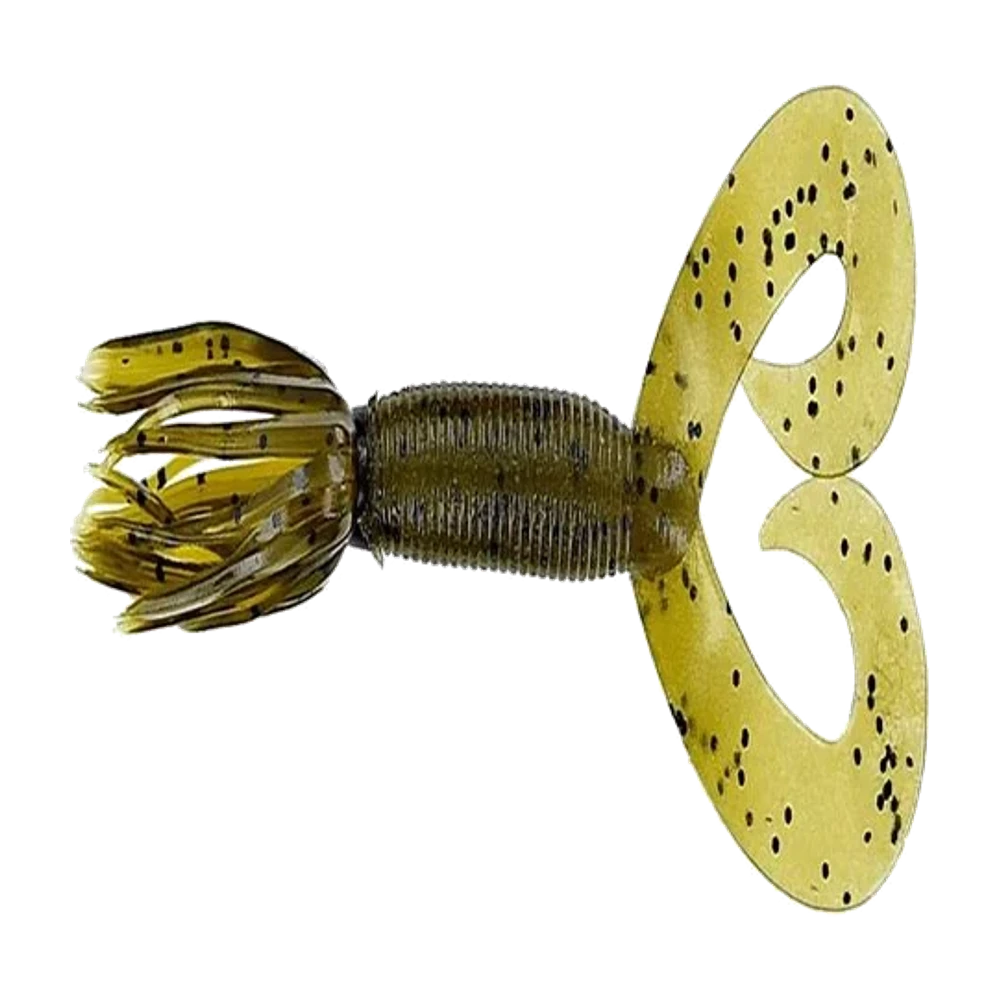
Gary Yamamoto Double Tail Hula Grub: two tails that turn into claws
The right lure in the wrong spot still catches nothing. CarnaFish spots the zone that works, from a single photo.
A rocky bottom between three and six metres, an even slope, no weed, no timber. It's a scene that inspires nobody: nothing catches the eye, there's no obvious target to aim at, and most anglers cross it in two casts before heading off to a more photogenic bank.
That's exactly where the crayfish live, though, and therefore the biggest bass in the lake for a good part of the year. The problem isn't knowing where they are, it's presenting them something that holds up over that kind of bottom for several minutes at a stretch, without snagging and without looking like a lure.
The Double Tail Hula Grub is built for that, and its geometry is dedicated entirely to one thing: what it shows while being dragged, slowly, over rock.
Two tails that aren't there to swim
A standard grub has a curly tail that spins and creates vibration. The Hula Grub doesn't play that game: its two tails are flat, wide at the base, and they work in a completely different register.
- Under tension, they spread and undulate sideways, slowly and widely, without ever spinning.
- At rest, they stand up. Sitting on the bottom, the bait presents two raised, spread appendages — the silhouette of a crayfish in a defensive posture, seen from above or from the side.
- They flare when it clears an obstacle, producing a brief, disorderly movement at the exact moment the bait tips over a rock.
That third point is what makes the difference in use. On a cobble bottom the bait is constantly bumping and tipping, and at every bump the two tails set off in a different direction. You get a continuous, irregular action you'd be incapable of reproducing deliberately.
A moulded skirt that replaces the skirted jig
The ringed collar at the front of the body isn't decorative. It plays the part of a silicone skirt: it increases apparent bulk without adding mass, it slows the fall very slightly, and it keeps moving when everything else is still.
The practical consequence: you don't need a dressed jig. A plain lead football head on this bait gives you a complete package. It's cheaper, easier to match up, and the silhouette is slimmer than a conventional jig — which counts in clear water and on pressured fish.
It works as a trailer on a proper jig too, but the result gets bulky. Save that rig for stained water or for hunting very big fish.
The retrieve: drag it, never reel it
- Cast up the slope and let it sink on a semi-slack line. Count: the depth at which it makes contact gives you the bottom profile, cast after cast.
- Set the rod at ten o'clock and move the bait by sweeping the rod slowly sideways, a metre over three or four seconds. The reel is only there to pick up the slack.
- Set it down and wait three to five seconds. The tails stand up, the skirt keeps breathing.
- When you feel a rock, don't pull. Give a little slack, let the bait tip over it and fall down the other side. That's the most productive phase.
- Work back up the slope if nothing happens, and fish the same zone in the other direction: a bait dragged downhill doesn't show the same silhouette as one dragged uphill.
On the water: you have to feel the nature of the bottom at all times. If you can't tell sand from gravel through the rod, your weight is too heavy or your rod too soft — and you'll miss half your bites, which here register as a simple sensation of added weight, never as a sharp knock. A bass eating a crayfish picks it up, it doesn't hit it.
Size, weight and how the plastic holds up
| Size | Weight | Ground |
|---|---|---|
| 4 in | 5 to 7 g (football head) | 1 to 3 m, clear water, average fish |
| 4 in | 10 g | Wind, drifting from a boat, 3 to 5 m |
| 5 in | 10 to 14 g | 4 to 8 m, hunting big fish |
| 5 in | jig trailer 10 to 21 g | Stained water, dead timber, bulk on purpose |
| 4 or 5 in | Carolina, 14 to 28 g weight | Big flats, slow searching at distance |
The football head is the reference rig over rock: its wide shape stops it wedging between two stones and keeps it flat, which a round head does not.
Yamamoto plastic is very heavily salted. That gives you a dense bait that sinks fast even unweighted and transmits bottom detail well. A fish taking it in doesn't meet a rigid material, which lengthens how long it holds on.
The flip side is that it's soft and fragile. Over rock, expect two to three fish per bait, sometimes fewer. Two habits limit the damage: always fit a small rubber stop or a drop of glue at the collar, and straighten the bait on the hook after every bite, even a missed one. A grub sitting crooked spins on itself and twists your line.
Not sure what to tie on?
Photograph your spot: CarnaFish reads the scene, cross-checks the conditions and gives you the zone, the lure and the retrieve. Free on iOS and Android.
Where not to use it
- Dense weed: the two tails collect everything, even on a Texas rig.
- Very coloured water: its signal is slow and subtle, a strongly vibrating bait finds fish faster.
- Active fish in open water: you're fishing the bottom, so you're passing underneath them.
- Fast searching: at this pace a spot takes five minutes to fish, not thirty seconds.
Hula Grub or moulded crayfish
The Savage Gear 3D Crayfish bets on static realism: a credible crayfish silhouette that stands up to inspection from a fish in clear water, but very little movement of its own. The Hula Grub does the opposite — it looks like nothing in particular when still, but it moves constantly, at every rock, at every slack line. Over an irregular bottom dragged for ten minutes, that continuous movement wins.
So the choice is made on the spot rather than the species: located fish in clear water and a static presentation for the moulded crayfish, slow searching of a rocky slope for the Hula Grub. On a Carolina rig, the latter has virtually no equal for combing a big deep flat.
From the same brand, the Yamamoto Senko 5 covers the other side of the catalogue, the slow fall and margin fishing. Our beginner's guide to bass fishing explains when to switch from the bank to the bottom. And if you're unsure which rig to use in front of a rocky slope, CarnaFish reads a photo of the spot and answers for you.
Key takeaways
- The two tails don't spin: they undulate under tension and stand up like claws at rest.
- The moulded collar replaces a jig's skirt — a plain football head is enough.
- You drag it with the rod, a metre every three or four seconds, never with the reel.
- The bite is a sensation of weight, not a sharp knock. Keep bottom contact at all times.
- Fragile over rock and unusable in dense weed.
FAQ
How do you fish a Double Tail Hula Grub?
By dragging it slowly along the bottom, rod held horizontal, a metre every three or four seconds, with pauses of three to five seconds. The reel is only there to pick up slack between sweeps.
Which jig head should I use?
A football head, whose wide shape stops it wedging between stones and keeps it flat. Figure 5 to 7 g down to three metres, 10 to 14 g beyond that or as soon as there's wind.
Do I need to rig it on a skirted jig?
Not necessarily: its moulded collar already acts as a skirt. Rigging it on a skirted jig is still worthwhile in stained water or when hunting very big fish, at the cost of noticeably more bulk.
What's the difference between the 4 and 5 inch?
The 4-inch is the default in clear water and for average fish. The 5-inch sinks faster, is easier to feel beyond four metres and sorts for bigger fish, at the cost of a few bites.
How do you recognise a bite while dragging?
By a sensation of added weight, or by the line moving gently off to one side. A bass picks up a crayfish instead of hitting it: there's almost never a sharp knock, and waiting for one means missing most of your fish.
Does the bait wear out quickly?
Yes, over a rocky bottom. The heavily salted plastic is soft and not very durable: expect two to three fish per bait. A rubber stop or a drop of glue at the collar extends its life noticeably.
The full bass lure guideSeason-by-season strategy: which family of lure, when, and why.Go from theory to fish
CarnaFish reads your spot from a photo and gives you the game plan: zone, lure, retrieve. Free on iOS and Android.