Zoom Super Speed Craw: the wide claws that brake the fall
The right lure in the wrong spot still catches nothing. CarnaFish spots the zone that works, from a single photo.
A laydown, two metres of water, late afternoon in May. You drop the jig half a metre off the trunk, let the slack come tight, and do nothing else. It is during that descent — three seconds at most — that everything is decided, and it is the trailer's claws, not the jig, that determine whether a fish lifts off the bottom. The Super Speed Craw was built to fill those three seconds.
Wide claws, and what that changes on the fall
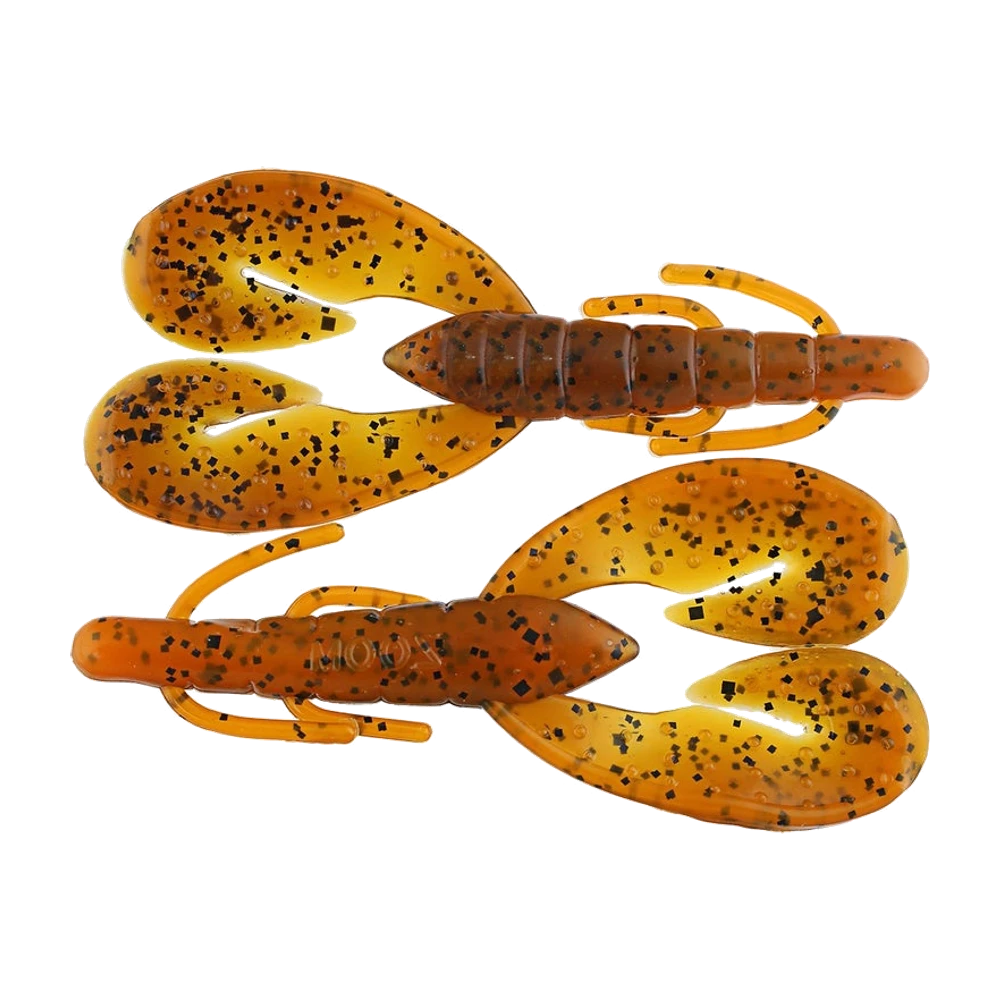
The most obvious thing in the product photo is the disproportion: the two flat claws are nearly as long as the abdomen and clearly wider than it. These are not realistic crustacean pincers, they are two oval paddles. Zoom advertises claws that are extra-wide and bulkier at the ends compared to the original Speed Craw. You can see the width; you cannot see the thickness — a top-down photo does not let you judge that, and this is an observation from a product photo, not a specification.
The mechanics are simple and worth dwelling on. A flat surface presented against the direction of the fall brakes. Two large flat claws therefore give you a bait that sinks more slowly than a streamlined body of the same weight, and whose descent is never straight: with each acceleration the claws fold back then reopen, and the bait wanders. That is what Zoom calls moving a lot of water. The phrasing is a sales line, the mechanism behind it is real.
There is a flip side, and it is worth knowing before you buy: that braking is paid for in depth reached. On a six-metre spot with a bit of wind, a big-clawed trailer forces you up in weight to keep contact, which cancels out part of the benefit. Keep the Super Speed Craw for shallow spots, margins and cover, and switch to a compact trailer when you go deeper.
What sets it apart from the original Speed Craw
Zoom presents it explicitly as a variation on the Speed Craw, with the claw shape as the only stated difference. There is no comparison table, no published weight, no measurement of either version: all you have is the brand's statement. In practice the Zoom Ultra Vibe Speed Craw and this Super Speed Craw occupy two different slots in the box. The first relies on ribbed appendages that vibrate as they move; the second relies on pure surface area and on the fall. Owning both is not duplication, it is two sink rates.
The body itself keeps the same philosophy: an abdomen segmented into pronounced rings, a back darker than the claws, four thread-like legs and two long antennae. The segments are not decoration: they form hinges that let the body bend around a Texas-rigged hook without losing its straightness once released.
Its first job: jig trailer
This is the use Zoom lists first and the one where the bait makes most sense. A 7 to 14 g jig, the Super Speed Craw threaded up to the keeper collar, and you get a package that sinks slowly while flapping. Claw orientation is the only real decision to make: rigged flat, claws parallel to the bottom, they maximise lift and the fall slows right down; rigged vertically, edge up, they flap more sharply but brake less. Start flat — that is the setting that forgives most.
Shorten the body if the overall profile gets too long: trim one or two rings from the front of the abdomen rather than cutting the claws, which are the whole point of the bait. The same body works behind a bladed jig, where it beats a skirt on fish that follow without committing.
Salt, and what it actually implies
Zoom impregnates its plastics with salt and says so: the stated argument is that fish hold the bait longer. That is a brand claim, impossible to verify precisely, but salt does have two measurable effects. It makes the plastic heavier, so the bait sinks on its own even unweighted — useful for a free-fall presentation, a nuisance if you wanted a floating trailer to lift the back of a jig. And it softens the material, so the bait tears faster: over a day of flipping, count one body per serious fish, sometimes two fish per body if you slide it back up in time.
Never store a salted Zoom in the same compartment as a painted hard bait or another brand's plastic. The plasticiser migrates, attacks the paint and welds bodies together — the original resealed bag is still the best storage box there is.
Texas rig, flipping and margins
On a weighted Texas rig, a 5 to 14 g tungsten depending on cover density, pegged or free. Pegged against the bait, the whole thing punches through moderate vegetation as one unit; left free, the weight drops first and the bait follows on a glide, which stretches the fall out further. Flipping laydowns, docks and weed edges remains the main playing field, exactly as it is for a Zoom Brush Hog — the difference is in the signal: the Brush Hog waves a lot of thin appendages, the Super Speed Craw sends out two big slow pulses.
A stripped-down version exists too, on a 3 to 7 g jighead, worked in short hops in contact with the bottom with long pauses. On hard bottom in clear water, that often outfishes a full skirted jig.
A useful note: Zoom publishes no weight for this bait. The dealer's table stops at the length and the number of pieces per pack — eight — which is a pack count, not a weight. If you need the figure to work out your sink rate, a kitchen scale settles it in ten seconds.
Not sure what to tie on?
Photograph your spot: CarnaFish reads the scene, cross-checks the conditions and gives you the zone, the lure and the retrieve. Free on iOS and Android.
Colours and water clarity
Zoom gives no colour name at all, only a range of house patterns. The sample photographed is translucent orange-brown, loaded with black and copper flake, with a back noticeably darker than the claws — an observation from a product photo.
- Stained water: exactly that flaked orange-brown finish, which picks up the tone of a moulting crayfish and stays readable without shining.
- Clear water: the dark greens of the green pumpkin family, more discreet, and the better bet on fish under heavy angling pressure.
- Dark water or low light: black and blue, which is not trying to imitate a colour but to cut a clean silhouette seen from below.
The mistake that costs bites
Working it during the fall. It is the hardest reflex to lose: you drop the bait, then pull straight away because you want to feel something. Yet the Super Speed Craw is precisely a bait whose useful phase is the passive descent, on a semi-slack line with the rod still. Watch the line rather than hunting for the bite by feel — with this kind of presentation, most takes are seen before they are felt.
The right trailer is worthless if the spot is badly chosen, and that is exactly where CarnaFish helps: a photo of the swim, and the AI suggests the zone, the depth and the kind of presentation that suit the day's conditions. To go back over tackle and typical swims before fine-tuning rigs, our beginner's guide to bass fishing covers the essentials.
What to remember
- Two large flat claws brake the fall and make it erratic: that is the whole point of the bait, and its limit in deep water.
- Zoom separates it from the Speed Craw by claw shape alone, with no comparative data published.
- The salted plastic makes the bait sink unaided and makes it fragile: stock up, one body does not always survive two fish.
- The phase that catches fish is the passive descent, not the hop that follows.
FAQ
How is it different from the standard Speed Craw?
Zoom advertises claws that are wider and bulkier at the ends, and nothing else. No comparative data is published, neither weight nor claw measurement, so you are left with the brand's statement and what the photo shows.
How much does a Super Speed Craw weigh?
The manufacturer does not say: the size table stops at the 4 in length and the pack count of eight pieces. That eight is a number of baits, definitely not a weight.
Which jig should I put it on?
A flipping or football jig of 7 to 14 g works well. Thread the body up to the keeper, claws flat to slow the fall as much as possible, and trim one or two rings off the abdomen if the package gets too long.
Does it sink on its own without a weight?
Yes, the plastic is salt-impregnated and therefore denser than water. That is useful for a free fall along a margin, but it rules it out as a floating trailer meant to lift the back of a jig.
Does it hold up to teeth?
No, and that is the accepted trade-off of soft salted plastic: it tears after one or two fish, sometimes on the first missed hookset. Slide it back up the hook as soon as the body slips and you buy a few more casts.
Is it a good choice in deep water?
Not really. The big claws slow the descent, which forces you up in weight to keep contact beyond five or six metres. On those spots a compact trailer does a better job.
The full bass lure guideSeason-by-season strategy: which family of lure, when, and why.Go from theory to fish
CarnaFish reads your spot from a photo and gives you the game plan: zone, lure, retrieve. Free on iOS and Android.