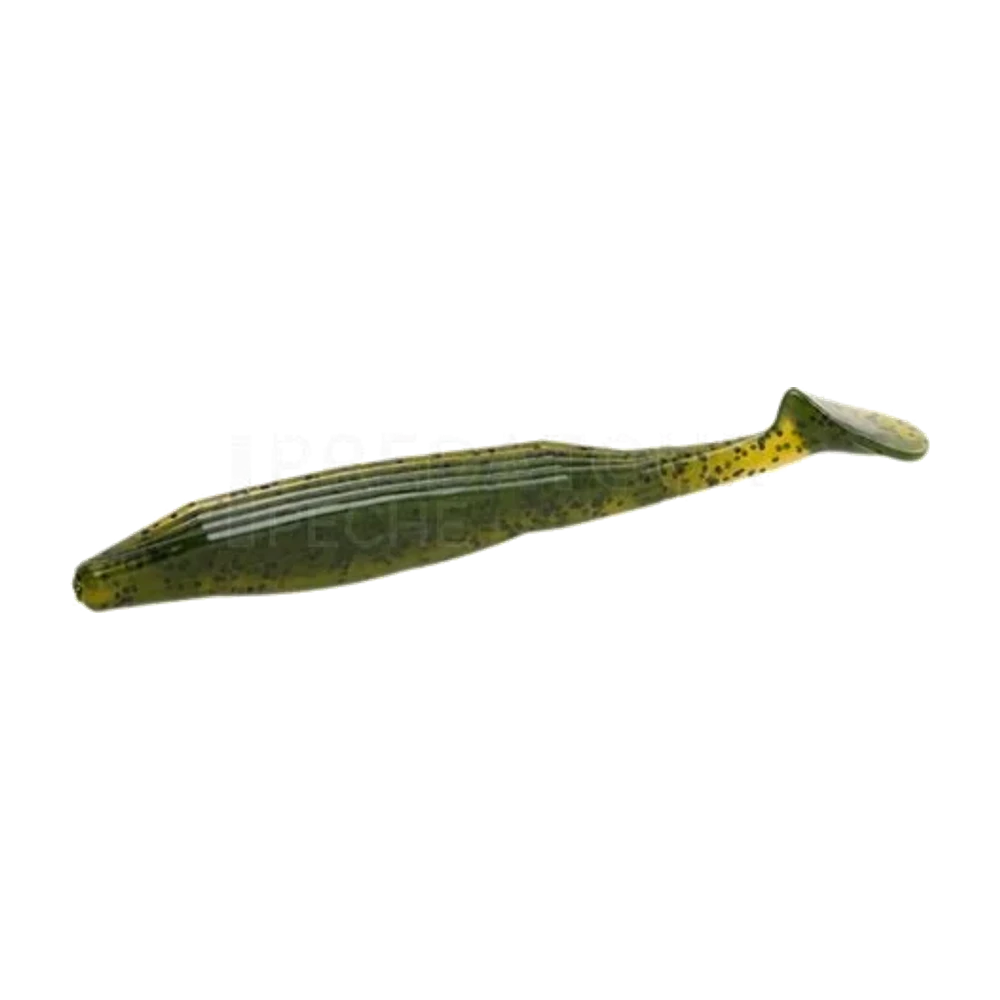
Zoom Swimmin Super Fluke: the fluke that swims on its own
Rather not fish it blind? Photograph your spot — CarnaFish cross-checks the conditions and points you the right way.
The classic fluke is an excellent bait with one practical flaw: it does nothing if you do nothing. With no rod work, it is a tapered piece of plastic travelling in a straight line. All of its effectiveness rests on sequences of twitches you have to produce non-stop, with a consistency that wears you out by the end of the day and becomes impossible to hold when you are fishing four straight hours of shoreline.
The Swimmin version fixes that by adding a paddle tail to the end of the body. Nothing else changes — same silhouette, same material, same dorsal slot for the Texas rig. But that single modification transforms how you fish the bait: it becomes a proper shad, able to work on a simple straight retrieve.
It is less spectacular than a well-worked fluke darting around, but it is far more usable over a long session.
What the paddle tail actually adds
- A self-sufficient action. The tail catches the water, drives the body, and triggers a steady kick from one slow turn of the handle. You can fish without lifting the rod once.
- A lateral line signal. The classic fluke is an almost purely visual bait. With a paddle tail, it puts out a detectable water displacement, which changes everything in lightly stained water or at the end of the day.
- A stabilised path. Paradoxically, the tail limits the veering: the bait tracks straighter, even at speed, whereas a tail-less fluke easily spins if you wind too fast.
- A slowed descent. At rest, the tail brakes the fall and keeps vibrating. The bait drops more slowly and flatter than a smooth fluke of the same weight.
In exchange, the paddle tail costs something: the erratic darting. A classic fluke twitched hard breaks violently one way then the other, with unpredictable direction changes. The Swimmin version does the same thing in a far more damped way. That is the real trade-off between the two models.
The three rigs that cover everything
| Rig | Weight | Layer fished | Typical use |
|---|---|---|---|
| Unweighted swimbait hook | 0 g | 0 to 50 cm | weed edges, high fish |
| Weighted swimbait hook | 3 to 5 g | 50 cm to 2 m | all-round, the most used |
| Heavy weighted swimbait hook | 5 to 7 g | 2 to 4 m | drop-offs, zander, wind |
| Round jig head | 5 to 10 g | bottom | zander on a bottom-scraping retrieve |
The benchmark rig is still the weighted swimbait hook rigged Texas style, point in the dorsal slot. It lets you go through weed and wood without hanging up while keeping the bait perfectly straight.
One rigging detail that makes a real difference: check that the bait is threaded on dead straight. A fluke rigged off-centre, even by two millimetres, spins the moment you speed up and ruins the action. Take it off and rig it again rather than trying to straighten it with your fingers.
On the water: if the bait starts spinning on itself, do not slow down — take it off and rig it straight. Nine times out of ten the spin comes from an off-centre rig, not from excessive speed. A spinning bait catches nothing and twists your leader into the bargain.
The retrieve: simplicity as the selling point
- Cast and let it sink as long as it takes to reach the target layer, line semi-tight.
- Retrieve straight, slowly, just fast enough to feel the tail working through the rod tip.
- Every six to eight seconds, mark a one to two second stop. The bait noses down slightly, then picks its swim back up.
- On bass along the bank, add a short twitch now and then: you recover part of the classic fluke's darting effect without having to work it constantly.
- On zander with a bottom-scraping retrieve, go to a jig head, wind slowly enough to touch the bottom every three or four turns, and set on the slightest unusual resistance.
That last application is often underrated: a 12 cm soft shad wound slowly in contact with hard bottom is a classic zander presentation, and the Swimmin Fluke's tail works exactly in the speed range that suits this fish.

Not sure what to tie on?
Photograph your spot: CarnaFish reads the scene, cross-checks the conditions and gives you the zone, the lure and the retrieve. Free on iOS and Android.
Where it wins, and where the classic fluke stays ahead
Pick the Swimmin version when:
- You are covering water for a long time and want fishing that does not wear you out.
- The water is lightly stained and a lateral line signal becomes useful.
- You are fishing deep, where twitching is hard to control.
- You are after zander, a fish that responds better to a steady swim than to violent darts.
- Wind is putting a belly in your line, which makes darting imprecise.
Stay with the classic version when:
- Bass are feeding on the surface and the fleeing-baitfish effect is the trigger.
- The water is very clear and calm, on educated fish where any vibration is suspect.
- You want an ultra-slow gliding fall, typically under a low branch.
Swimmin Fluke or Super Fluke
The Zoom Super Fluke is a bait you work. It demands continuous rod work and rewards a precise touch with paths nothing else reproduces. It is the right call on active fish, on top, when imitating a panicking baitfish is what triggers.
The Swimmin version is a bait you retrieve. It asks less, it delivers a steadier result, and it opens two areas the classic fluke covers badly: depth and lightly stained water. Plenty of bass anglers keep both in the same box and switch according to the activity they see rather than according to the spot.
Against a conventional shad like the Keitech Easy Shiner 4, the Swimmin Fluke keeps the advantage of the fluke's tapered silhouette, less bulky and closer to a long baitfish, where the Easy Shiner presents a fuller body and a rollier swim.
Our beginner's guide to bass fishing covers the moments when a straight retrieve beats working the rod. And if you are torn between the two versions when you reach the bank, CarnaFish analyses a photo of the spot and answers.
Key takeaways
- The paddle tail makes the bait self-sufficient: it swims on a straight retrieve with no rod work at all.
- It adds a lateral line signal and slows the fall, but removes the erratic darting.
- Benchmark rig: a 3 to 5 g weighted swimbait hook, Texas style in the dorsal slot.
- A bait threaded off-centre spins: take it off and rig it again rather than fixing it by hand.
- For zander, wind slowly enough to touch the bottom every three or four turns.
FAQ
What is the difference with the classic Super Fluke?
The Swimmin version carries a paddle tail that triggers a self-sufficient swim on a straight retrieve. The classic fluke has no paddle tail and demands constant twitching, but in exchange it produces erratic darting the swimming version does not reproduce.
Do I need to work the Swimmin Fluke?
No, not necessarily. A slow straight retrieve is enough to make it work. One to two second stops every six to eight seconds, and a few short twitches on bass, improve the return without being essential.
What hook should I use?
A swimbait hook with a built-in weight, rigged Texas style in the dorsal slot, 3 to 5 g for all-round use. That rig keeps the bait straight and lets it go through weed and wood without hanging up.
Why is my bait spinning on itself?
Almost always because it is threaded off-centre on the hook. Even a two-millimetre offset is enough to make it spin as soon as you speed up. Take it off and rig it properly centred rather than slowing down.
Does it work for zander?
Yes, that is one of its good uses. On a 5 to 10 g round jig head, wound slowly in contact with hard bottom, it offers exactly the steady swim zander respond to best.
Which version in stained water?
The Swimmin version. The classic fluke is an almost exclusively visual bait, whereas the paddle tail adds a water displacement the lateral line can detect, which stays usable when visibility drops.
The full bass lure guideSeason-by-season strategy: which family of lure, when, and why.Go from theory to fish
CarnaFish reads your spot from a photo and gives you the game plan: zone, lure, retrieve. Free on iOS and Android.