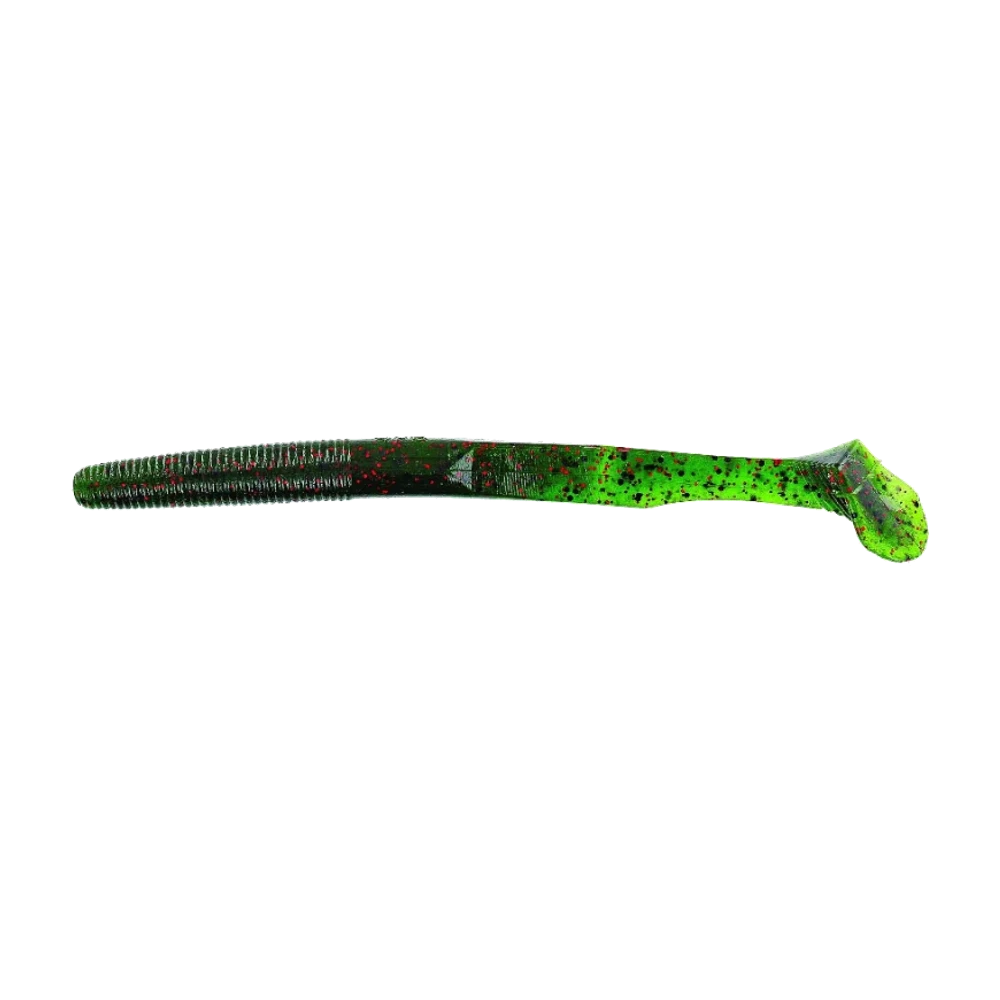
Gary Yamamoto Swim Senko: a Senko you can finally retrieve
One lure, endless conditions. CarnaFish reads your spot from a photo so you are not just guessing.
The standard Senko has a flaw nobody really owns up to: it does nothing on the retrieve. Its fall is remarkable, but the moment you start reeling it turns back into a plastic stick crossing the water with no signal at all. In practice that means you only use a third of every cast — the descent — and waste the other two thirds dragging a dead bait back.
On a spot you know well, that's fine: you cast accurately, you use the fall, you cast again. On three hundred metres of bank to sweep, it becomes a serious waste of time.
The Swim Senko fixes exactly that by adding a paddle tail to the original salted body. The fall is still a stick bait's fall — that's the essential part — but the way back becomes a fishing phase in its own right. You aren't replacing your Senko: you're recovering the half of every cast that used to do nothing.
What the tail actually changes
It's worth being precise, because bolting a tail onto a stick bait is not a neutral move.
What is kept. The body retains the Senko's density and salt loading: the fall is still slow, and the side-to-side shimmy of the body on the way down is still there. That shimmy, produced by the softness of the plastic rather than by any particular shape, does most of the work on a settled fish.
What is added. On a straight retrieve, the tail kicks and passes a roll through the body. You get a genuine soft shad, with a slow, rolling action that puts out a continuous signal.
What is altered. The tail slows the descent slightly and stabilises it: the bait sinks a little more slowly, flatter, and shimmies a little less than the original Senko. On an extremely wary fish in very clear water, that difference shows. It's the price of versatility, and it's real.
What you get as a bonus. During the fall, the tail keeps kicking instead of hanging dead, so you have a second moving point on top of the body shimmy, which increases visibility at range.
The retrieve: using both phases in one cast
The right approach gives up neither the fall nor the retrieve.
- Cast past the spot and let it sink on a semi-slack line, following the line with your eyes. That first fall is your best chance at a fish holding on the structure.
- Wait for bottom contact or the depth you want, five to fifteen seconds depending on the weight.
- Start a slow straight retrieve, just fast enough to feel the tail working in the rod tip. Thirty to forty centimetres per second is plenty.
- Pause every three or four seconds. The bait drops back shimmying, and that break is the most triggering moment of the sequence.
- Restart sharply after each pause, with a quick half turn of the handle.
- Carry on to your feet, keeping the same rhythm.
On fish feeding at the surface there's an effective variation: rigged weightless on a Texas hook, the bait fishes fifteen centimetres down on a continuous retrieve, no pauses at all, just letting the tail work. It's clean, it comes through weed, and it lands in holes a treble-hooked bait can't reach.
On the water: when you alternate fall and retrieve within the same cast, make a mental note of which phase produced the bite. Over a session that tally tells you everything: if it all comes on the fall, the fish are settled and you should be making lots of short casts at structure. If it all comes on the retrieve, they're active and hunting, and you'd be better off switching to a faster bait to cover more ground.
Rigs and working ranges
| Rig | Weight | Depth | Situation |
|---|---|---|---|
| Weightless Texas | none | 0 to 1 m | Weed, lily pads, high fish, very slow fall |
| Weighted Texas | 3 to 7 g | 1 to 3 m | Margins, drowned timber, the most versatile rig |
| Weighted swimbait hook | 3 to 10 g | 1 to 3 m | Clean retrieve at constant depth, big exposed hook |
| Finesse jig head | 5 to 10 g | 2 to 4 m | Hard bottom, drop-offs, deeper searching |
One detail that matters: salted plastic is heavy and fragile. It tears faster than standard plastic, especially where the hook goes through. A spring keeper or a drop of glue on the hook eye extends the life of a bait considerably. Buy plenty: this is not a twenty-fish bait.
For line, a 0.22-0.28 mm fluorocarbon leader depending on the cover. If you're fishing lily pads, go to straight braid with a weightless Texas rig.
Not sure what to tie on?
Photograph your spot: CarnaFish reads the scene, cross-checks the conditions and gives you the zone, the lure and the retrieve. Free on iOS and Android.
Where it wins — and where the Senko is still better
Its window:
- Long margins to sweep, where you want to keep casting without losing the way back.
- Weed beds and lily pads, where a weightless Texas comes through anything and the tail puts out a signal without needing speed.
- Active fish in early season and autumn, which respond to movement but still react to a slow fall.
- Lightly stained water, where the tail's continuous signal makes up for the loss of visibility.
The standard Senko stays better in three cases. In very clear water on pressured fish, where the pure shimmy without a tail is finer and less suspicious. In sight fishing, where the slowest possible fall is what counts. And on a wacky rig, which relies on the body folding in the middle — a rig the tail makes less coherent.
Swim Senko or standard Senko
The Yamamoto Senko 5 is still the benchmark for a pure fall, with the finest shimmy in the family. Pick it when you're fishing a precise point and you accept that the way back is wasted. The Yamamoto Fat Senko pushes bulk and slow descent even further, for fish that want a big motionless mouthful.
The Swim Senko doesn't replace either one: it fills the gap those two leave, the cast that has to earn its keep from end to end. If you can only take one bait for a session sweeping the margins, this is it. If you already know where the fish are and you can afford to fish slowly, take the original Senko. And against a conventional soft shad like the Keitech Swing Impact 4, the difference comes down to the fall: the Keitech swims better and faster, the Swim Senko drops better.
Our beginner's guide to bass fishing explains how to chain searching and finesse fishing in the same session. And if you're torn between the fall and the retrieve when you reach a weedy margin, CarnaFish reads a photo of the spot and answers for you.
Key takeaways
- The tail makes the cast pay from end to end: the way back becomes a fishing phase.
- The Senko fall is kept, but slightly slowed and stabilised by the tail.
- Alternate fall and retrieve within the same cast, with a pause every three or four seconds.
- Note which phase produced the bite: it's your best read on how active the fish are.
- The standard Senko is still ahead in very clear water, in sight fishing and on a wacky rig.
FAQ
What does the tail change compared with a standard Senko?
It makes the bait retrievable: on a straight retrieve, the tail kicks and passes a roll through the body, where the Senko produces nothing. In exchange, it slows and stabilises the fall slightly, so the pure shimmy is a little less refined.
Does it need weight?
Not necessarily. Weightless on a Texas hook it fishes between the surface and a metre, which is perfect in weed. A 3 to 7 g weight becomes useful as soon as you need to reach two or three metres or fish in wind.
How fast should I retrieve it?
Slowly, just fast enough to feel the tail working in the rod tip, around thirty to forty centimetres per second. Pause every three or four seconds to let the bait drop back shimmying — that's the most effective break in the sequence.
Does this bait replace the standard Senko?
No, it complements it. The Senko is still better on a precise point, in very clear water, in sight fishing and on a wacky rig. The Swim Senko takes over as soon as you have to sweep a margin and make every cast count all the way through.
Why do my Swim Senkos tear so fast?
Because salted plastic is dense and fragile, especially at the hook point. A spring keeper on the hook shank or a drop of glue at the head of the bait extends its life noticeably, but it will never be a twenty-fish bait.
Which size should I choose?
The middle size around 11 cm covers most bass situations. Drop to the shorter sizes in very clear water or on wary fish, and go longer when the fish are feeding on big baitfish in autumn.
The full bass lure guideSeason-by-season strategy: which family of lure, when, and why.Go from theory to fish
CarnaFish reads your spot from a photo and gives you the game plan: zone, lure, retrieve. Free on iOS and Android.