Zoom Winged Fluke: the soft jerkbait that glides down on its wings
Not sure this lure fits YOUR spot today? CarnaFish tells you in 10 seconds, from a photo.
There is a precise moment over a school of baitfish when a straight retrieve stops producing: the bass follow, inspect, and turn away without opening their mouths. The reflex is to slow down, but speed is almost never what blocks them — regularity is. A soft jerkbait fixes that by making the path unpredictable, and Zoom's Winged Fluke pushes the idea one step further by grafting two protruding wings onto an otherwise conventional fluke body. Here is what they actually do in the water, and what they cost along the way.
What the wings really change
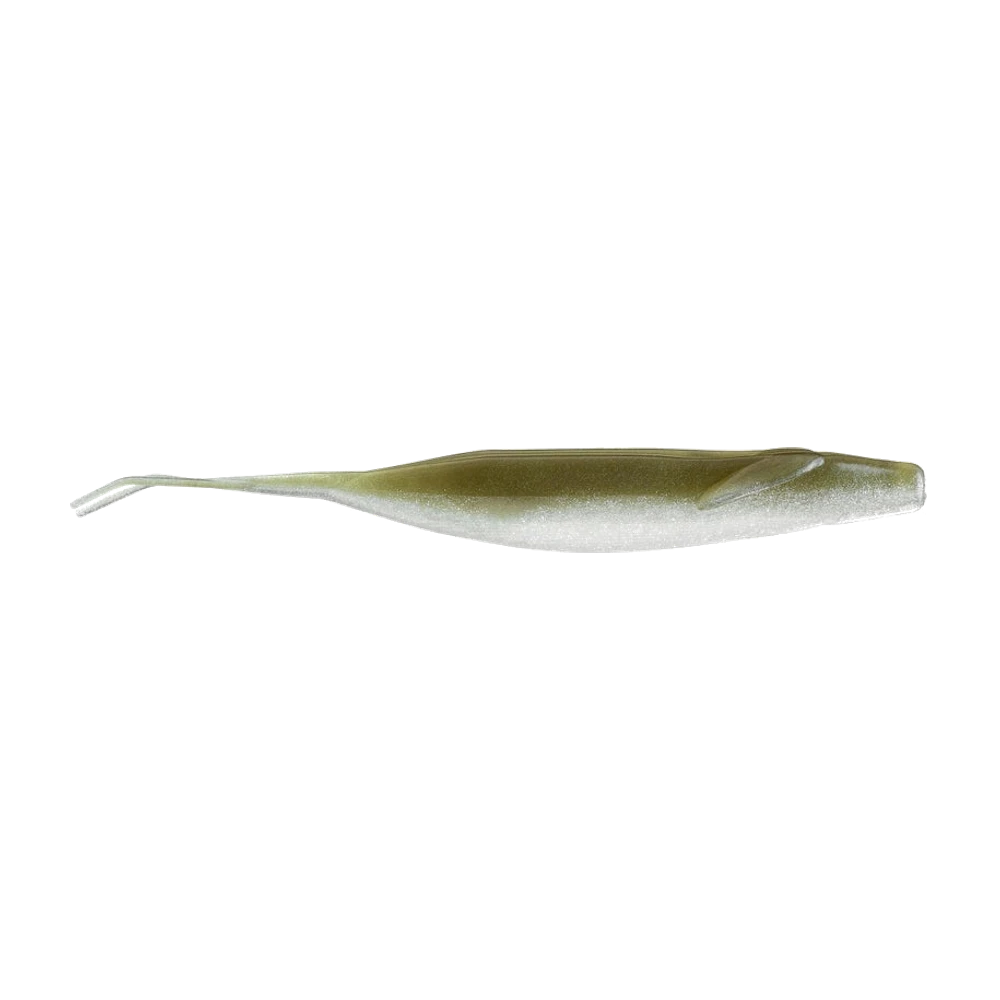
Zoom states two protruding wings and keeled fins along the head, said to produce a dying-baitfish action and side-to-side darting. On the product photo the wing is clearly there: a small flat fin standing well clear of the flank, just behind the head, on an otherwise textbook fluke profile — tapered body, rounded back, very fine forked tail. The rest of the body is smooth, with no ribs and no cavity. This is not a new silhouette; it is a fluke with appendages added.
Physically, a flat appendage set across the flank does two opposite things. On the twitch it adds drag on the side the bait is heading towards: the dart gets crisper, but also shorter. On the pause that same appendage slows the descent and makes the bait plane instead of rolling over flat. The second half is what matters most, because that is where the bites happen. A wingless fluke sinks by gliding forward, fairly quickly; a winged fluke drops more slowly, rocking from flank to flank, and therefore stays inside the fish's window of vision for longer.
Put plainly: if you expect wider darts than a Zoom Super Fluke gives you, you will be disappointed. If you expect a slower, messier fall, you will get it. Zoom also raises the pairing with forward-facing sonar — that is the brand's own selling point, written for a US audience, and what it really describes is a bait that stays on screen a long time because it sinks slowly.
Three sizes, and a table you need to read correctly
The retailer's spec table fits on one line: 4" 8, 5" 6, 6.5" 5. Its header reads "Length Quantity". The second figure is therefore the pack count, the number of baits per bag, and definitely not a weight: eight baits in 4 in (10.2 cm), six in 5 in (12.7 cm), five in 6.5 in (16.5 cm). The trap is a classic one on soft plastics and it is worth flagging, because reading "4 inches, 8 g" would lead you straight to a hook twice as heavy as it should be.
A direct consequence, and an important one: Zoom publishes no weight for this bait, and no buoyancy class. There is no floating, sinking or suspending label anywhere in the description. The only way to know how it behaves at rest is to drop it in a bucket before you leave — a thirty-second test worth every spec table, especially on a bait that is mostly fished weightless. The metric figures above are conversions of round inch values: treat them as orders of magnitude, not as calliper measurements.
The hook makes the bait
Weightless on a wide gap hook
This is the reference fluke rig, and the one that exploits the wings best. A 3/0 to 5/0 wide gap worm hook depending on size, entered through the nose and brought out a third of the way down the body, point just under the skin. The bait then works the top metre of water, darts on every rod stroke and glides back down over a two to four second pause. No weight means no dead spot — it is the most natural version, and the most demanding on line watching, because the bite almost always comes on the pause and shows up as nothing more than the line falling slack.
Keel-weighted hook
Zoom explicitly recommends a keel-weighted hook, meaning a worm hook carrying a small elongated weight along the shank under the belly. Two to five grams (0.07-0.18 oz) is plenty. The keel does three jobs: it holds the bait flat instead of letting it spiral, it gets you down to two to five metres, and it exaggerates the wobbling fall because the weight pulls the belly while the wings brake the flanks. Use the lightest keel that still reaches your depth — beyond that the fall flattens out and the whole point of the model disappears.
The classic mistake
Working it too hard and too often. When a bait stops producing, the reflex is to speed up the twitching rhythm; here that simply deletes the phase in which the wings do their work. Two sharp rod strokes, then a long pause during which you touch nothing and watch your slack line: that is the baseline rhythm, and you only change it when the fish tell you to. And if genuine retrieve action is what you are after, change bait rather than rhythm: a Zoom Swimmin Super Fluke with its paddle tail does that job far better.
Count your pauses under your breath. On a winged fluke, going from two to four seconds of stop changes more than going from one colour to another — and it is the only variable you can adjust without changing rigs.
Not sure what to tie on?
Photograph your spot: CarnaFish reads the scene, cross-checks the conditions and gives you the zone, the lure and the retrieve. Free on iOS and Android.
Where and when to fish it
In Europe, the Winged Fluke's natural ground is reservoir and gravel-pit bass from late spring through autumn: laydowns, point tips, inflows, anywhere forage balls up near the surface. The 4 in size also picks up perch on those same spots, without that being the bait's purpose.
The second use is worth mentioning: in white, a fluke this size is a serious tool for sea bass along the coast, during and just after a feeding frenzy, when fish refuse anything moving too much. The wings keep the bait in the surface layer longer, which is exactly what you want there. Use a stainless hook and rinse the rig in fresh water afterwards.
Colour by water clarity
Zoom names no colour in this description, and the range rotates from season to season: rather than invent references, think in tone families. The bait photographed carries an olive green back over a pearl white belly flecked with silver, a classic baitfish finish.
- Clear water: an olive or natural back over a pearl belly, exactly as shown. The silver flake alone creates a discreet flash on the drop.
- Cold water or pale forage: solid white, which gives the most readable silhouette under the surface when you are sight fishing or watching a screen.
- Stained water or low light: a solid dark tone, or a chartreuse belly. In coloured water it is silhouette contrast that carries, not the fineness of the pattern.
The best rig never replaces reading the spot: knowing where the forage sits and at what depth the fish strike decides everything else. That is exactly what CarnaFish makes easier — a photo of the spot, and the app suggests a zone and a presentation suited to the day's conditions. For tackle and spot fundamentals, our beginner's guide to bass fishing is a good place to start.
Key takeaways
- The wings shorten the dart but slow and disorder the fall: this bait works on the pause, not on the twitch.
- The retailer's table reads "Length Quantity": 8, 6 and 5 are pack counts, never weights.
- No weight and no buoyancy class published by Zoom: bucket-test it before you build a session around it.
- Lightest possible keel weight, long pauses, and you have the essentials of this bait.
FAQ
Does the Winged Fluke float or sink?
Zoom does not say: the description carries no buoyancy label at all, neither floating, sinking nor suspending. A fluke of this kind usually sinks very slowly once rigged, but the only reliable answer is a bucket test with your own hook fitted, because the hook weight is what decides.
Which size should I start with?
The 5 in, around 12.7 cm, is the all-rounder. Drop to the 4 in (10.2 cm) when forage is small or fish are pressured, and keep the 6.5 in (16.5 cm) for spots where you are sorting for bigger fish.
What hook for a weightless rig?
A wide gap worm hook: 3/0 for the 4 in, 4/0 for the 5 in, 5/0 or 6/0 for the 6.5 in. Those are hook gauges, not weights. Keep the point tucked just under the skin so the bait still slips through light weed while the hookset can break through.
How is it different from a standard Super Fluke?
The Zoom Super Fluke produces wider darts and a cleaner forward glide. The Winged Fluke trades part of that amplitude for a slower, less stable fall. On active fish the Super Fluke is often still the better choice; on fish that follow without committing, the braked descent of the Winged Fluke is what makes the difference.
Can it be fished for sea bass?
Yes, in white and in the 4 or 5 in size, on and around surface activity. Use a stainless hook, rinse it in fresh water after the session, and accept that soft plastic wears out fast on a fish with abrasive jaws like a sea bass.
The full bass lure guideSeason-by-season strategy: which family of lure, when, and why.Go from theory to fish
CarnaFish reads your spot from a photo and gives you the game plan: zone, lure, retrieve. Free on iOS and Android.