Big Bite Baits Jerkbait: the fluke that darts just under the surface
Rather not fish it blind? Photograph your spot — CarnaFish cross-checks the conditions and points you the right way.
A school of baitfish getting shredded on the surface, spray everywhere, and the hard bait you just cast goes straight through without drawing a single reaction. It happens more often than you would think: when predators are inside a dense school, a bait swimming too evenly disappears into the crowd. What you need right then is something that veers off sideways, stops dead, and looks like a single disoriented fish. That is exactly what the Big Bite Baits Jerkbait does, a 12.7 cm soft fluke.
A minimal shape for maximum darting
The principle of the soft jerkbait, or fluke, fits in one sentence: a smooth minnow body, no lip and no appendages, with no action of its own, doing only what you tell it to. Pull on the rod and it shoots sideways. Release and it stops and glides. Pull again and it goes the other way. In the water that reads as a horizontal zigzag very close to walking the dog with a topwater stickbait, only played thirty centimetres under the waterline.
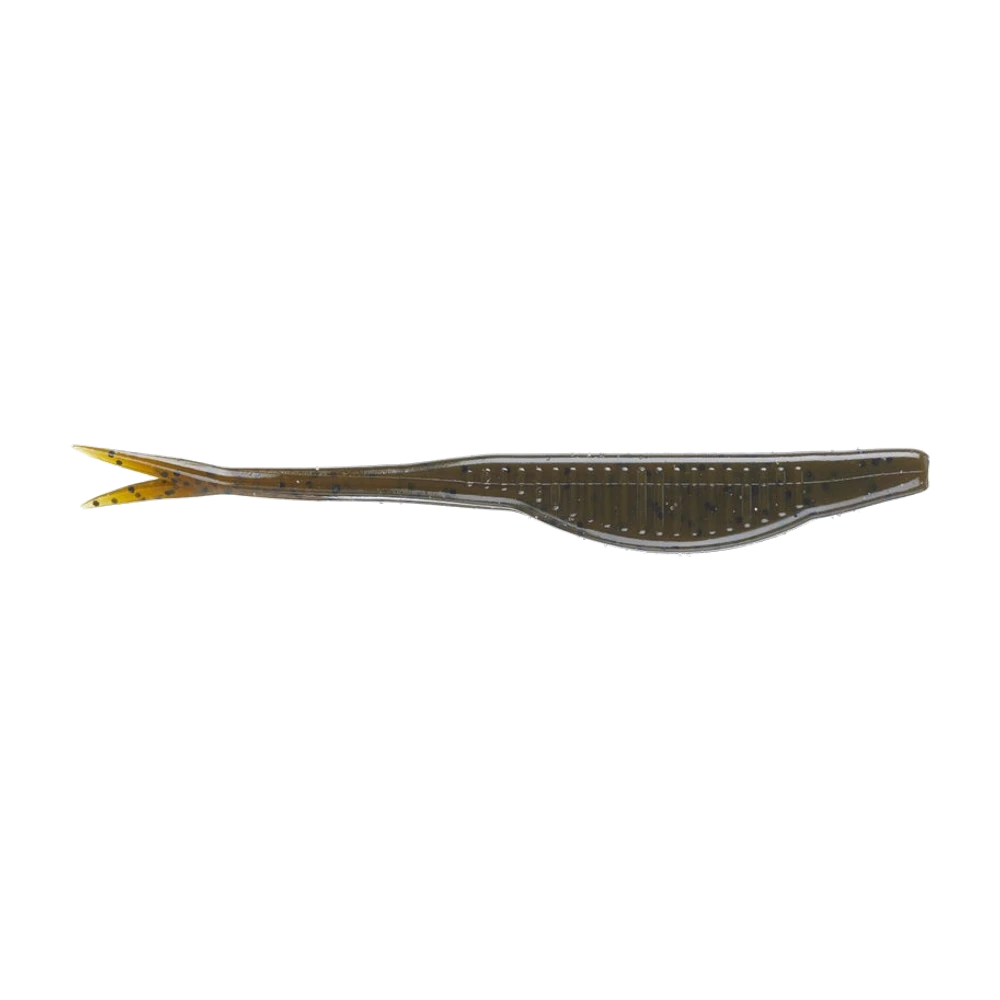
The forked tail on the Big Bite model is not decoration. The two separated tips create asymmetric resistance on every acceleration: that is what tips the bait one way then the other, and it is also what keeps vibrating during the pause when the rest of the bait is dead still. A fluke with a solid tail darts less sharply and demands a wider rod stroke.
The thick nose, a detail you see on the receipt
Big Bite advertises a deliberately thickened nose to prevent tearing and blowouts around the hook point. It is an answer to the family's historic flaw: on a standard fluke the plastic gives up after two or three fish and the bait starts sliding down the shank on every cast. With a reinforced head you typically gain a few fish per bait, which changes the economics when a pack holds ten and you are getting bitten repeatedly on an active school.
One caveat: the body plastic is still described as ultra-soft, because that softness is what lets the bait stay high in the column and be twitched weightless. A reinforced nose does not mean an indestructible bait — it means the part that used to fail first now fails later.
Always add a stinger hook linked by a small split ring to the eye of your main hook, point riding free around the middle of the body. Strikes on a fluke are often aimed at the back end, and without a stinger you can lose one fish in two over a day of chasing activity.
Three rigs for three depths
Weightless Texas
The benchmark rig and the one the manufacturer leads with. A 4/0 wide gap hook, point tucked into the back, no weight at all. The bait works the top metre, passing over weed and through branches without snagging. This is what you tie on for a surface feeding frenzy, a pad edge, or over a drowned weed bed in summer.
Light jighead
A round or bullet head of 3 to 7 g transforms the bait: it keeps its zigzag behaviour but drops between twitches. That lets you fish a break or a bridge pile down to three or four metres, alternating two rod strokes with a pause during which the bait dives nose-first. It is a very effective rig on bass suspended in open water.
Lightly weighted Texas
A 3 to 5 g bullet weight ahead of a Texas rig buys you casting distance into a headwind without completely wrecking the action. It is a compromise rather than a rig in its own right: use it when casting distance becomes the limiting factor.
How to work it without making it unreadable
Two or three sharp, short rod strokes with the tip pointed down, then a one to three second pause while you take up the slack. The commonest fault is twitching without ever stopping: the bait then just runs in a straight line and loses all its appeal. The pause is not dead time, it is when the fish makes its decision. Weightless, the bait stays close to suspended during that pause — Big Bite makes a point of this, and it is the whole reason for the very soft plastic.
On an active school, shorten the pauses and lengthen the bursts. On a fish parked under a tree, do the exact opposite: two twitches, five seconds of nothing, repeat. A fluke is very good at doing almost nothing.
The classic mistake
Using too heavy a hook. A thick-wire hook drags the nose down and destroys the horizontal attitude that makes the weightless rig worth fishing. Take a medium-wire wide gap hook, and if you absolutely need heavy wire for a toothy fish, accept switching to a jighead: at least you get a coherent action instead of a bait that noses over.

Not sure what to tie on?
Photograph your spot: CarnaFish reads the scene, cross-checks the conditions and gives you the zone, the lure and the retrieve. Free on iOS and Android.
Colour by water and by forage
- Clear water over small silver baitfish: Watermelon Seed or a translucent olive with flake, like the colour in the photo, which stays credible even when the fish can see perfectly.
- Feeding frenzy on silver baitfish: Pearl White, a pearl finish that throws light sideways and shows up from a distance inside the school.
- Stained water or last light: Junebug, a dark purple with green reflections whose silhouette stays readable as visibility drops.
What it does, and what it does not
The Big Bite Jerkbait plays in the same category as a Zoom Swimmin Super Fluke or a 6th Sense Flush 5.2 Soft Jerkbait: same size, same use, with nuances in plastic softness and tail shape. It is not a bottom bait, it is not a fast search bait, and it is of no interest in cold water when fish are glued to the substrate. For those days, a Big Bite Baits Finesse Worm on a drop shot is infinitely more relevant.
In Europe it finds its best ground on gravel pits and large lakes where baitfish schools show on the surface from May to October, and along cluttered banks where pike patrol shallow. One warning in that last case: without a suitable leader, a pike cuts fluorocarbon in a second.
Spotting the feeding activity is one thing; understanding why it is happening right there and not thirty metres away is another. That is exactly what CarnaFish makes easier — a photo of the spot, and the app suggests the zone and the presentation suited to the day. If pike is what you are after with this kind of bait, our guide to choosing a pike lure runs through the families worth knowing and their limits.
Key takeaways
- A 12.7 cm fluke with no action of its own: everything comes from your wrist, and the forked tail amplifies each dart.
- The reinforced nose extends bait life, but the body stays ultra-soft by design.
- Weightless Texas keeps the bait in the top metre; a 3 to 7 g head takes it down without killing the zigzag.
- A stinger hook is close to mandatory: strikes often land on the back half of the bait.
FAQ
Does the Big Bite Jerkbait float?
No, it is not a floating bait. The manufacturer states that the very soft plastic lets it stay high in the column and be twitched near the surface when rigged weightless; in practice it sinks very slowly. No specific density figure is published.
What hook should I use weightless?
A 4/0 medium-wire wide gap hook suits the 12.7 cm size. Avoid heavy wire, which pulls the nose down and destroys the horizontal attitude you are after.
How do I stop the bait sliding down the shank?
The thickened nose already limits it. Add a piece of heat-shrink tubing or a small silicone bead against the hook eye and you will go from two or three fish to five or six per bait.
Can it be used for pike?
Yes, along banks and over shallow flats, but only with a leader suited to their teeth. A fluke tied straight to fluorocarbon is lost on first contact. The bait also stays fragile against teeth.
How is it different from a hard jerkbait?
A hard jerkbait has a lip, an action of its own and controlled buoyancy; it works even on a mindless retrieve. A soft fluke has none of that: it is mute unless you work it, but its profile and silence get further with wary fish.
Should I work it fast or slow?
Both, depending on context. On an active school, run bursts of three or four twitches with short pauses. On a parked fish, two twitches and five seconds of nothing produce far better results.
The full bass lure guideSeason-by-season strategy: which family of lure, when, and why.Go from theory to fish
CarnaFish reads your spot from a photo and gives you the game plan: zone, lure, retrieve. Free on iOS and Android.