Zoom Fluke: the 4 in soft jerkbait that glides instead of sinking
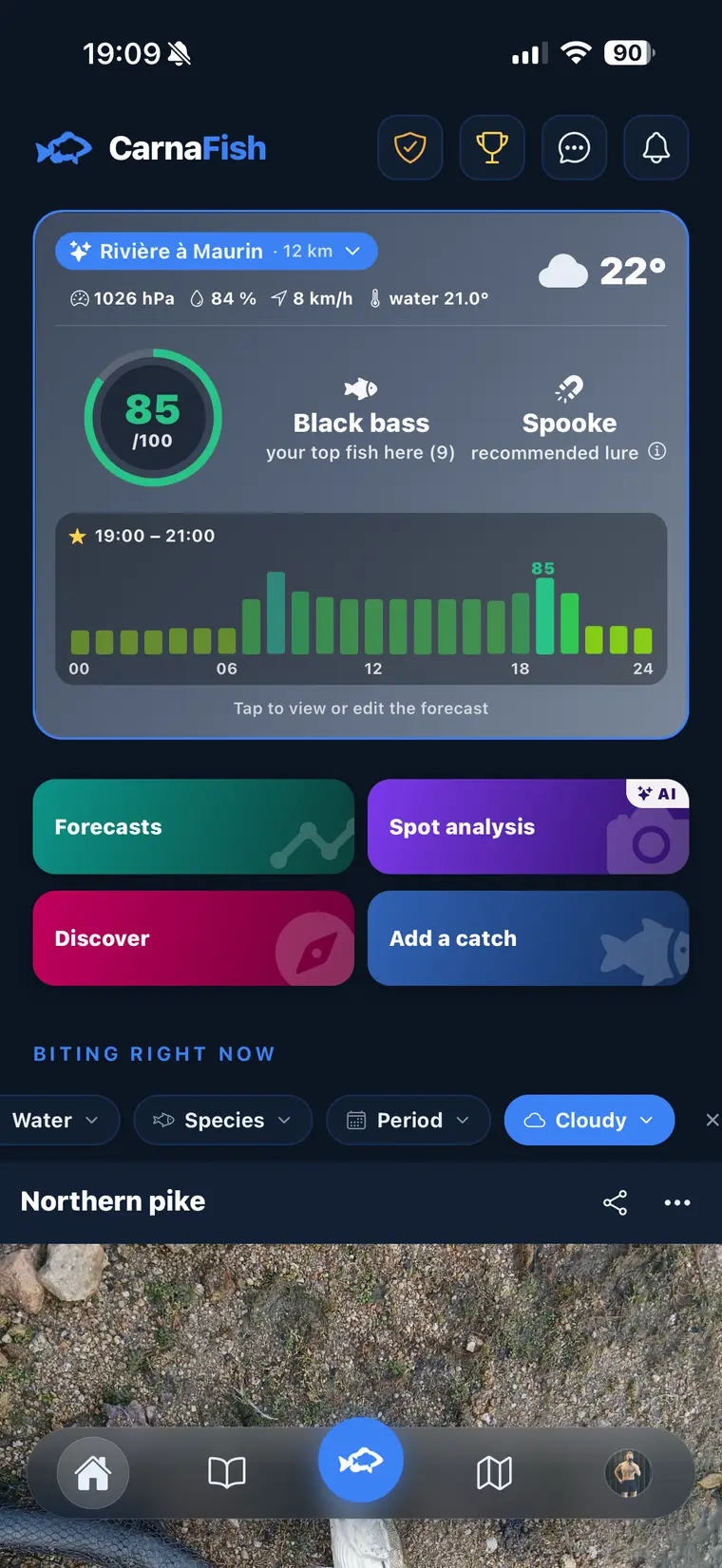
Before tying this one on, it helps to know if the spot actually calls for it. CarnaFish reads the scene from a photo.
There is one precise moment when the Fluke becomes the best bait in the box: when predators are pinning a school of small baitfish near the surface and refusing anything that swims too regularly. A lipped bait gets ignored. So does a paddle-tail shad, because it kicks too mechanically. The Fluke doesn't swim on its own — it darts to one side, stops, and glides over on its flank. Which is exactly what a fry does when it is trying to break away from an attack.
A flat profile that glides instead of dropping
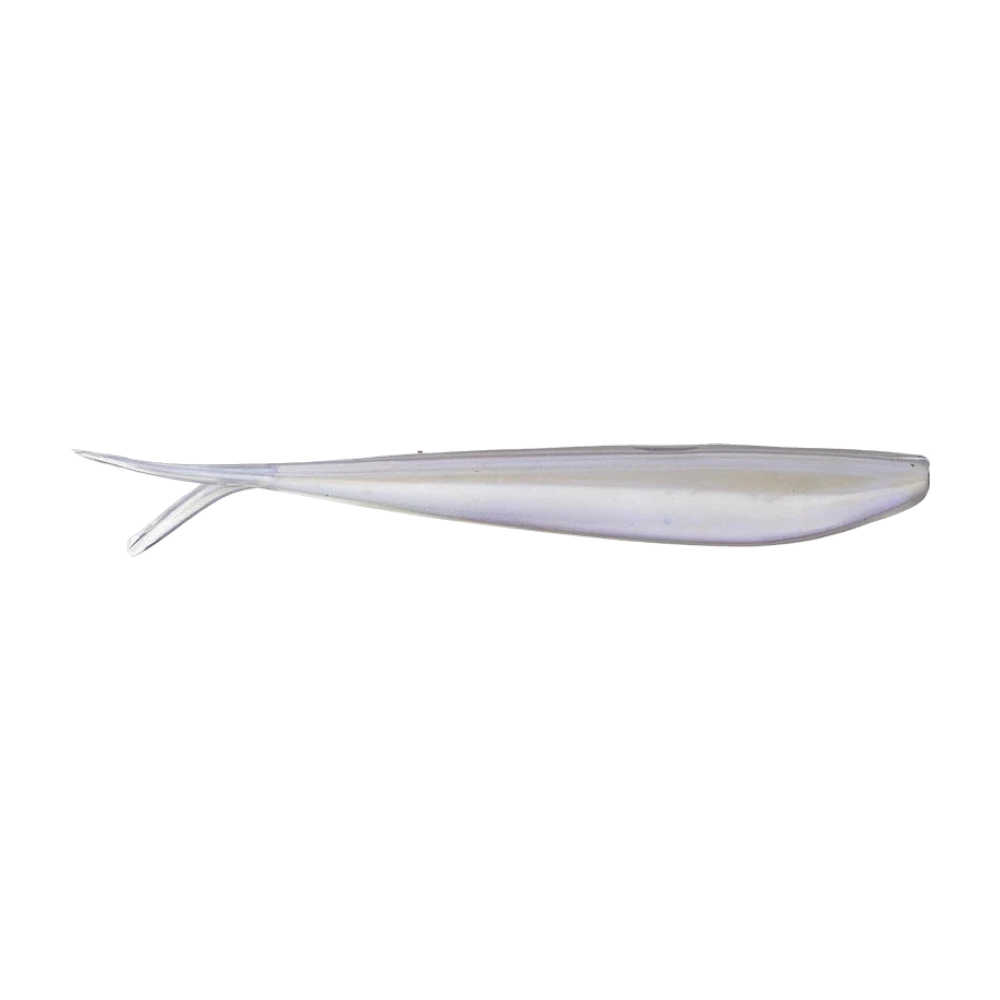
Zoom describes the Fluke as a bait with a natural baitfish profile that glides and swoops through the water. The product photo confirms the shape: a long, smooth body with no ribbing at all, distinctly flat-sided, ending in a deeply forked tail whose two tips are very fine. The finish shown is a pearl white, slightly translucent.
The flat sides do all the work. On each twitch of the rod tip the bait doesn't run straight: water pressure on that flat surface pushes it sideways, exactly the way a hard jerkbait darts thanks to its lip. And when you give slack, it doesn't drop vertically — it keeps gliding to the side for a second or two, like a falling leaf.
The plastic is salt-impregnated, which Zoom states explicitly and which has two consequences. The first is the one the brand promotes: more density in the mouth, so a fish holds on an instant longer before spitting. The second is never written down: salt makes the material denser than water. A weightless Fluke therefore does not float, unlike a Zoom Trick Worm — it sinks slowly, and that sink is what you fish.
The three rigs Zoom names
Weightless Texas
The reference rig. A wide-gap 2/0 or 3/0 hook, in through the nose and out mid-back, point tucked into the plastic. On this 10 cm size, don't reach for a 4/0: the hook would overhang the back and kill the glide. Rigged this way the bait slips through sparse vegetation and stays in the top metre of water.
Weighted hook
A moulded-weight hook of 1-3 g, or a small nail weight pushed into the nose, takes the Fluke down without stripping its sideways dart. That is the answer when there is wind, current, or when fish are feeding two metres down rather than on top. Past 3 or 4 g the bait falls straight and you have lost the point of it.
Double rigging — check before you try it
Zoom mentions rigging two Flukes on the same line, a widespread technique in the United States to simulate two fry chasing each other. In Europe the question is not technical but regulatory: the number of baits and hooks allowed per line varies by country, by water category and sometimes by individual fishery. Check your local rules before trying it; our overview of fishing regulations explains where to find the text that actually applies.
The cadence: two twitches, one pause — mostly the pause
The Fluke produces nothing on a straight retrieve. Wind it in at constant speed and it follows the line lifelessly, which is why plenty of anglers conclude the bait doesn't work. The pattern that does work has three beats: two or three short, sharp twitches with the rod low, then a full stop of two to four seconds with slight slack in the line.
The bite comes during that stop, usually with no sensation at the rod at all. You see the line move sideways or go slack all at once. Hence the case for thin braid with a fluorocarbon leader: you will see the bite before you feel it.
Watch the line, not the bait. When the Fluke glides, the fish takes it from underneath and rises with it: the line doesn't tighten, it falls slack. If you wait for a solid thump before setting the hook, you will miss half the day's bites.
Not sure what to tie on?
Photograph your spot: CarnaFish reads the scene, cross-checks the conditions and gives you the zone, the lure and the retrieve. Free on iOS and Android.
4 in or 5.25? What the size changes
The advertised four inches is exactly 10.16 cm. This is the compact size in the family, and it does a different job from the 13.3 cm Zoom Super Fluke. The 10 cm matches a young-of-the-year fry, the kind that schools from late spring into autumn; it draws more bites, including from small fish, and is harder to cast into a headwind because of its light weight.
The bigger model sorts for size better and casts further. If you only take one, take the 10 cm: it matches the most common forage size in Europe, for bass as well as for sea bass along harbour walls or shingle beaches. Zoom's description explicitly claims fresh and saltwater use, and this is one of the rare soft baits where that dual billing isn't empty: a pearl fluke twitched on a weightless hook is a classic sea bass presentation.
The second figure in the spec table, 10, sits under the "Quantity" header: it is the piece count per bag, not a mass. Zoom publishes no per-piece weight for this model.
The classic mistake: overworking it
The Fluke punishes generosity. Twitches that are too long send it too far in one go and flatten the glide; an angler who gets bored during the pause shortens the stop and removes precisely the moment the fish commits. If in doubt, count out loud through the stop: three seconds feels very long when you count it, and it is often still too short.
Colour by water clarity
Zoom mentions "several proven colors" without naming one, so there is no trade reference to quote — but the finish in the photo is already the most useful.
- Clear water: the translucent pearl of the photo, which returns light without flashing and imitates any silver-flanked fry. It is the default for sea bass as much as for bass in clear water.
- Overcast skies, average clarity: a green or grey back over a pale belly, shad style, which keeps a readable contrast in low light.
- Stained water: a dark, opaque tone. On a bait this slim, silhouette counts for more than colour: seen from below, it reads against the sky.
A well-worked bait on the wrong zone catches nothing, and that is exactly where CarnaFish helps: a photo of the spot, and the app suggests a zone, a depth and a presentation suited to the day's conditions. If you want to take it to the coast, our guide to sea bass fishing with lures covers the marks and tide windows where this kind of soft bait makes the most sense.
Key takeaways
- The Fluke does not swim on a straight retrieve: it is a bait of sharp twitches and long pauses, and the bite comes during the pause.
- Salted plastic, so it sinks slowly even rigged weightless: that gliding descent is the heart of the presentation.
- The 10 cm size matches the most common fry in Europe and draws more bites than the 13.3 cm Super Fluke.
- Watch the line rather than the bait: during the glide the bite is seen, not felt.
FAQ
Does the Zoom Fluke need weight?
Not necessarily. Weightless on a 2/0 or 3/0 Texas hook, it already sinks slowly thanks to the salted plastic. Add 1-3 g only if there is wind or current, or if fish are feeding below the top metre.
Why does my Fluke catch nothing on a straight retrieve?
Because it isn't built for it: with no lip and no kicking tail, it just follows the line without producing any action. Work it with short sharp twitches, then stop for two to four seconds, which is when the bite happens.
What hook size for a 4 in Fluke?
A wide-gap 2/0 or 3/0. A 4/0 overhangs the back on this 10 cm size and kills the sideways glide, which is the whole appeal of the bait.
Does the Zoom Fluke work in salt water?
Zoom explicitly claims fresh and saltwater use, and the 10 cm size in pearl is genuinely effective on sea bass along harbour walls or beaches. Rinse it in fresh water after the session.
What's the difference with the Super Fluke?
Size and job. The Zoom Super Fluke measures 13.3 cm and sorts better for bigger fish; the 10 cm Fluke matches the most common fry size and generates more bites.
How many Flukes come in a bag?
Ten. The spec table reads 4" 10 under a "Length Quantity" header: the second figure is a piece count, not a weight.
Go from theory to fish
CarnaFish reads your spot from a photo and gives you the game plan: zone, lure, retrieve. Free on iOS and Android.