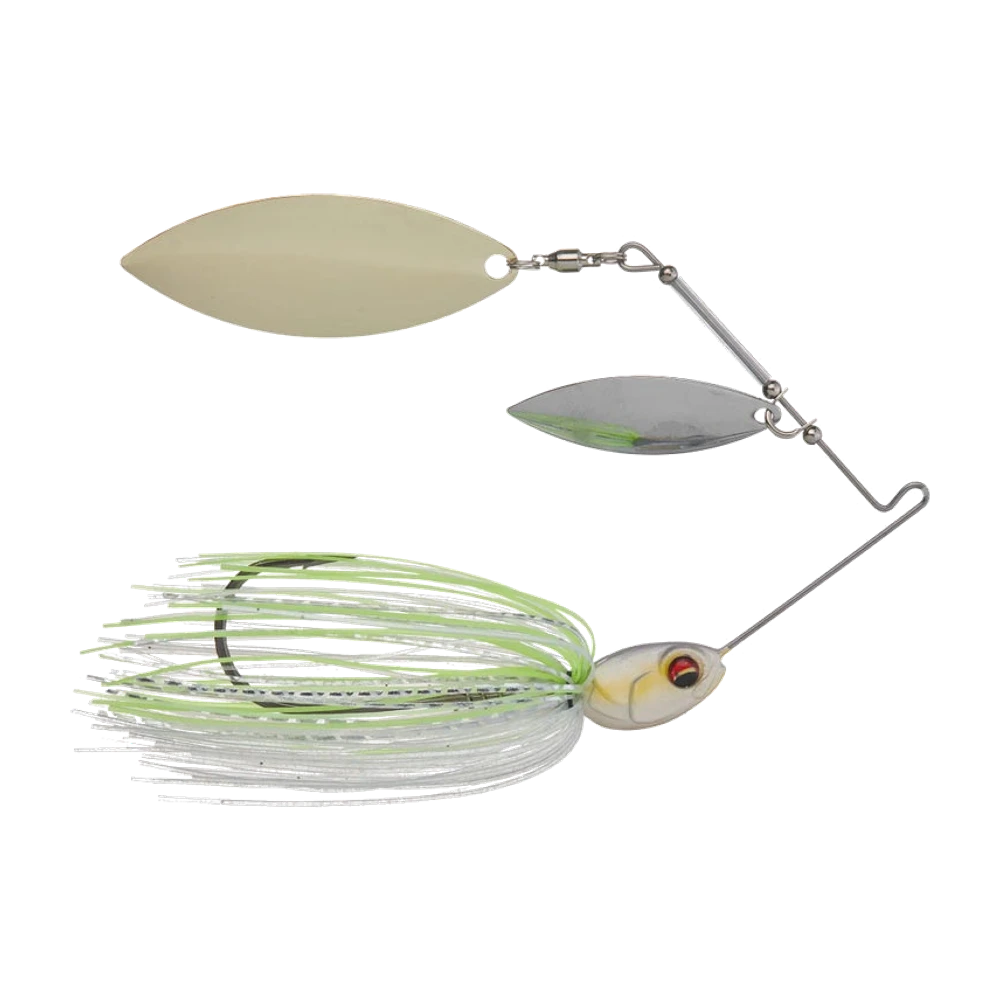
6th Sense Divine Spinnerbait: raw vibration, no gimmicks
Rather not fish it blind? Photograph your spot — CarnaFish cross-checks the conditions and points you the right way.
A late-October morning, a bank littered with deadwood, water at 13 °C (55 °F) starting to colour up after two days of rain. The fry are pinned against the edge, and something scatters them by the handful every couple of minutes. In that exact situation a discreet hard bait is useless: you need signal. A spinnerbait does precisely that — it fills a volume of water with vibration and flash, and it forces a decision out of a fish that wasn't asking for one. The 6th Sense Divine Spinnerbait is a no-frills version of that principle, which is rather good news.
What actually makes a spinnerbait vibrate
A spinnerbait isn't a complicated lure, and that's exactly why component quality shows immediately. Three parts decide everything.
The wire arm first. 6th Sense uses heat-treated stainless steel, and the point isn't just durability: it's the balance between stiffness and flex. An arm that's too stiff holds the blades well but transmits a dull vibration. An arm that's too soft bends on the first bite and ends up out of true. An arm that flexes just enough lets the blade thump travel through the whole lure and into your rod — that feedback in the handle is what tells you, without looking, that the lure is working properly.
The swivels next, and that's the part manufacturers skimp on most often. A blade that doesn't start turning the instant it hits the water, or that locks up after a few casts, turns a spinnerbait into an inert lump of metal. On this model the swivels are flagged as a point of attention, and they really are the first thing to check on a spinnerbait, new or old.
The hand-tied skirt last. A tightly tied skirt keeps its bulk and pulses behind the blades even at slow speed; a badly tied one collapses and the lure loses half its silhouette.
Blades, the one thing worth genuinely understanding
The maker offers several configurations without publishing a detailed chart, but general blade logic applies to any spinnerbait and is worth knowing.
A wide, round Colorado-style blade spins almost perpendicular to the arm. It creates a lot of resistance, a lot of low-frequency vibration, and it makes the lure ride up: that's the choice for stained water, cold spring conditions and slow retrieves. A slim willow-leaf blade spins close to the arm, offers little resistance and throws enormous amounts of light. It runs deeper, retrieves faster, and it's the choice for clear water and fish hunting slim baitfish. Double blade setups mix the two logics, in the manner of a War Eagle Double Colorado Spinnerbait for high-vibration configurations.
In practice: if you can't see your lure one metre under the surface, go for bulk and vibration. If you can see it clearly at three metres, go for flash and slimness.
Speed, depth and three ways to fish it
The slow roll is the most productive and most ignored technique. Let the spinnerbait sink to the bottom, then retrieve at the minimum speed that keeps the blades turning. The lure crawls over the substrate, bumps obstacles, and that presentation drags fish out that nothing else will convince in cold water.
Contact in wood asks for the opposite: a medium retrieve, rod high, and deliberately steering the lure into branches. Like a squarebill, a spinnerbait draws its power from deflection: when a blade clips a branch it stalls for half a second then resumes, and that stumble is the trigger.
Waking means retrieving fast enough that the blades churn the surface without breaking out. At first light along a flat bank it's spectacular and deadly, but it's also the quickest way to miss bites if you strike on sight instead of on feel.
Trailer and trailer hook
The screw lock keeper on the head holds a soft plastic in place, which is useful for two reasons: a trailer adds bulk to the silhouette, and it slows the fall, which helps on a slow roll. A simple soft shad does the job. As for a trailer hook — the extra treble or single behind the main hook — it noticeably improves your conversion rate on soft, half-hearted strikes, but it doubles your snag rate in wood. Keep it for open water.
The test to run in the shop and on the bank: hold the spinnerbait by the arm and flick the blade with a finger. If it stops in under two revolutions, the swivel is dead or cheap. A spinnerbait whose blades don't start instantly on impact isn't fishing for the first two metres of the retrieve, and that's often where the bite is decided.
The classic mistake
Retrieving too fast out of reflex. A spinnerbait pulled fast makes noise, rides up, and passes over the fish. The right speed is almost always slower than the one you adopt instinctively: just fast enough to feel the steady blade thump in the handle, not one turn more. Second mistake of the same kind: never checking the arm's alignment. After a good fish, a bent arm makes the lure spin out — a thumb press to put blade and hook back on the same axis is usually enough to fix it.
Not sure what to tie on?
Photograph your spot: CarnaFish reads the scene, cross-checks the conditions and gives you the zone, the lure and the retrieve. Free on iOS and Android.
Colors by water and light
- Clear water, bright sun: white or white-silver skirt with nickel blades. The combination imitates a school of fry without ever looking gaudy.
- Stained water, overcast: chartreuse and white with gold blades. Gold throws a warmer light that carries further through loaded water.
- Dark water, dawn or dusk: black or black-blue. Counter-intuitive, but a dark silhouette reads better against a bright sky than any vivid color.
Spinnerbait or chatterbait?
The question comes up every time. A spinnerbait puts out vibration carried by freely spinning blades: continuous signal, plenty of flash, and a real ability to get through deadwood thanks to the arm shielding the hook. A chatterbait like the Z-Man ChatterBait Jack Hammer puts out a tighter, more aggressive vibration and handles grass better, but it hangs up more in branches. In cold water and over wood the spinnerbait keeps the edge; in a grass bed the chatterbait takes over.
Within the family, the Divine lines up against established benchmarks like the Strike King Tour Grade Spinnerbait or the Booyah Covert Spinnerbait. The difference isn't in the principle — unchanged for sixty years — but in the care given to the head, the swivels and the way the skirt is tied.
In Europe it's also a very good pike lure along pond margins and backwaters, provided you rig a proper leader: a spinnerbait hit by a pike with no protection is a lure gone. For the rest of the lure choice on that species, our guide to choosing a pike lure runs through the families. And to work out whether the bank in front of you is worth a spinnerbait at all, CarnaFish reads the spot from a single photo.
The short version
- Three parts make the lure: arm stiffness, swivel quality, skirt bulk.
- Wide round blade for stained water and slow retrieves, slim blade for clear water and faster speeds.
- The bottom-hugging slow roll is the most productive and most neglected technique.
- A bent arm after a fish makes the lure spin out — realign blade and hook as a matter of habit.
FAQ
How fast should I retrieve a spinnerbait?
The slowest speed that keeps the blades turning, which is almost always slower than people think. You should feel a steady thump in the handle; once the sensation turns into a continuous buzz, you're fishing too fast.
Do I need a wire leader?
As soon as there are pike on the spot, yes, or at minimum 40/100 (20 lb) fluorocarbon. On a bass-only water, a thinner fluorocarbon is enough and stays more discreet.
Can you fish a spinnerbait in winter?
Yes, and it's one of its best windows on a very slow bottom-hugging slow roll. Fish are less willing to chase, so the lure has to pass slowly and as close to their station as possible.
Which blade should a beginner choose?
If you can only pick one, take a high-vibration configuration for stained water: it forgives speed mistakes more readily and stays detectable even when visibility is poor.
Why does my spinnerbait spin out?
Almost always because the arm has bent, often after a fish or a snag. Check that blade, arm and hook sit on the same axis and straighten by hand if needed.
Should I add a soft trailer?
Not compulsory, but useful: a trailer adds bulk to the silhouette and slows the fall, which helps on a slow roll. The screw lock keeper on the head holds it without slipping.
The full bass lure guideSeason-by-season strategy: which family of lure, when, and why.Go from theory to fish
CarnaFish reads your spot from a photo and gives you the game plan: zone, lure, retrieve. Free on iOS and Android.