Missile Baits Buzz Wagon: the buzzbait that runs at a crawl
Before tying this one on, it helps to know if the spot actually calls for it. CarnaFish reads the scene from a photo.
Five in the morning in July, not a breath of wind, a lily pad edge running forty metres along the bank. You cast a conventional buzzbait, you reel fast because that's what it takes to keep the blade up, and the lure crosses the zone in eight seconds. The bass sitting under the pads never had time to make up their minds. The whole point of the Missile Baits Buzz Wagon lies in that gap: it's built to do the same job, slowly.
One blade, and what that changes
The Buzz Wagon runs a single blade, where most buzzbaits line up two or three. The maker describes it as a knocking blade, meaning it strikes the wire on every revolution instead of simply churning. The acoustic result isn't a continuous drone but a series of sharp knocks, considerably more audible at range over calm water.
The maker specifies that the blade is anodized, for two stated reasons: better sound and lighter weight. The second point matters more than it sounds. A light blade needs less energy to start turning, and therefore less retrieve speed to stay on the surface. That's the entire logic of the lure.
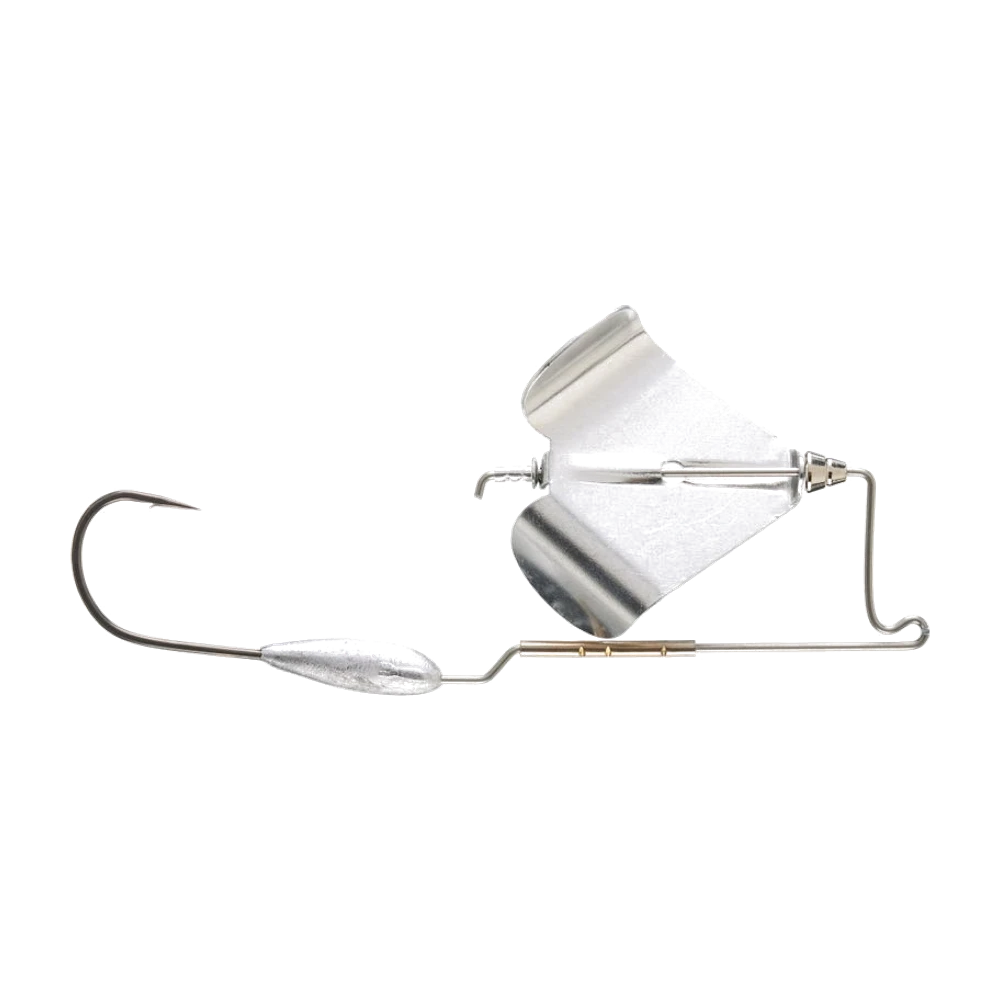
In the photo you can clearly see that two-lobed blade on a bushed shaft, and a brass sleeve on the wire directly under the path of the lobes. The head is photographed bare, with no skirt and no trailer.
The real argument: slowness
The maker states that the Buzz Wagon can run at the water's surface at slower speeds than average, for two benefits: more drawing power and a longer stay in the strike zone. Those are two different things.
Drawing power is the distance at which a fish registers the lure and decides to come and look. A slow buzzbait makes noise for longer along the same path, so it reaches more ears. Time in the zone is how long the lure spends in front of a given fish. On a forty-metre edge, going from eight to eighteen seconds of travel nearly doubles the number of chances.
In practice, hunt for your minimum speed every session. Cast, start briskly to bring the blade up, then slow down progressively until the knocking becomes irregular. One notch above that point is your working speed for the day. It shifts with rod angle, how high you hold the tip and how much line is out.
Never set the hook on the sound. On a buzzbait the fish often misses its first strike and comes back within a second. Set on the splash and you tear the lure out of its mouth before it ever had it. Wait until you feel weight in the rod, then set by sweeping sideways, not upwards.
A head built for a trailer
The maker states that the Buzz Wagon was designed specifically for securing toad trailers — those soft plastics with flapping legs that imitate a frog. It's a deliberate orientation: this isn't sold as a conventional skirted buzzbait, it's a platform for a soft bait.
Rigging is simple. Thread the toad onto the shank, body aligned with the hook axis, legs trailing. A Zoom Horny Toad or any flapping-leg soft plastic of comparable size will do. Check that the body isn't bowed: a trailer rigged crooked makes the whole package spin and ruins its surface stability.
The advantage over a silicone skirt is twofold. The toad adds its own leg noise to the blade's knock, and it gives a solid silhouette, visible from below against the light. The drawback is just as real: a soft bait wears out, and you'll go through several in a good morning.
The hook, a detail that isn't one
The Buzz Wagon is armed with a 3/0 Gamakatsu G-Power Flip Punch. Three stated features are worth understanding.
The point is shortened. On a single topwater hook, a short point sets faster because it has less distance to travel before it bites — a real advantage when the fish strikes at an angle, which is the norm on the surface.
The coating is a nano smooth treatment, stated to speed up penetration. And the wire is a Tournament Grade Wire, given for extra strength and for staying sharp longer.
The classic mistake
Swapping the hook for something larger in the belief you'll hook up better. On a buzzbait frame the geometry is calculated: the position of the point relative to the blade and the lead decides whether the lure tracks straight. A longer hook shifts that balance and you end up with a buzzbait that lies over on its side the moment you slow down — which is precisely what you came to do.
Not sure what to tie on?
Photograph your spot: CarnaFish reads the scene, cross-checks the conditions and gives you the zone, the lure and the retrieve. Free on iOS and Android.
What the spec sheet doesn't say
Let's be clear: the maker publishes neither a length nor a weight for this lure. No spec table accompanies the description, and I'm not going to invent a figure. That's awkward for two things — matching your rod and comparing it with another buzzbait — and you get around both the same way: weigh it when it arrives and write the number on your box.
What we do know is that the lure is made in the USA by Brazalo Lures and that it comes in several blade colour options.
Blade colour by light
- Overcast or clear water: a silver blade, the one in the photo, returning diffuse light without flashing harshly.
- Stained water: a gold blade, whose warm reflection stays readable as visibility drops.
- Dawn, dusk, night fishing: a dark blade, which reads as a silhouette against the sky for a fish looking upward.
A niche lure, and unapologetic about it
The Buzz Wagon isn't trying to replace an all-round buzzbait like the Booyah Buzz. It occupies the slow-surface niche, alongside other single-bladed designs such as the Buckeye Lures G-Buzz. In Europe, where bass waters are often small and heavily fished, being able to slow down without losing the surface is a genuine edge on a spot three anglers have already worked.
Topwater still depends first on timing and on the lie. That's what CarnaFish makes easier: a photo of the spot, and the app suggests the zone, the depth and the presentation that suit the day. To set your calendar, our season-by-season predator fishing guide covers when the surface becomes relevant.
Key takeaways
- A single anodized blade, stated to be lighter and louder: that's what lets the lure run on the surface at slow speed.
- A frame designed specifically to hold a soft toad trailer, not a silicone skirt.
- Factory 3/0 Gamakatsu G-Power Flip Punch hook, shortened point and tournament grade wire: don't replace it with a larger one.
- No length and no weight are published by the maker: weigh it yourself to match your tackle.
FAQ
What does the Buzz Wagon weigh?
The maker doesn't publish it, and no spec table comes with the description. Weigh it on arrival and note the figure: it's the only reliable number you'll have for matching your rod and comparing it with your other buzzbaits.
Is a trailer mandatory?
The lure is stated to be designed specifically for securing toad trailers, and it's photographed bare, with no skirt. In that spirit, fishing it without a trailer deprives you of both the bulk and the leg noise that round out the blade's knock.
How fast should I retrieve?
As slowly as the blade will keep turning steadily. Find the point where the knocking becomes irregular, then come back up one notch. That setting shifts with rod angle and line out, so redo it every session.
Why one blade instead of two?
A single knocking blade produces a sharp, spaced acoustic signal rather than a continuous drone, and it needs less energy to turn. That's what lets the lure stay on the surface at reduced speed, where a twin-blade needs more pace.
Can it be fished on a pike spot?
Nothing stops you, but the lure carries a single hook with no wire trace, and a pike striking on the surface will cut braid or fluorocarbon in one bite. If you know they're there, fit a wire trace and accept the loss of discretion.
Is it a good lure to start topwater fishing with?
Broadly yes, because the slow speed it allows gives you time to watch the strike coming and to learn not to set too early. The real lesson is the delayed hookset, and that takes a few missed fish before it becomes reflex.
The full bass lure guideSeason-by-season strategy: which family of lure, when, and why.Go from theory to fish
CarnaFish reads your spot from a photo and gives you the game plan: zone, lure, retrieve. Free on iOS and Android.