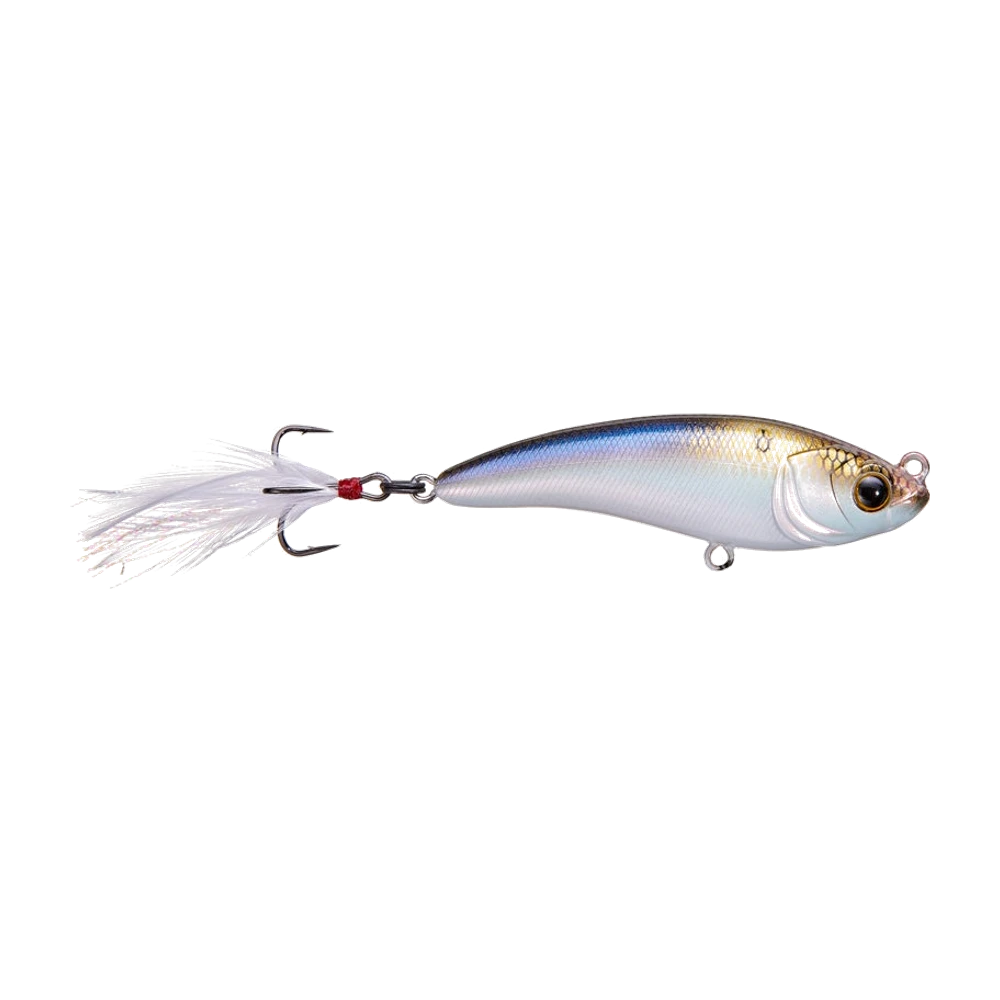
6th Sense HyperJerk 70: the top-mounted line tie changes everything
Before tying this one on, it helps to know if the spot actually calls for it. CarnaFish reads the scene from a photo.
A pond that gets fished every weekend, clear water, a metre of depth, and bass that follow your lure to the bank without ever opening their mouths. You have already slowed everything down and nothing changed. In that situation the answer is usually not to slow down further: it is to produce a movement so abrupt and so disorderly that the fish commits before it has had time to think. The HyperJerk 70 is built to produce exactly that kind of movement.
The line tie sits on the skull, not the nose
That is the detail that defines this bait. On a classic jerkbait the tie is at the tip of the nose: every rod stroke pulls the bait forward, and the lip is what kicks it sideways. On the HyperJerk the tie sits on top of the head. The pulling point is therefore above the centre of gravity, which turns a pull into a roll.
In practice a sharp twitch does not push the bait forward, it pivots and breaks it off sideways, often downward, at an angle you cannot predict from one stroke to the next. It is not an even, two-beat walk-the-dog like a topwater stickbait; it is the deliberately incoherent behaviour of a small fish in a panic.
A 7 cm body at 10.5 g: density does the work
Those numbers deserve a pause, because they are unusual. Ten and a half grams on 7 cm is a high density for a hard bait of this size. That has three very concrete consequences.
The first is casting distance. A typical 7 cm finesse bait often weighs under five grams and becomes impossible to place with any headwind. This one flies properly even on light tackle, which matters enormously in clear water where the fish sees you before you see it.
The second is counting down. The HyperJerk is rated slow sinking, so it drops on its own during a pause, but horizontally, without nosing over. You can count two, five or ten seconds after the splash to reach the layer you want, then work it at that level.
The third is holding its line in wind and current. For the same profile, a denser bait is pushed around less. Along a windy bank it stays on the path you cast it.
Do not reel between sets. Give two or three twitches, then genuinely let it sink for three to five seconds without touching anything. Most bites come on that sink, and they usually show up as the line simply stopping — not as a thump in the rod.
The cadence, and what ruins it
The basic sequence is simple: two to three short, sharp rod-tip strokes from the wrist, rod pointed down, then a pause. The twitches must be brief — ten to twenty centimetres of line each, no more. Then you let the bait sink, pick up the slack, and start again.
The classic mistake
Working it on a tight line. With the line straight between tip and bait, every twitch arrives as a clean pull and the bait tracks obediently forward: the whole point of the raised tie disappears. What you want instead is a small belly of slack, so the stroke reaches the bait abruptly and untidily. It is counter-intuitive, and it is nonetheless what separates a HyperJerk that works from a disappointing one.
The second common error is cinching the knot down on the eye. A locked knot limits the bait's roll. A loop knot or a micro snap solves it.
The hardware details that matter
The HyperJerk comes armed with two Mustad Triple Grip trebles, whose slightly turned-in points hold a fish that shakes its head at the surface. The rear treble carries a hand-tied feather: it slows the sink slightly, keeps the descent horizontal and gives the back of the bait a visual anchor point. Do not trim it, it is part of the tuning.
The bait also houses an internal knocking rattle. In clear water that noise mostly turns the head of a fish holding a few metres away; in stained water or downwind, it is what brings fish in from further out.
For line, thin braid with a metre of 20 to 25 lb fluorocarbon leader is the right compromise: braid transmits the twitch without stretch, fluorocarbon handles abrasion and stays discreet. On a pike spot, add a suitable leader — a 7 cm bait also draws small pike, and fluorocarbon will not hold.
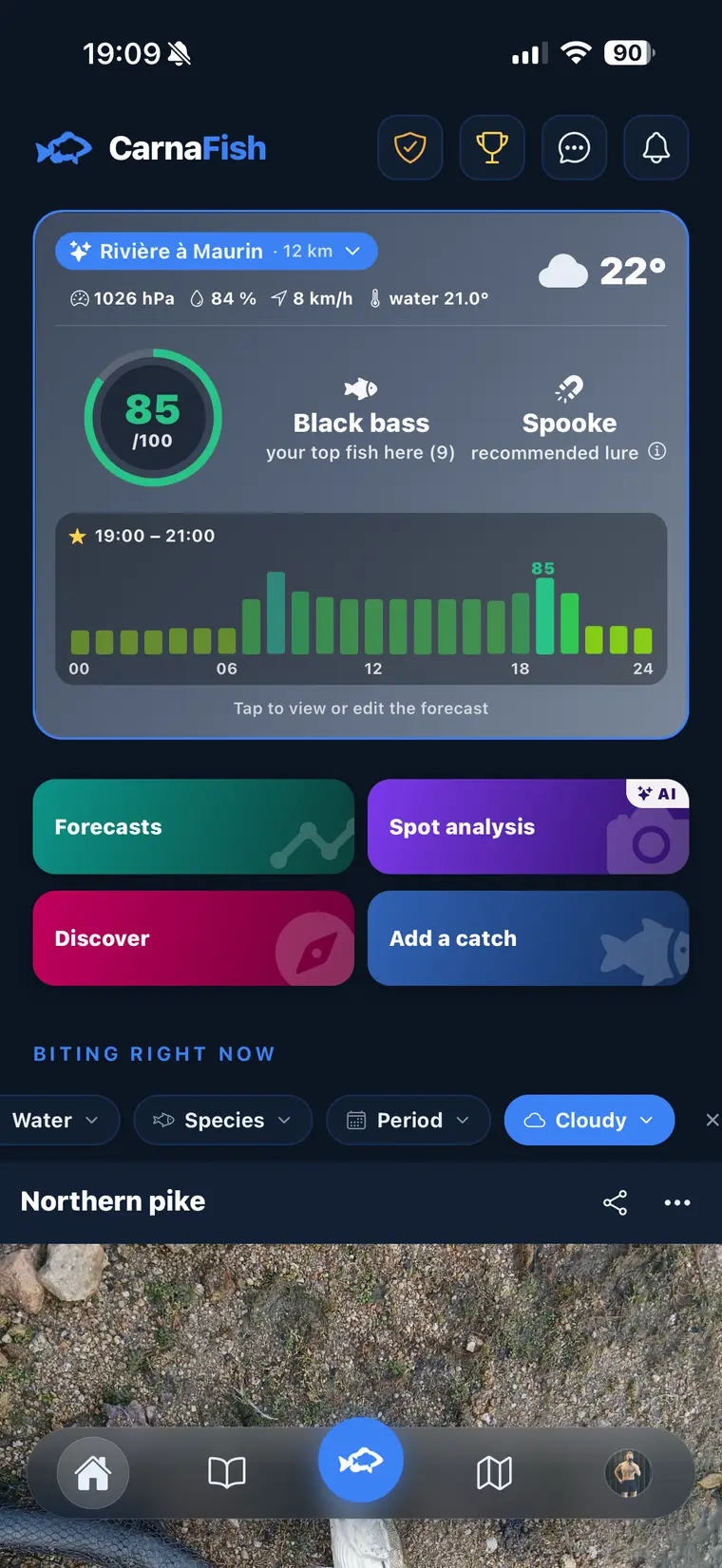
Not sure what to tie on?
Photograph your spot: CarnaFish reads the scene, cross-checks the conditions and gives you the zone, the lure and the retrieve. Free on iOS and Android.
Colors by light
- Clear water, wary fish: translucent silver finishes, which let light through and avoid freezing too sharp a silhouette. That is the default on heavily fished water.
- Lightly stained water: an olive back over a gold flank, natural enough not to alarm but contrasted enough to be followed across two metres.
- Low light, dawn or dark water: full white or a touch of chartreuse, which gives a readable target once the bait's detail stops being visible.
Where it completes a jerkbait box
The HyperJerk 70 is not a search bait. Its size and very physical cadence make it a precision bait, for an identified target or a fish you have seen. To cover a flat quickly, a 6th Sense Provoke or a Lucky Craft Pointer 78 will move far faster. To drop further in size on difficult perch, an Illex Tiny Fry 50 remains better suited. The HyperJerk owns the middle slot: a small bait that casts a long way and moves a lot for its size.
It still has to land in the right place, and that is what CarnaFish handles: a photo of the spot, and the app suggests the zone, the depth to target and a presentation suited to current conditions — handy when you are torn between a search bait and a fine approach like this one. To work on the basics with pressured fish, our beginner's guide to bass fishing lays out the tackle and spot-reading reference points.
Key takeaways
- A line tie on top of the head turns every twitch into an unpredictable sideways roll rather than a forward pull.
- 10.5 g on 7 cm: a small bait that casts far and can be counted down to a precise layer.
- Work it on a slightly slack line. On a tight line the bait tracks straight and loses its point.
- The rear feather is part of the sink tuning: leave it alone.
FAQ
Why is the line tie on top of the head?
Because it puts the pulling point above the centre of gravity. Every rod stroke then rolls the bait sideways instead of dragging it forward, at a different angle on every twitch. That disorder is what triggers undecided fish.
Does the HyperJerk 70 float or sink?
It is rated slow sinking: on a pause it drops on its own, but flat rather than nose down. That lets you count seconds after the splash to reach the depth you want before starting the action.
What rod works best with it?
A light, crisp rod, preferably short, in light to medium-light power. You need a tip that snaps on a wrist movement, not a long rod whose tip absorbs every twitch.
Should I keep the feather on the rear treble?
Yes. It slows the sink and helps the bait stay horizontal on the way down, on top of the visual effect. Removing it changes how the bait behaves on the pause, which is exactly when the bites happen.
Does this bait work on perch?
Yes, that is one of its good uses. A 7 cm body stays within the proportions of a decent perch's prey, and the hard sideways darts often trigger a chase. A 20 lb leader is plenty in that case.
How does it differ from a classic suspending jerkbait?
A suspending model hangs motionless on the pause and works mainly through horizontal darts. The HyperJerk sinks slowly at every stop and breaks sideways at an unpredictable angle, which makes it stronger on a short target with pressured fish, but less suited to covering a big flat quickly.
The full bass lure guideSeason-by-season strategy: which family of lure, when, and why.Go from theory to fish
CarnaFish reads your spot from a photo and gives you the game plan: zone, lure, retrieve. Free on iOS and Android.