Berkley Finisher 5 FFS: the small sinking bait built for forward sonar
Not sure this lure fits YOUR spot today? CarnaFish tells you in 10 seconds, from a photo.
You mark a fish on the screen eight metres ahead of the boat, suspended in mid-water. You cast a standard bait: it floats, it climbs, it passes two metres above the fish, and nothing happens. The problem is almost never the lure itself - it is that the lure never goes where you can see the fish. The Finisher 5 answers exactly that. It is small, it is heavy for its size, and it sinks.
A tiny body with a density that changes everything
Berkley's size chart leaves no room for doubt: 2 in, 1/3 oz, Sinking. That works out to roughly 5 cm for 9.5 g. The density is the key to everything else. A floating 5 cm jerkbait weighs a third of that and gets pushed around by the slightest current; this one drops cleanly, holds its line in wind, and settles at the depth you choose by counting the seconds on the fall.
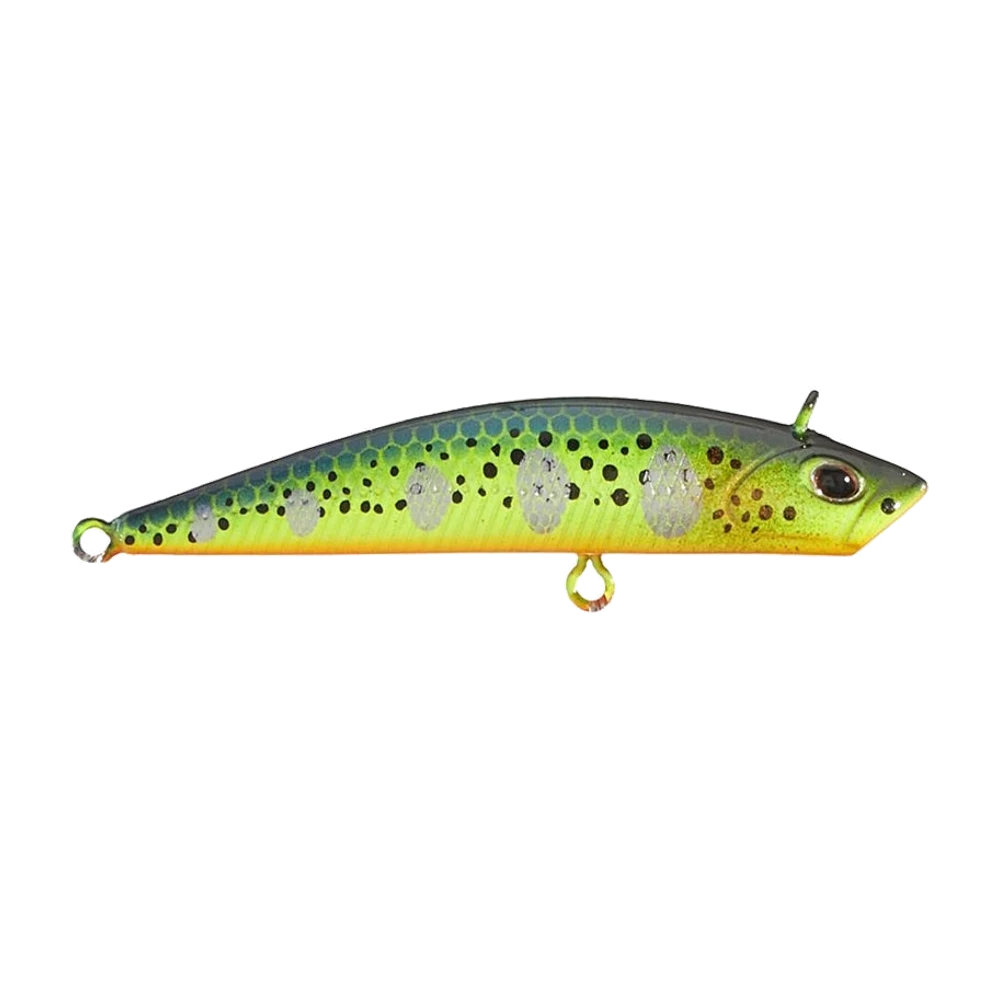
The body carries no lip. So it is not a jerkbait in the traditional sense: nothing drives it down when you pull, nothing forces it back to level. The whole swim comes from the body shape and from where the pull point sits. Berkley describes an arc-shaped body with a flattened belly, and that matches what you see in the water: on a pull the bait kicks sideways while rolling onto its flank, flashes that flank for a fraction of a second, then settles again without climbing.
Count out loud while it drops. Three, six, nine seconds: you always know what depth you are working, and you can repeat the exact same sequence on the next cast. With a sinking bait this small, counting is worth more than any tuning.
Two retrieves, two different lures
What makes the Finisher interesting is that it changes personality with the amplitude you give it. That is not marketing, it is a mechanical consequence of a pull point set fairly high on the head.
Short, sharp wrist snaps, rod tip down, line slightly slack: the bait slides thirty to forty centimetres sideways, then stops. That is the miniature glide bait retrieve, the one that works on a fish that follows without committing. Alternate left and right and the bait barely leaves the spot.
Longer, harder strokes: the glide stretches out, the bait bolts almost a metre to the side and changes axis abruptly. That is the trigger retrieve, the one you save for the fish that has followed three times with its mouth shut.
Between the two there is the fall, and the fall is often what gets bitten. Berkley describes a minnow-like tail swing as it drops: in practice the lure does not sink flat, it wags its back end on the way down. Let it. Do not take up contact too soon.
Rigging, and the detail of the line tie
The line tie is set perpendicular to the body, meaning the eye is turned 90 degrees to the axis of the lure. The point is simple: the knot does not slide to one side of the loop on every pull, it stays centred. In practice you can tie straight on without a snap - unlike a lipped crankbait, the Finisher needs no freedom of movement at the nose to swim.
Fluorocarbon from 0.20 to 0.25 mm is plenty for bass and perch. If you are fishing water that holds pike, though - and a small silver bait worked in mid-water will find them - add a short fine wire or titanium leader of 20 cm. The Finisher costs what a decent jerkbait costs, not what a throwaway costs.
One last word on hooks: the lure is listed with two Berkley Fusion 19 trebles, and that genuinely matters with this kind of action, because a glide bait on a single hook comes loose easily when a fish shakes its head. The product photo, on the other hand, shows the bare body with no hooks fitted - do not be surprised if the display model does not match.
Where this bait makes sense, and where it does not
The Finisher was built around forward facing sonar, and that is where it shows its full value: you see the fish, you drop the bait in front of it, you work it inside its field of view and you read the reaction live. Without a screen you lose part of the point, but not all of it. Fished vertically on a drop-off or along a bridge piling, a 5 cm sinking bait glided on the spot stays deadly on zander and on big perch.
Where it makes no sense is covering water. Five centimetres does not search a flat. If you still have to find fish before working them, start with something loud and fast, then come back to the Finisher once the zone is pinned down. This is a second-pass lure, not a search bait.
It does not replace a classic suspending jerkbait either, such as the Berkley Stunna or the Megabass Vision 110, which hold a fixed depth on the pause and cover far more ground on the cast. In the same box, the Berkley Krej plays yet another register, the bait that backs up as it rises. Three tools, three behaviours, and the Finisher is the one for a fish you have already found.
The mistake to avoid
Working it too hard and too fast out of habit. A 9.5 g bait packed into 5 cm reacts far more sharply than a big glide bait: the same stroke produces a proportionally enormous move. If the lure spins on itself or twists your line, you are pulling too hard. Halve the amplitude and leave more dead time.
Not sure what to tie on?
Photograph your spot: CarnaFish reads the scene, cross-checks the conditions and gives you the zone, the lure and the retrieve. Free on iOS and Android.
Colours by light level
- Stained water or overcast sky: a speckled chartreuse like the one in the photo, whose silver flank blotches throw back what little light there is.
- Clear water and wary fish: a translucent silver baitfish tone, which stays believable when a fish has time to study the bait up close - and with this lure, it does.
- Low light, dawn or real depth: a dark silhouette, far easier to read from below than a pale colour that blends into the surface.
Finding the fish is half the job, and that is exactly what CarnaFish makes easier: one photo of the spot, and the AI suggests the zone to work, the depth and the lure type that suit the day's conditions. For the rest, our guide to getting started with zander fishing on lures covers the spots and the vertical retrieves that suit this kind of bait.
What to remember
- 5 cm / 2 in for about 9.5 g / 1/3 oz, in a sinking class: that density is what lets you reach the exact depth of the fish you marked.
- Short wrist snaps for a tight glide, long strokes for a hard sideways break: two retrieves for two situations.
- Fishes on the cast and vertically, but does not cover water - treat it as a second-pass bait.
- The perpendicular line tie lets you knot straight on, with no snap.
FAQ
Do you need forward facing sonar to fish the Finisher 5?
No, but that is what it was drawn for. Without a screen, keep it for vertical work on a known spot or for grinding out a drop-off you already trust. With nothing located, a 5 cm bait covers too little water.
Does the Finisher 5 float or sink?
It sinks. The manufacturer's chart explicitly lists the Sinking class for the single listed version, at 2 in and 1/3 oz.
How fast does it drop?
Berkley publishes no figure. At 9.5 g in 5 cm the fall is brisk: count seconds on your first casts to build your own reference, then repeat the count.
Can it be fished on a straight retrieve?
That is not its ground. With no lip it has no swimming action of its own on a steady wind, so it needs snaps and pauses. For straight retrieves a crankbait or a paddle tail does the job better.
Is it any good for perch and zander?
Yes, and that is probably its best use in Europe. The 5 cm profile matches small baitfish, and a sinking bait glided on the spot is exactly what works vertically on zander.
How is it different from a true glide bait?
Size and density. A classic glide bait runs 15 to 25 cm and works on or just under the surface with wide sweeps. The Finisher borrows the gliding principle but in a tiny sinking format, built to work one located fish rather than to pull fish from a distance.
The full bass lure guideSeason-by-season strategy: which family of lure, when, and why.Go from theory to fish
CarnaFish reads your spot from a photo and gives you the game plan: zone, lure, retrieve. Free on iOS and Android.