6th Sense Scramble: the propbait you hear before you see it
The right lure in the wrong spot still catches nothing. CarnaFish spots the zone that works, from a single photo.
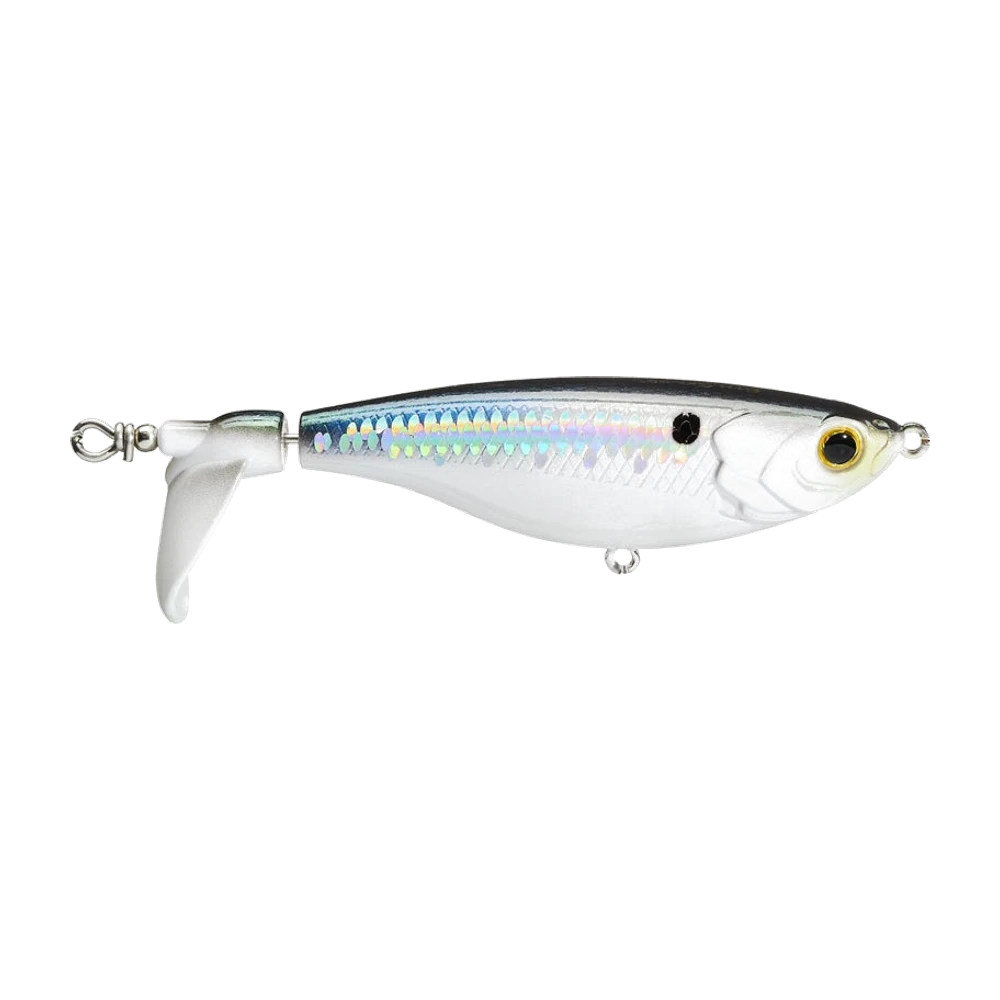
A school blows up forty yards out on glass-flat water, and you have three seconds to put something in it before the whole thing shuts down. That is exactly where a compact propbait beats a light popper: it casts a mile, it lands in the middle of the bait ball, and it makes noise before your first turn of the handle. The 6th Sense Scramble is built for that precise scenario, and for few others.
Two noise sources, not one
Most topwaters lean on a single signal: a cupped mouth that spits, a tail that slaps, a blade that churns. The Scramble stacks two. At the back of the body spins a metal prop that tears the surface film and leaves a trail of bubbles and spray behind it. Inside the body, 6th Sense fitted loose weights — knockers — that bang against the walls every time the bait rocks.
That combination changes the nature of the call. A prop on its own produces a surface noise: sharp, local, something a fish mostly detects up close or by sighting the wake. The internal knockers put out a lower-frequency vibration that travels through the water column and carries far further. The upshot is that the Scramble works on two ranges at once, which is exactly what you want when you are trying to pull scattered fish off a big flat rather than trigger one fish parked under a laydown.
Three sizes that do not fish the same
The Scramble comes in three models, all floating and all strictly topwater. The numbering follows body length in millimetres.
- Scramble 80 — 8 cm / 3.15 in, about 9.4 g / 0.33 oz. The size for schooling fish on tiny forage, in late summer when the bait balls are still minuscule. It is also the only one of the three that casts comfortably on a medium rod.
- Scramble 106 — 10.6 cm / 4.17 in, about 19.6 g / 0.69 oz. The all-rounder, and the reference size on this page. Heavy enough to reach a distant blow-up in a crosswind, compact enough not to spook an average fish.
- Scramble 126 — 12.6 cm / 4.96 in, about 28 g / 1 oz. A selective bait, for days when you know the big ones are there and you accept fewer bites. It needs a heavy rod and a well-set drag.
If you only buy one, buy the 106. The other two answer specific cases — tiny forage on one side, size selection on the other — while the 106 covers most days on the water.
Three speeds, three different answers
6th Sense list the Scramble as working on a fast, slow or stop-and-go retrieve, which is true, but those three do not serve the same purpose.
The fast retrieve is the schooling-fish presentation. You cast into the boil, you reel without stopping, the prop spins at full tilt and the bait draws a continuous bubble line. It is crude and it works when fish are already committed.
The slow retrieve is far harder to execute well. At low speed the prop stops spinning continuously: it stutters, stalls, catches again. That irregular noise often triggers better than a steady churn, but you have to find the exact rotation threshold — generally the speed just above the point where the prop stalls out. This is the one to try when the water is slick and fish refuse a fast pass.
Stop-and-go exploits both. Three turns of the handle, a one-second pause, three more turns. On the restart the prop kicks in all at once and the internal knockers fire together: that noise spike on a bait that has been dead still for a second is what pulls followers into committing.
The classic mistake: setting on the sound
A loud topwater draws a lot of missed strikes, and the Scramble is no exception. The instinct when the water explodes is to set immediately — and nine times out of ten you rip the bait out of the fish's mouth before it has it crossways.
The right mechanics are to wait until you feel weight in the rod, not until you see the blow-up. In practice: keep reeling at the same cadence until the line loads, and only then sweep the hookset to the side, never upward. That is why you fish this class of bait on a relatively soft tip over a strong butt section: the tip buys you reaction time, the butt drives the trebles.
If you miss two strikes in a row, do not change colour and do not change baits: slow down one notch. A fish striking short is almost always a fish that cannot work out the trajectory of a target moving too fast.
Rigging and hooks
Thirty-pound braid for detection and long-range hooksets, with about a yard of 15 lb fluorocarbon leader. Avoid straight monofilament throughout: it floats, which is good, but its stretch kills the hookset at thirty yards. If pike share the water, step the leader up to a heavy 60-80 lb fluorocarbon — a 4 or 5 in propbait on the surface is a bait pike take willingly in summer.
The stock trebles are fine, but this is exactly the kind of lure where a hook upgrade earns its keep: surface strikes are messy and plenty of fish get pinned on the outside of the jaw. A slightly heavier-wire treble in the same size cuts lost fish without changing how the bait sits. Do not oversize, though: a rear treble that is too large can reach the prop and jam its rotation, which removes the entire point of the lure.
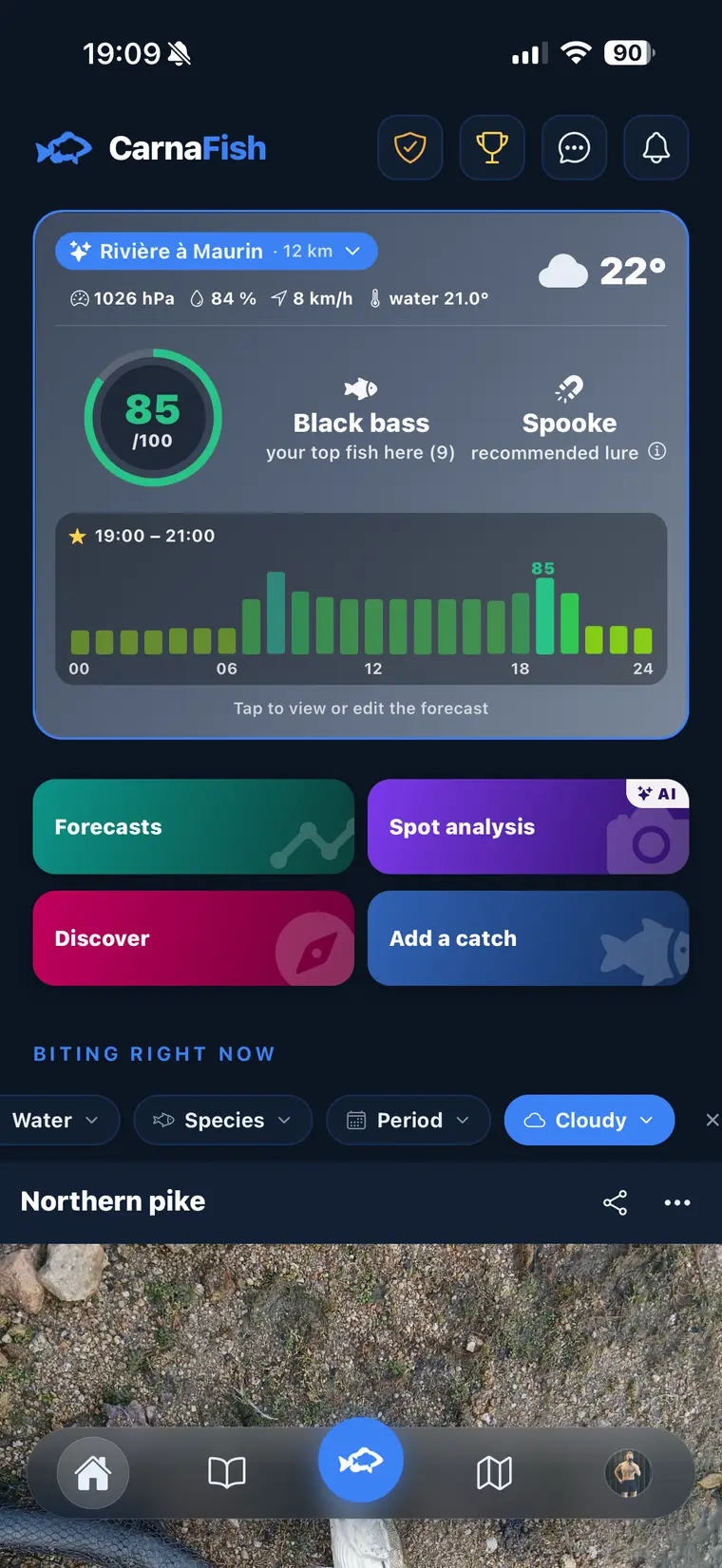
Not sure what to tie on?
Photograph your spot: CarnaFish reads the scene, cross-checks the conditions and gives you the zone, the lure and the retrieve. Free on iOS and Android.
Colours by light and water clarity
- Clear water, full sun: a natural silver or blue back, which stays believable seen from underneath against the sky. On top, a fish mostly reads a silhouette and a flash, not a paint job.
- Stained water or overcast skies: a hard white or chartreuse belly. The goal is no longer realism but contrast, so the fish can place the target despite the visual noise of a broken surface.
- Dawn and dusk: a dark finish, black or deep green back. Against a still-bright sky, a crisp silhouette reads better than a pale bait that washes out in the light.
What it complements, and what it does not replace
The Scramble is not a universal search bait. Against a Berkley Choppo, whose rotating tail puts out a deeper, slower chop, the Scramble is sharper, more nervous, and far easier to cast long thanks to its streamlined body. Compared with a River2Sea Whopper Plopper 130 it is less demanding about retrieve consistency but calls fish from less distance on slick water. And against a classic like the Heddon Torpedo, it gains clearly in casting distance and sound volume, at the cost of the subtlety a small metal-prop bait keeps on heavily pressured fish.
Its limit is plain: over cold water or fish glued to the bottom, a topwater is useless however loud it is. Working out whether the situation even calls for a surface bait is in fact the only question that matters before you pick a model. That is exactly what CarnaFish is for: a photo of the spot, and the AI suggests a zone, a depth and a presentation style matched to the conditions. To build the groundwork on reading water and gear, our beginner's guide to bass fishing is a solid starting point.
Key takeaways
- Two simultaneous sound sources: the tail prop on the surface, the internal knockers down in the water column — that stacking is what sets it apart from a plain propbait.
- Three sizes from 3.15 to 4.96 in and roughly 0.33 to 1 oz: the 106 covers most situations, the other two answer specific cases.
- The slow retrieve pays best but is the hardest to run: you need the speed just above the prop's stall point.
- Never set on the sound, set on the weight, and sweep sideways rather than up.
FAQ
Which Scramble size should I start with?
The 106, 10.6 cm / 4.17 in for about 19.6 g / 0.69 oz. It casts well on a standard medium-heavy setup, it stays believable over average-sized forage, and it takes all three retrieve speeds without any tuning. The 80 is for very small forage, the 126 for hunting bigger fish.
Does the Scramble sink if I stop reeling?
No, all three sizes are listed in the topwater class, so they float. The bait stays on top through the pause, which is precisely what makes stop-and-go possible: it starts churning again the moment you reel without needing to be brought back up.
Why does my prop not spin all the time?
That is normal on a slow retrieve: the prop has a stall speed below which it stutters instead of turning. That irregular noise often triggers better than steady rotation. Still, check that an oversized rear treble is not jamming it mechanically.
Can you catch pike on this lure?
Yes, in the 106 or 126, over shallow water in summer or early autumn. Run a heavy 60-80 lb fluorocarbon leader: pike teeth on a 15 lb leader give you no chance. It is not a zander or perch bait, though.
Should I replace the stock trebles?
Not necessarily, they are decent. But because surface strikes are messy, a slightly heavier-wire treble in the same size cuts lost fish noticeably. Do not go above the stock size on the rear split ring, or you risk jamming the prop.
How does it differ from a Whopper Plopper?
The River2Sea Whopper Plopper 130 puts out a deeper, very steady chop that carries a long way on flat water and wants a constant retrieve. The Scramble is sharper, more nervous, handles rhythm changes better, and casts further at the same weight thanks to its streamlined body.
The full bass lure guideSeason-by-season strategy: which family of lure, when, and why.Go from theory to fish
CarnaFish reads your spot from a photo and gives you the game plan: zone, lure, retrieve. Free on iOS and Android.