Berkley Screamin' Choppo: the plopper that squeaks through chop
Not sure this lure fits YOUR spot today? CarnaFish tells you in 10 seconds, from a photo.
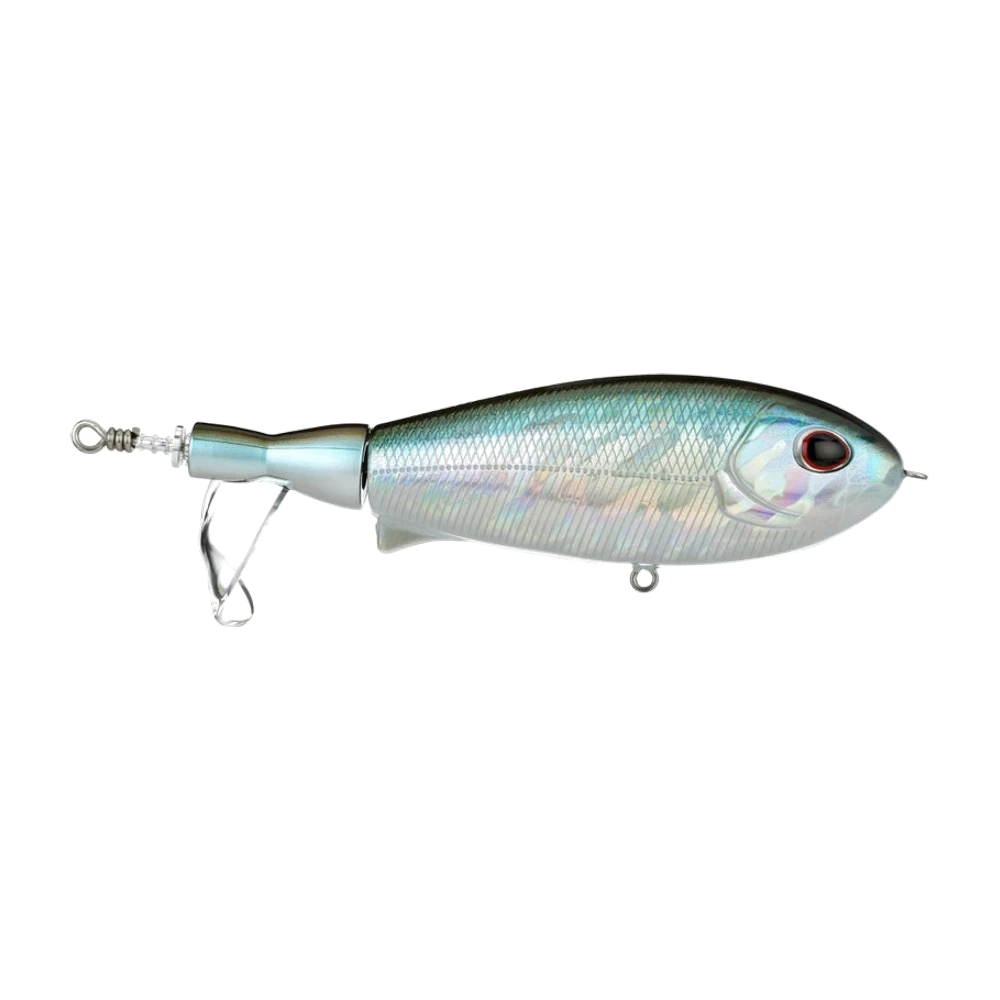
Some mornings the surface is glass. Others, a quartering wind chops the water into short, busy waves. On the second kind of day most topwater baits go quiet in a way that matters: their signal disappears into the background noise and fish simply stop finding them. The Screamin' Choppo was built for exactly that window — same tail-prop principle as the original Choppo, with a high-pitched squeak added on top, tuned to carry over disturbed water.
The squeak, and why it earns its place
A plopper works off a prop mounted free at the rear. The moment the bait moves forward the prop spins around the tail axis and slaps the surface on every revolution, producing the low, regular plop the family is known for. The Screamin' Choppo keeps that sound and stacks a second one on it: Berkley added a metal tail insert, a concentric rivet and a sound resonance chamber in the body. Together they generate a high squeal that runs continuously as long as the prop turns.
The point isn't to be louder in absolute terms, it's to occupy a second frequency band. The low plop travels well but blends into chop; the squeak stays distinct even when the wind is working the surface. On flat, clear water that signature can be too much — and that's where a standard Berkley Choppo or a silent walking bait takes the lead again. Treat the Screamin' as a tool for hard conditions, not a universal replacement.
Two sizes, two jobs
Berkley lists the bait in two formats, both classed as topwater:
- Screamin' Choppo 95: 9.5 cm / 3.75 in for 21 g / 0.75 oz. The bass size, the one you throw along a lily edge or down a dock line, compact enough not to spook an average fish.
- Screamin' Choppo 110: 11 cm / 4.3 in for 28 g / 1 oz. More mass, so more distance into a headwind, and a prop that moves more water. This is the one for covering open water, and the only one I'd seriously tie on over a pike spot.
The 7 g between them isn't just casting range: the 110 engages its prop a touch lower in the speed range, which leaves more room to slow down before the bait goes quiet.
A wide body that refuses to roll
The classic failing of tail-prop baits is roll. Once the body tips onto its side the prop lifts partly out of the water, loses its bite and the sound stops dead — usually at the worst moment, late in the retrieve near the boat. Berkley's answer was a deliberately wide body that raises lateral stability and keeps the bait from lying over. In practice that means a straight track even in a crosswind, and a sound that runs uninterrupted for the whole length of the cast.
It also makes the bait forgiving of a retrieve that's slightly too fast: where a narrow plopper starts spiralling as soon as you speed up, this one holds its attitude.
The retrieve: steady, but not just any steady
The Screamin' Choppo is a straight-retrieve bait. All the subtlety is in the speed. Start at the bottom end: just fast enough for the prop to engage and produce a regular plop rather than one every other turn. That's the rhythm that works most often, because it gives fish time to come up. If nothing happens after several casts, speed up sharply rather than in small increments — a fast plopper triggers reflex strikes the same bait never draws when crawled.
Avoid long pauses, though. Unlike a popper, this bait says nothing when stopped: the prop stalls, the signal disappears, and it takes two or three handle turns to get it back. If you want to break the rhythm, do it with a short burst of speed, not with a stop.
Tackle and rigging
A 2.10-2.20 m casting rod in medium-heavy, 30-40 lb braid, a short fluorocarbon leader. Braid helps here for two reasons: it floats, so it doesn't pull the nose down, and it transmits the hookset at distance without stretch. The bait ships with Fusion 19 trebles, which hold up well — no need to swap them on principle.
A direct knot is fine, since the swim doesn't depend on a diving lip you could restrict. A wide snap just makes changes quicker. Over pike water, a steel or titanium leader isn't optional: a 11 cm topwater bait gets bitten off regularly.
The mistake that costs fish
Setting on the noise. A plopper strike is spectacular, and the reflex is to swing the moment the water explodes. But fish often miss the bait on the first pass, and a hookset into thin air rips the lure out of the zone. The right reaction is to keep reeling at the same rhythm and only set when the rod genuinely loads up.
When a fish misses, don't cast straight back in. Wait thirty seconds, then run the exact same line at the exact same speed: a fish that missed its target very often comes back, but it needs time to reposition.
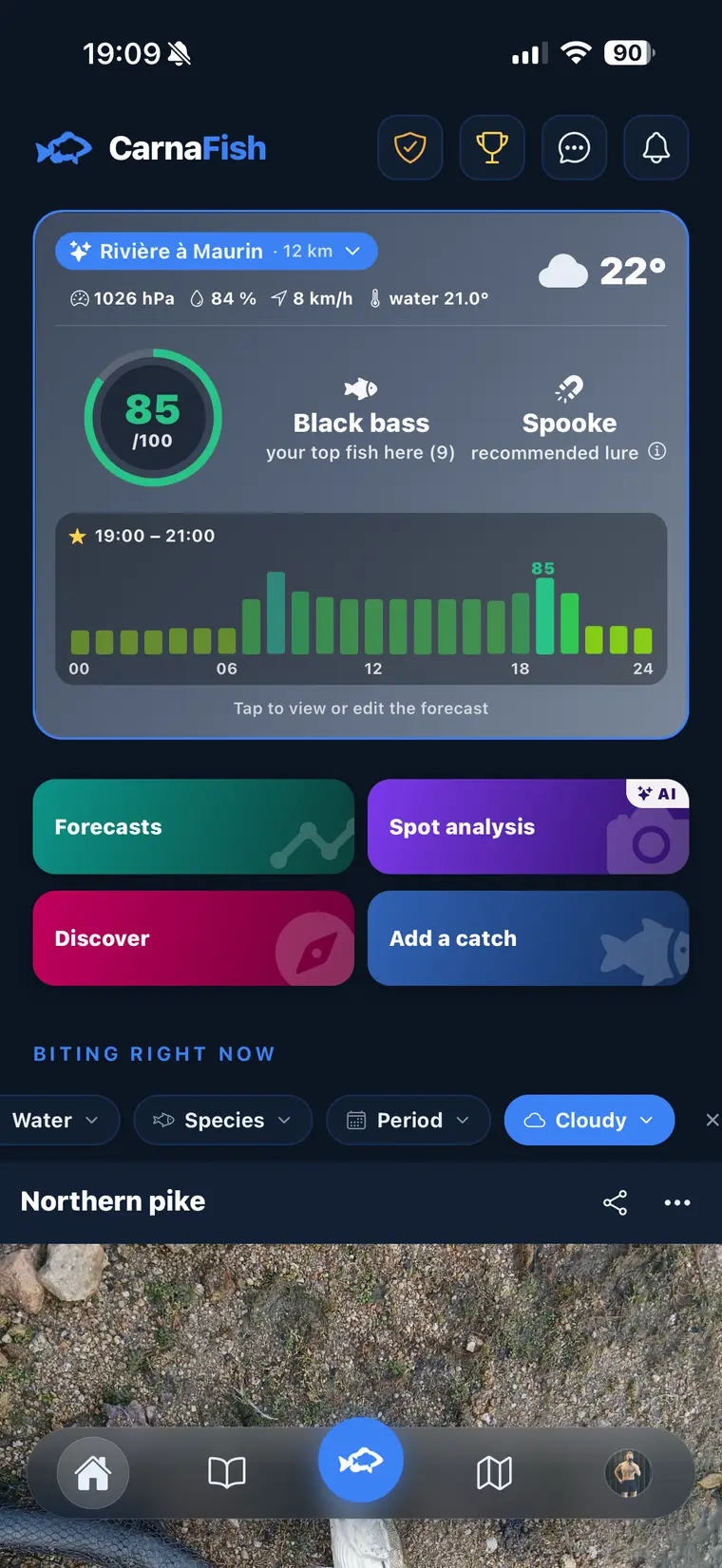
Not sure what to tie on?
Photograph your spot: CarnaFish reads the scene, cross-checks the conditions and gives you the zone, the lure and the retrieve. Free on iOS and Android.
Colour by light
- Clear water, bright sun: a pearl holographic finish like the one on the photographed bait, throwing shifting flashes without ever reading as a solid block of colour.
- Overcast, lightly stained water: bone or an opaque white. Seen from below it's the silhouette that counts, and an opaque body cuts out better than a translucent one under flat light.
- Dusk, dark water: black. Same logic taken further — the fish sees a clean shadow against the sky, and the squeak handles the rest of the locating job.
Where it sits in a topwater box
The Screamin' Choppo doesn't replace a walking bait like the Heddon Zara Spook, which needs rod input and shines on flat water. It doesn't replace a River2Sea Whopper Plopper 130 either, longer and deeper-toned, often the pike angler's pick. It fills one precise slot: the bait you tie on when the wind gets up and the rest of your topwater box has gone quiet.
That said, the best topwater bait in the world does nothing landing in the wrong place. That's exactly what CarnaFish is for: a photo of the spot, and the app suggests the zone, the depth and the lure family that match the day's conditions. To place surface fishing inside a wider pike strategy, our guide to choosing a pike lure covers the other families worth carrying.
Key takeaways
- The squeak from the metal insert and resonance chamber earns its keep in chop, where the low plop alone gets swallowed by the surface noise.
- Two sizes: 9.5 cm / 21 g for bass, 11 cm / 28 g for distance and pike.
- The wide body stops the bait rolling onto its side, so the sound doesn't cut out mid-retrieve.
- No long pauses: the prop stalls and the signal dies. Break the rhythm with a burst of speed instead.
FAQ
How is it different from the original Choppo?
The sound mechanism. The Choppo gives you the low plop of the tail prop; the Screamin' adds a high squeak generated by a metal tail insert, a concentric rivet and a resonance chamber. On flat, clear water the original is often the better pick.
Should I buy the 95 or the 110?
The 95 (9.5 cm, 21 g) for bass and edge fishing, the 110 (11 cm, 28 g) for covering water, casting into wind and working pike spots. If you only buy one for bass, take the 95.
How fast should I retrieve it?
Start at the minimum: just fast enough for the prop to turn without skipping a beat. That's the most productive rhythm. If nothing comes up, speed up sharply rather than gradually, to provoke a reflex strike.
Does it catch pike?
Yes, mostly in the 110 and over shallow water early and late in the day. Always run a steel or titanium leader: a topwater bait this size gets cut off regularly.
Do I need to upgrade the stock hooks?
No. The factory Fusion 19 trebles are sharp and strong enough for this kind of fishing. Just check the points after any session around hard cover, as with any topwater bait.
Why does my bait go silent mid-retrieve?
Either you're reeling too slowly for the prop to engage continuously, or the braid has wrapped the prop on the cast. Also check that the prop still spins freely on its axis — a knock against a rock can bind it.
The full bass lure guideSeason-by-season strategy: which family of lure, when, and why.Go from theory to fish
CarnaFish reads your spot from a photo and gives you the game plan: zone, lure, retrieve. Free on iOS and Android.