Heddon Torpedo: the prop that spins while the lure stays put
Not sure this lure fits YOUR spot today? CarnaFish tells you in 10 seconds, from a photo.
A bass under a low branch, two metres off the bank, in a pocket the size of a handkerchief. You get one cast, maybe two, and your strike zone is a square metre. A topwater lure fished on a straight retrieve crosses that zone in a second and a half. After that, it is fishing empty water.
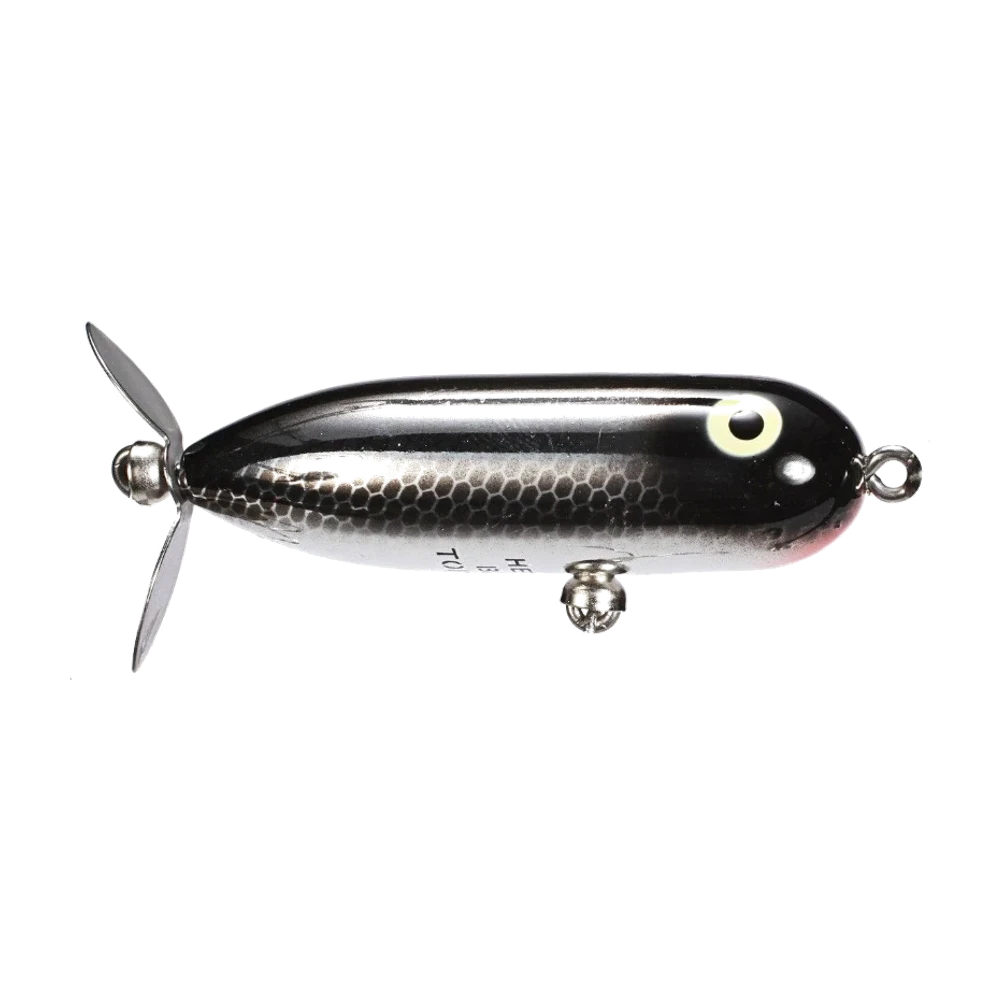
That is exactly the limit the Torpedo removes. Its rear prop is mounted on the treble's shaft, free to spin: it churns the water the moment you pull on the line, even if the lure barely moves at all. A ten-centimetre flick of the wrist, and you produce a sound and a visual signal while the body stays in place.
The result: you can keep the lure in the strike zone for twenty seconds instead of a second and a half. On a precise spot, that changes everything.
A free prop, not a driving tail
This is the distinction to have in mind before comparing this lure to what sells today.
On the Torpedo, the prop is a passive part mounted at the rear. It spins under the water flowing through it as the lure is pulled. It propels nothing, it stabilises nothing: it makes noise and throws droplets.
On a rotating-tail lure such as the River2Sea Whopper Plopper 130 or the Berkley Choppo, the tail is an organ of propulsion and stability. It forces a continuous straight retrieve: those lures fish by moving forward, they cover ground, they call from a distance.
Two opposite philosophies:
- Rotating tail: searching, large areas, continuous noise, the fish comes from far away.
- The Torpedo's free prop: precision, small volumes of water, intermittent noise, the fish is already there and has to be talked into it.
The Torpedo also produces a much sharper, higher sound — a metallic crackle rather than a deep plop. On heavily fished ponds where every bass has heard the rotating tail fifty times, that different register has real value.
The retrieve: working on the spot
- Cast past the spot, never onto it. Take the lure alongside the target, not over it.
- Wait for the rings to disperse. Three to five seconds. The Torpedo floats, nothing happens.
- Bring it up to the edge of the strike zone with two or three turns of the handle.
- Link very short twitches, ten to fifteen centimetres, wrist only, rod tip low. The lure barely moves, the prop crackles.
- Vary it: three twitches, two seconds of stop, two twitches, four seconds of stop. Irregularity does more than cadence.
- Do not leave the zone too quickly. Fifteen to twenty seconds over a square metre is the right order of magnitude.
- Set on the weight, not on the noise. A bass that misses a topwater lure often comes back within two seconds if the lure keeps going.
On the water: on a prop bait, the noise does not come from the force of the twitch but from the speed at which it starts. A short, sharp move spins the prop far more convincingly than a long, soft pull of the same length. If your Torpedo is not crackling, it is not short of water: your wrist is too slow.
A productive variant when the water is flat and the fish apathetic: the very slow continuous retrieve, just fast enough for the prop to spin without stopping. The lure then leaves a continuous rustling wake, more discreet than a series of twitches.
Setup by version and by spot
| Version | Length | Use |
|---|---|---|
| Tiny | around 5.7 cm | Wary fish, small waters, perch as a bonus |
| Baby | around 6.4 cm | The do-it-all size for bass |
| Magnum | up to 7.6 cm | Long casts, wind, big fish |
A few rigging points that matter:
The line. Fluorocarbon of 0.25 to 0.30 mm straight through, or braid with a one-metre leader. Braid has a real advantage here: it does not stretch, so the short twitch reaches the prop in full. With mono, part of the move is lost in the stretch.
The prop. Check by hand that it spins freely. A prop slightly bent by an unhooking rubs on the body and stops producing anything. Gentle straightening with pliers is usually enough.
The front split ring. The Torpedo fishes better on a split ring or a loop knot than on a knot cinched tight to the eye, which restricts the short twitches.
Not sure what to tie on?
Photograph your spot: CarnaFish reads the scene, cross-checks the conditions and gives you the zone, the lure and the retrieve. Free on iOS and Android.
Where it excels, where it is useless
Its windows:
- Tight, cluttered spots: under a branch, against a jetty, in a gap in the weed, at the foot of a dead tree.
- Calm, shallow waters at first light and at dusk.
- Heavily pressured waters, where a sound register different from the fashionable lures makes the difference.
- Pond margins in summer, when the bass are glued to the bank and refuse to come out.
Where it is no use at all:
- Searching large areas. It does not call from a distance and does not move forward enough to cover ground.
- Chop and wind. Its fine crackle is completely lost as soon as the surface is ruffled.
- Deep water with no surface activity. No topwater lure will pull a fish up from five metres.
- Dense weed, where two exposed trebles plus a prop catch on everything.
Torpedo or walking bait
The Heddon Zara Spook covers the opposite role in the same brand: it moves forward, it zigzags, it sweeps twenty metres of margin. That is the searching tool. The Torpedo is the closing tool — the one you pull out when you know where the fish is and the walking bait has made it follow without committing.
Plenty of anglers use them in tandem: Spook to find, Torpedo to work over the spot that reacted. The two logics complement each other instead of competing.
Our beginner's guide to bass fishing covers how to alternate searching and working a spot along the same margin. And if you are unsure which type of topwater to tie on in front of a cluttered spot, CarnaFish analyses a photo of the spot and answers.
Key takeaways
- The prop is free and passive: it churns even when the lure barely moves.
- It lets you hold twenty seconds over a square metre, where a straight-retrieve lure goes past in one.
- The sound is sharp and high, very different from the deep plop of a rotating tail.
- Short, sharp twitches, not wide ones: it is the speed at the start that spins the prop.
- No use for searching, no use as soon as there is chop.
FAQ
What is the difference with a Whopper Plopper or a Choppo?
On those lures, the rotating tail propels and forces a straight retrieve: they search and call from a distance. On the Torpedo, the prop is passive and works even at a standstill, which makes it a spot lure rather than a searching lure.
How do I get a good crackle out of the prop?
With short, sharp twitches rather than long, soft ones. It is the acceleration at the start of the move that spins the prop, not the amplitude. Braid as a main line transmits that start better than stretchy mono.
Which version should I start with?
The Baby, around 6.4 cm, covers the great majority of bass situations. The Tiny suits wary fish better and regularly catches perch; the Magnum is mainly for casting far or fishing in wind.
Can it be fished on a continuous retrieve?
Yes, reeling just fast enough for the prop never to stop. That produces a continuous rustling wake, often more effective than twitches when the water is flat and the fish are not very active.
What should I do if the prop stops spinning?
Check that it has not been buckled during an unhooking: a slightly bent blade rubs on the body and blocks the rotation. Careful straightening with pliers, without forcing, restores it in most cases.
Does it work on pike?
Occasionally, on shallow margins in summer, but its trebles and hardware are sized for bass. For regular topwater pike, a bigger and better-armed model is preferable.
The full bass lure guideSeason-by-season strategy: which family of lure, when, and why.Go from theory to fish
CarnaFish reads your spot from a photo and gives you the game plan: zone, lure, retrieve. Free on iOS and Android.