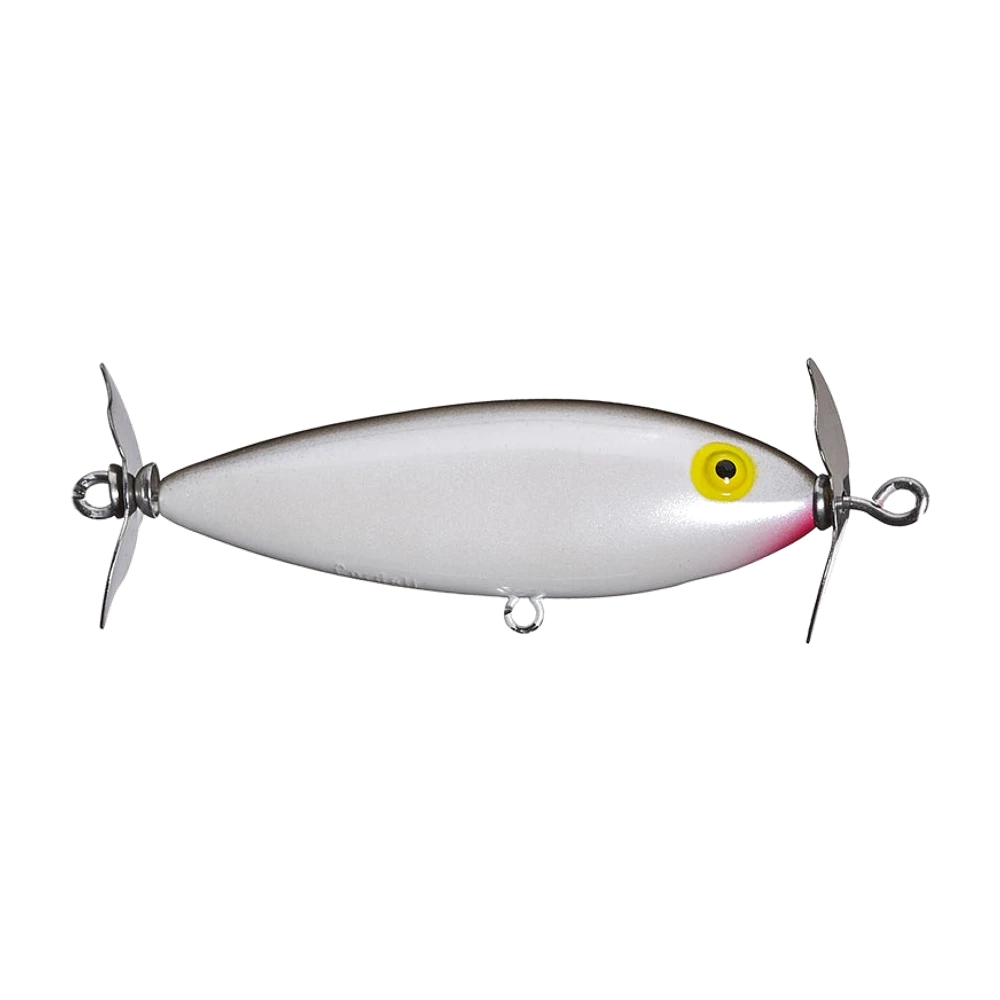
Cotton Cordell Crazy Shad: the 3 in propbait that casts a mile
One lure, endless conditions. CarnaFish reads your spot from a photo so you are not just guessing.
There are August mornings when fish school and feed well out of reach. You watch them porpoising thirty-five metres out, and your usual topwater lands ten metres short. That is exactly where a small, compact body that is heavy for its size earns its keep: it leaves the rod like a bullet and drops into the school. The Cotton Cordell Crazy Shad, an old catalogue item brought back by demand, is built around that trade-off.
A very small body making a lot of noise
The specs are simple: 3 in, or 7.6 cm, at 3/8 oz, which is 10.6 g. That ratio is the whole point. Barely eight centimetres, but a density that gives casting distance out of all proportion to the size — which is what the maker leads with, and what sets it apart from most topwaters in this class, usually too light to reach a school out in open water.
The profile is a slim baitfish, with no lip and no offset ballast. At each end sits a metal prop: one behind the nose, one behind the tail. Every movement, however small, spins them, churns water and throws spray. That pair of noise points is what gives the lure its distress signal, far more than its silhouette.
For depth, the maker lists topwater in its table, meaning the surface, without publishing a floating or sinking class for this model. In practice it is a bait you work in contact with the surface from the first turn of the handle to the last.
Two opposite cadences, and nothing in between
Fast, for feeding fish
When the school is active, you reel without stopping, adding short sharp rod strokes that keep both props turning continuously. The track turns deliberately irregular: the lure kicks sideways, straightens, kicks again. That disorder mimics a single panicked baitfish, which is exactly what a fish already feeding in a pack is looking for. On this cadence the bites are violent and often come on the first pass.
Slow, for settled fish
At the other end, on slick water or a fish holding under a tree, you land the lure and wait. Three, four, five seconds. Then one short pull: the props clack once, and you wait again. It is a war of attrition, far slower than this lure looks like it should be fished, but it is often the only thing that makes an inactive fish commit.
There is nothing worth having between those two cadences. A propbait retrieved at a steady medium speed produces neither the disorder nor the waiting: that is the setting that catches nothing. Pick your side on the first cast.
The twin hooks, and what they change
The maker makes a point of the two-hook construction, one under the belly and one at the rear. On a 7.6 cm bait that is not a detail: surface strikes are often missed because the fish hits beside the lure, and two hook points on a body this short cut the margin of error substantially. It is the main argument against a single-hook topwater of the same size.
Be careful with the props when unhooking, though: they sit close to the trebles and long-nose pliers save a lot of grief. An unhooking mat and a pair of long pliers belong in the basic kit as soon as you fish this sort of lure.
The classic mistake
Tying it straight to bare braid with no leader. A light propbait spins in flight and often comes back with the line wrapped around a prop. A metre of 10-12 lb fluorocarbon leader stiffens the connection and fixes it. Use a snap or a loop knot too: a knot cinched onto the nose ring kills the freedom of movement this lure needs to kick sideways.
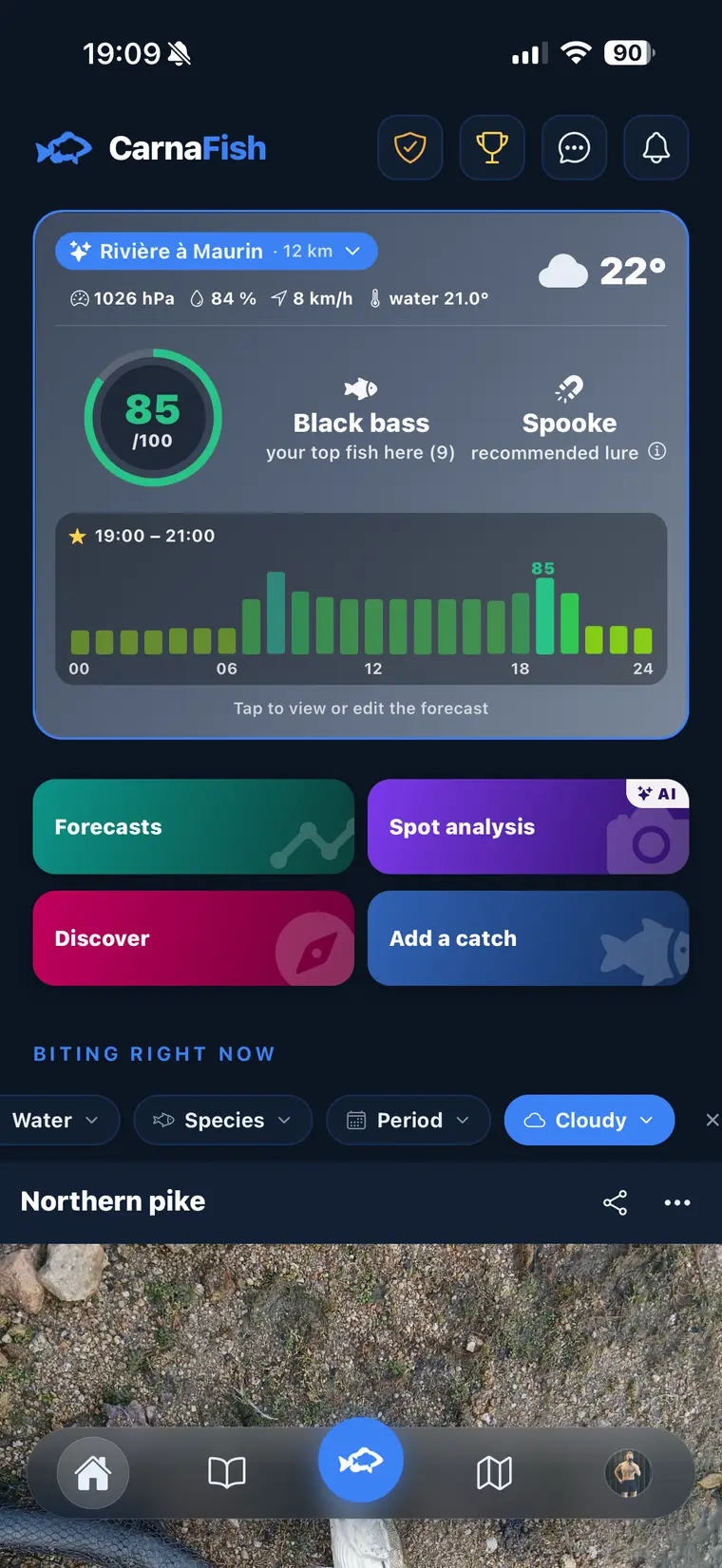
Not sure what to tie on?
Photograph your spot: CarnaFish reads the scene, cross-checks the conditions and gives you the zone, the lure and the retrieve. Free on iOS and Android.
Tuning the props, the detail nobody looks at
The props on a prop bait are pieces of folded sheet metal, and their angle is never exactly identical from one lure to the next. That is good news, because it can be adjusted. Pinch a blade gently between two fingers and increase its twist slightly to get more churn and noise, or reduce it for a quieter lure that still spins at slow speed. Do it one lure at a time and note what you changed, or you end up with a box of baits that are all different without knowing why.
Check as well that the props spin freely on their shafts. Salt, sand or the beginnings of corrosion are enough to slow them, and a prop bait with one dead prop puts out half its signal. A rinse in fresh water and a drop of light oil after brackish-water sessions is enough to keep them alive.
Colour by water
The maker offers a mix of original production colours and more recent translucent tones.
- Clear water: chrome with a pearl belly, as pictured. The reflective flank complements the prop noise without adding needless contrast.
- Bright light, wary fish: a translucent tone, which lets light through and softens the silhouette just as the fish arrives underneath.
- Stained water or heavy cloud: a dark opaque finish, which restores a readable silhouette seen from below.
The lure is not everything: knowing where a school of baitfish will hold at six in the morning is worth more than a full tacklebox. That is what CarnaFish is for: a photo of the spot, and the app suggests the zone and the presentation suited to the conditions. To sharpen your reading of perch water, our guide to lure fishing for perch covers the situations where a topwater takes over.
Key takeaways
- 7.6 cm / 3 in for 10.6 g / 0.375 oz: a weight-to-size ratio that gives a topwater genuine casting range.
- Two props, front and rear: the noise comes from them, not from the profile.
- Two cadences and no middle ground: fast and erratic on an active school, very slow with long pauses on settled fish.
- Twin hooks: fewer missed strikes than a single-hook topwater of this size.
FAQ
Does the Crazy Shad float at rest?
The maker does not publish a floating or sinking class for this model, but its table lists it as topwater, meaning the surface. It is fished in contact with the surface for the whole retrieve.
Is it any good for perch?
Yes, and that is one of its best uses in Europe. Seven and a half centimetres matches the prey size of a decent perch well, and summer surface feeding is exactly the context where this kind of lure works.
Why does my propbait come back tangled?
Almost always because the connection is too limp. Add a metre of 10-12 lb fluorocarbon leader: it stiffens the whole thing and stops the line catching in the rear prop in flight.
How does it differ from a walking topwater?
A Heddon Super Spook Jr is worked walking-the-dog and produces a quiet lateral sweep. The Crazy Shad leans on the noise and spray of its two props, for fish hunting by ear as much as by sight.
Should the factory hooks be replaced?
Not necessarily on a bait at this price and size, but fresh trebles always improve the hook-up rate on the surface. Keep the same size so the lure's attitude in the water does not change.
What should I pick when fish refuse the surface?
Drop a layer with a lipless from the same maker such as the Cotton Cordell Super Spot, or move to a bulkier prop bait like the Berkley Spin Bomb Propbait if fish are present but will not come up for a small profile.
The full bass lure guideSeason-by-season strategy: which family of lure, when, and why.Go from theory to fish
CarnaFish reads your spot from a photo and gives you the game plan: zone, lure, retrieve. Free on iOS and Android.