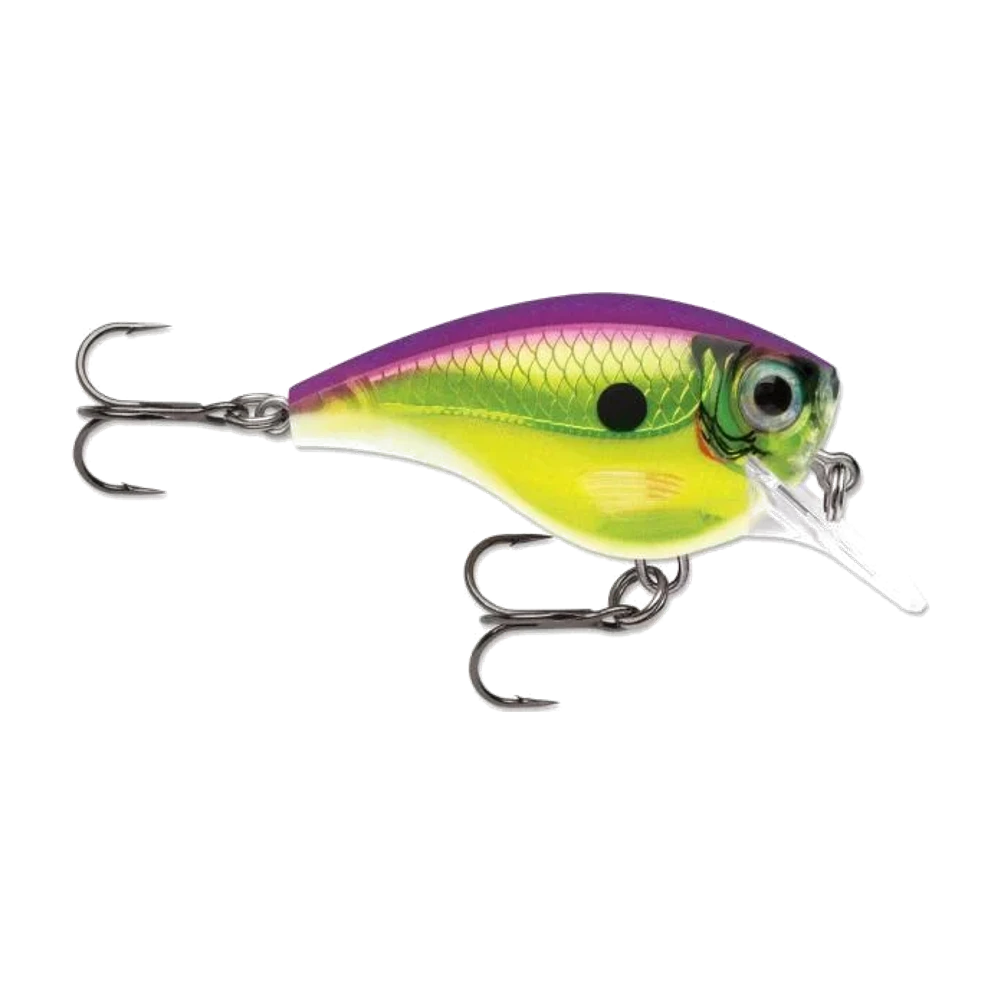
Rapala BX Brat: balsa rebound inside a shell that takes the hits
Not sure this lure fits YOUR spot today? CarnaFish tells you in 10 seconds, from a photo.
A squarebill is not built to swim. It is built to hit things. You cast it into flooded timber, you deliberately run it against stumps and rock, and you wait for the moment the square lip catches something, kicks violently sideways, then gets going again. That deflection is what draws the bite — not the tidy swimming between two hits.
Which is exactly why the material of the body becomes the real subject. A hollow plastic crankbait absorbs the hit, carries on, but takes a fraction of a second to find its action again. A balsa crankbait rises on its own after the hit, because its buoyancy pushes it upward before you have even turned the handle again. The deflection is sharper, the lift is cleaner, and the lure pulls itself out of the branches instead of staying wedged in them.
The historic problem with balsa is that it breaks. A solid wooden body that hits rock all season ends up split, and a badly seated hook tears the wire harness out. The BX construction answers exactly that: a balsa core with a hard copolymer shell moulded over it. You keep the behaviour of wood and lose its fragility.
What the twin construction actually changes
Three things, in order of importance.
The lift after contact. This is the heart of it. When the lip bumps a branch, the lure kicks sideways and slows. The buoyancy of the balsa then lifts it ten centimetres or so, almost vertically. To a bass sitting under that stump, a vertical climb reads as escape — and that is the trigger, far more than the noise of the impact.
Resistance to crushing. The shell takes the impacts against rock and the odd set of teeth. You can fish riprap all season without seeing the body mark up.
Keeping its attitude. Bare balsa tends to blow out onto its side as soon as the retrieve speeds up. The density of the shell steadies the whole thing: you can crank hard without the lure breaking loose.
What you give up in exchange: a little of the liveliness a pure balsa has at very low speed. A solid wood crankbait starts working on nothing at all; this one needs a definite start to the retrieve before it gets going.
The retrieve, in four stages
- The deliberately short cast. You are not after distance but angle. Position yourself so the retrieve runs alongside the cover for three or four metres, instead of crossing it at right angles over one.
- Getting it working. Three or four fast turns of the handle the moment it lands, to bring the lure down to its working depth before it reaches the hard stuff.
- The contact retrieve. Medium, constant speed, rod low. You are not trying to avoid cover, you are trying to touch it. Two or three contacts per retrieve is the target.
- The reaction to the hit. The instant you feel the lip catch, stop the handle for half a second, then carry on. It is during that half-second that the balsa lifts the lure, and that is almost always when the bite comes.
That fourth point is the one most anglers skip. The natural reflex when you snag is to speed up and pull the lure clear. By speeding up you force the lip against the cover and turn a deflection into a solid hang-up, while deleting the lift that made the whole pass worthwhile.
On the water: do not use a snap on this lure, tie straight to the split ring. A squarebill works permanently on the edge of blowing out, and the weight of a snap, even a light one, is enough to tip the nose down a degree or two — enough for the lip to catch instead of deflect. If you want to change fast, use a fine loop connector, never a coil snap.
Choosing the size for the depth of water
| Situation | Size | Target depth | Speed |
|---|---|---|---|
| Margins, weed, under 1 m | 5 cm | 1 to 1.5 m | Medium, frequent contact |
| Flooded timber, 1 to 2 m | 5 or 7 cm | 1.5 to 2 m | Medium, stops on the hit |
| Riprap, 2 to 3 m | 7 cm | 2 to 2.5 m | Brisk, permanent bottom contact |
| Cold water, settled fish | 5 cm | 1 to 1.5 m | Slow, one-second pauses |
One simple rule runs through that table: pick the size that hits, not the one that passes above. A squarebill that touches nothing on its whole run is useless; you may as well take a round-lipped crankbait, which will swim better in open water.
Where it shines, where it is the wrong tool
It is at home on laydowns and stumps, on riprap and rock piles, and along shallow margins early and late in the season, when the fish are tight to the bank and react to a lure that comes past fast and bangs into things.
Rule it out in three situations. Open water on a big lake: with nothing to touch, it expresses nothing and a deep diver will do better. Beyond 2.5 m: the square lip is not built to go down, you are working for nothing. Very slow searching in midwinter: it needs a firm retrieve to start working, which does not suit a fish that is not moving.
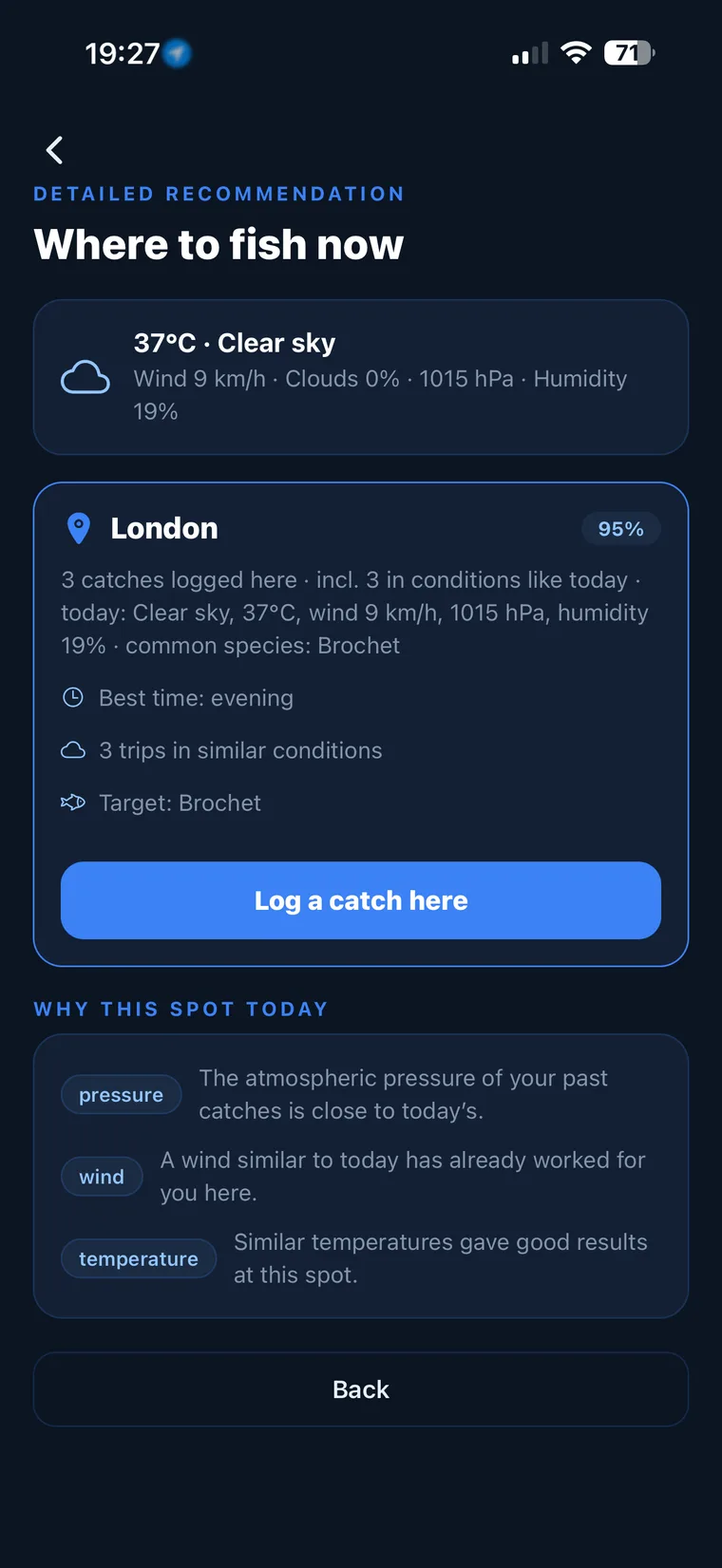
Not sure what to tie on?
Photograph your spot: CarnaFish reads the scene, cross-checks the conditions and gives you the zone, the lure and the retrieve. Free on iOS and Android.
Colours
- Hard bottom, rock, clear water: craw pattern, brown and orange. That is the prey living precisely where you are making the lure hit.
- Flooded timber, slightly stained water: perch or roach pattern, with a well-marked pale belly. The silhouette has to read from underneath.
- Stained or dirty water: chartreuse, solid white or a full black back. A squarebill's signal is as much vibration as sight, so the colour only has to stand out.
BX Brat or plastic squarebill
The Bomber Square A is the benchmark classic plastic squarebill: effective, very cheap, and precisely made to be lost in timber without regret. If you fish areas where you leave three lures behind per session, it is the rational choice.
The Strike King KVD Squarebill plays on the most pronounced deflection in the category, with a wide body that pushes a lot of water — a calling lure in dirty conditions.
The BX Brat stands apart on one point, but it is decisive: the lift after contact. Where a plastic squarebill sets off again horizontally, this one climbs. If your bites come on the hits, take note and stay with plastic; if they come just afterwards, in the second that follows contact, it is the balsa producing them and the BX Brat is for you. The Rapala BX Minnow applies the same construction to an entirely different family, if you want that behaviour on an open-water lure. Our beginner's guide to bass fishing places the squarebill within a typical day, and if you are torn between attacking a laydown with a crankbait or a soft plastic, CarnaFish analyses a photo of the spot and answers.
Key takeaways
- The balsa core lifts the lure after every hit: that is when the bites come, not during the hit.
- Stop for half a second the moment the lip catches, never speed up to pull clear.
- No snap: its weight tips the nose down and turns a deflection into a hang-up.
- Pick the size that touches bottom or wood, not the one that passes above.
- Pointless in open water, beyond 2.5 m and when searching very slowly in winter.
FAQ
What is Rapala's BX construction?
A balsa core covered by a moulded hard copolymer shell. The idea is to keep the buoyancy and behaviour of wood while removing its fragility against rock and teeth.
How deep does the BX Brat run?
Around 1 to 1.5 m for the small size and up to 2 to 2.5 m for the large one, on a straight retrieve with fine fluorocarbon. Beyond that the square lip is out of its element.
Why should I not use a snap?
Because a squarebill swims on the edge of blowing out. The weight of a snap tips the nose down by a few degrees, which is enough to make the lip catch on cover instead of deflecting off it.
How do I avoid hanging up in timber?
By stopping the handle for half a second the moment the lip bumps, instead of speeding up. The buoyancy of the balsa then lifts the lure over the obstacle — and that is also the moment the fish attacks.
What is the difference with a plastic squarebill?
The behaviour after contact. A plastic squarebill sets off again horizontally; this one rises several centimetres thanks to the balsa. If your bites come in the second following the hit, the difference is clear.
Does it work for perch and pike?
Yes. The small size is deadly on margin perch in summer, and the large one regularly interests pike over shallow weed. In that case, add a short wire leader.
The full bass lure guideSeason-by-season strategy: which family of lure, when, and why.Go from theory to fish
CarnaFish reads your spot from a photo and gives you the game plan: zone, lure, retrieve. Free on iOS and Android.