6th Sense Swank 77X: the power crank that still runs flat
One lure, endless conditions. CarnaFish reads your spot from a photo so you are not just guessing.
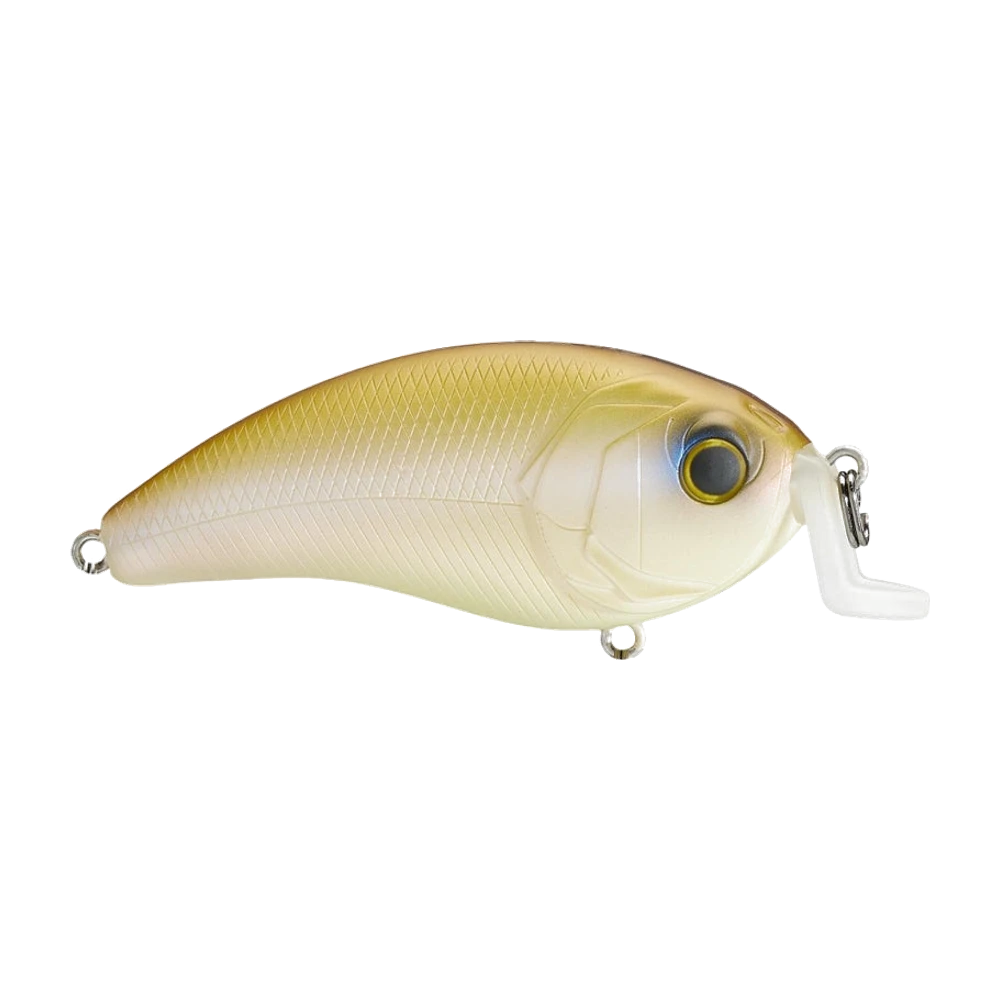
A hundred metres of rock bank, a 20 kph crosswind, and the need to land the lure four metres off the edge so it works the right depth band. With a 10 g crank you spend the day correcting your trajectory. With 21 g you put it where you want it. The Swank 77X is the muscular version of the Swank, and that's exactly why it exists.
Power cranking, and why 21 g changes the fishing
Power cranking isn't about physical strength, it's about throughput. The idea is to cover as much productive bank as possible during the window when fish are active, accepting that you'll miss the subtle ones in order to catch every fish that reacts.
A 21 g / 3/4 oz lure serves that in three ways. It casts far and straight, including into the wind, which means fewer wasted casts and more metres fished per hour. It reaches running depth in two or three metres instead of five, so a larger share of every cast is useful. And it holds its attitude in the chop along an exposed bank, where a light crank starts swimming off-kilter.
The flip side is worth stating plainly: this isn't a finesse bait. In clear water, low pressure, on fish that follow without committing, it will be too much. That's where the 6th Sense Swank 66X at 6.6 cm / 2.6 in takes back the advantage, because it offers the same bill geometry on a profile fish accept more readily.
The L-shaped bill on a 7.6 cm body
6th Sense describes the Swank's L-shaped bill as designed to produce a more natural, more horizontal swimming posture. On the 77X that geometry earns extra value: a 7.6 cm / 3 in body at 21 g pushes a lot of water, and a conventional bill would have pulled its nose sharply down at speed.
By staying level, the lure does two things heavy cranks rarely do well. It parts grass instead of balling it up, because the bill meets vegetation edge-on rather than face-on. And it kicks hard sideways when it hits a rock or stump instead of leaping toward the surface — which keeps it in the strike zone after every contact instead of pulling it out.
The manufacturer explicitly claims effectiveness comparable to a traditional squarebill over rock, stumps and brush. That's a useful comparison: the 77X fishes like a squarebill, but it casts much farther and its sound signature carries a great deal further.
The tackle that goes with it
Rod and reel
A 21 g crank on too stiff a rod means a string of pulled hooks; on too soft a rod the hook set never arrives. Aim for a casting rod of 1.95 to 2.10 m / 6'5" to 7', medium-heavy with a forgiving parabolic action that absorbs head shakes without tearing trebles. A casting reel in a mid gear ratio, around 6.3:1, is plenty: no need for anything very fast, the speed comes from the lure and your arm, not from the reel.
Line
Braid with a metre of 35 to 40/100 fluorocarbon: the braid transmits contact and sheds grass with a snap of the rod tip, while the fluorocarbon supplies the stretch that keeps you from tearing hooks on a close-range head shake. If you're fishing a spot that holds pike, a thin wire leader or 60/100 fluorocarbon becomes necessary — a 7.6 cm body at that depth is exactly what a 70 cm pike comes looking for in autumn.
The 77X carries enough mass to tear a treble out on a head shake near the boat. Before you upgrade the factory hooks, change how you fight instead: loose drag, rod horizontal and never vertical, and the fish's head only leaves the water at the net. That saves more fish than any hardware upgrade.
Where the 77X beats the 66X
Three clear situations. Wind-exposed banks, where casting distance and swimming stability decide everything. Stained water in late autumn, where the very pronounced sound signature becomes a genuine advantage once visibility drops under a metre. And lakes where the forage has grown out, typically after the year's growth, when a 6 cm lure disappears between schools of well-developed baitfish.
Conversely, in clear midsummer water, on a busy pond, or when fish are pinned to the bottom and won't come up, the 77X is one step too far. A Bomber Square A or a Storm Wiggle Wart with a rounder signal and a more modest profile will produce more.
The classic mistake
Fishing the 77X like a soft bait, hunting for bottom and slowing down on every contact. A power crank is fished at a brisk pace, accepting the snags, and relying on deflection rather than precision. If your reflex is to brake the moment the bill touches something, you're neutralising the very mechanism that triggers the bites.
Second mistake: casting parallel to the bank without accounting for the 0.6 to 1.5 m band. This lure runs in a narrow stripe. Above it, it touches nothing; below it, it ploughs. Find the depth contour that matches and cast so you follow it for as many metres as possible.
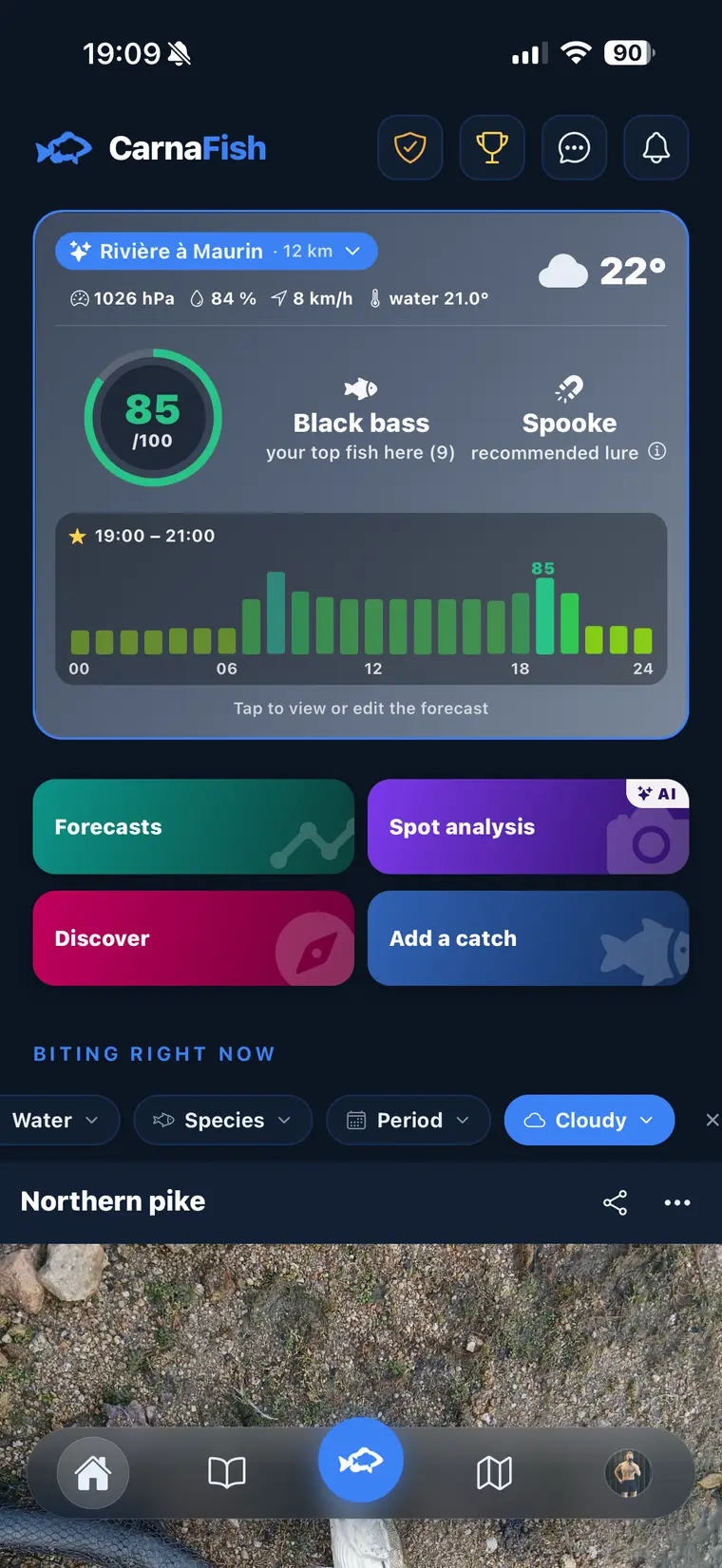
Not sure what to tie on?
Photograph your spot: CarnaFish reads the scene, cross-checks the conditions and gives you the zone, the lure and the retrieve. Free on iOS and Android.
Colour by water and season
- Clear water, baitfish forage: shad or perch pattern, dark back and reflective flanks. An already bulky profile doesn't need a loud colour on top.
- Rock bottom, spring: brick-red or orange-brown craw. Consistent with a lure that is constantly knocking substrate.
- Stained water, after rain: chartreuse with a black back. Contrast takes over once visibility drops to a metre, and it complements the rattle rather than duplicating it.
The manufacturer advertises detailed finishes without publishing a fixed colour catalogue: better to think in tone families than exact names.
A throughput lure, to be used at the right moment
The Swank 77X isn't meant to live on the end of your line. It's a phase lure: the phase when fish are shallow and active and you need to cover a lot of ground fast. Outside that phase it works less well than finer baits.
Recognising that phase is the real skill, and that's exactly what CarnaFish makes easier: a photo of the spot, and the app suggests the zone, the depth and the kind of presentation that fit the day. To understand how predators move through the months and when this kind of lure becomes relevant, our season-by-season guide to predator fishing sets out the framework.
Key takeaways
- 7.6 cm / 3 in and 21 g / 3/4 oz: a distance-and-stability crank built to cover an exposed bank quickly.
- The L-shaped bill keeps the lure level despite the mass, so it parts grass and deflects cleanly off rock.
- A very loud rattle chamber: a clear advantage in stained water, potentially too much in clear water.
- The same depth band as the 66X, 0.6 to 1.5 m / 2 to 5 ft — the choice is about casting distance and forage size.
FAQ
What's the difference between the Swank 77X and the 66X?
Profile and mass, not depth. The 77X is 7.6 cm / 3 in at 21 g / 3/4 oz, the 66X is 6.6 cm / 2.6 in at 14 g / 1/2 oz, and both are rated 0.6 to 1.5 m / 2 to 5 ft. You pick the 77X to cast far, beat the wind and target bigger fish.
Do I need a special rod for this lure?
A casting rod of 1.95 to 2.10 m / 6'5" to 7' in medium-heavy with a forgiving action is the right compromise. Too stiff a blank tears trebles out on head shakes; too soft a blank transmits nothing through 21 g of lure.
Does the Swank 77X get through vegetation?
It handles grass well thanks to its level posture and its mass, which lets it force a path. That doesn't make it snag-proof: with two trebles, dense weed will eventually load it up.
Is it suitable for pike?
Yes, from autumn onward along shallow banks. Its 7.6 cm / 3 in profile and strong sound signature suit an active pike well, provided you add a suitable leader.
What treble size comes fitted?
The manufacturer advertises premium black-nickel trebles without stating a size for the 77X, where it does specify size 4 on the 66X. If you want to replace them, compare directly against the fitted hooks rather than trusting a theoretical size.
Can it be fished slowly?
No, that's counterproductive. The 77X needs speed to hold its attitude and express its wobble. For a slow presentation in the same depth band, a soft bait or a lighter crank will serve you better.
The full bass lure guideSeason-by-season strategy: which family of lure, when, and why.Go from theory to fish
CarnaFish reads your spot from a photo and gives you the game plan: zone, lure, retrieve. Free on iOS and Android.