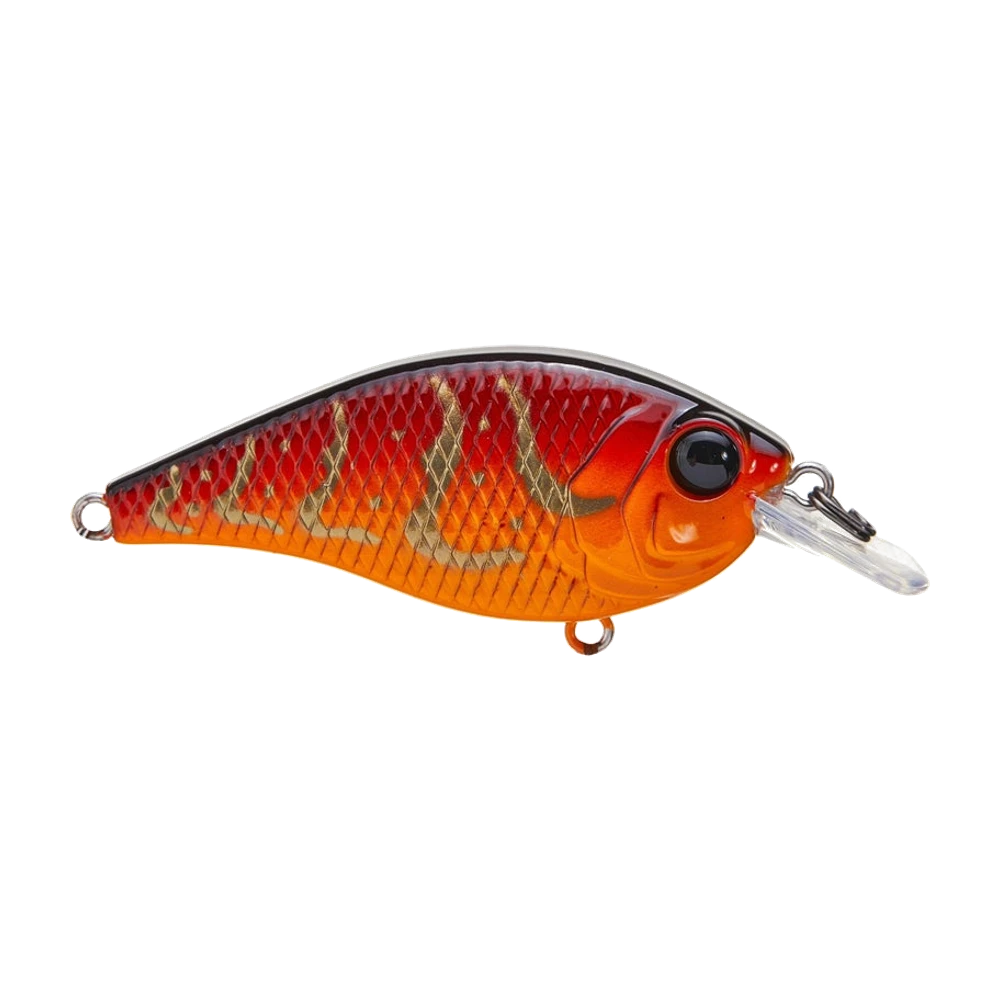
6th Sense PD4 Pressure Series: the 2-1/4 in flat-sided squarebill
Rather not fish it blind? Photograph your spot — CarnaFish cross-checks the conditions and points you the right way.
The bank of a pond in September, water almost transparent, two laydowns and a line of reeds. The classic squarebill — fat, bulky, loud — has had its run here: the fish have seen it ten times since June and just watch it go by. The 6th Sense PD4 Pressure Series offers the same deflect-off-cover mechanics with two thirds of the volume and a tenth of the noise.
A squarebill that isn't built like one
A squarebill, by definition, is a square bill that kicks off cover instead of hanging in it. The family was built on wide bodies and a very broad action, because in stained water and heavy wood you need volume for the fish to register the lure at all. The PD4 Pressure goes the other way: 2.25 in for 3/8 oz, and above all a flat-sided body.
That choice flips the signal entirely. The wobble stays tight, the bait doesn't shove water, and the attraction comes from the flash of flat sides more than from movement. There's a rattle too, but a deliberately muted one — not a single knocker that cracks, more a background noise that places the lure without announcing it from sixty feet. On a closed water where fish have been worked all summer, that's exactly the noise level that still gets through.
The trade-off is worth knowing: in genuinely dirty water or thick grass the PD4 won't carry enough. There, a Strike King KVD 1.5 Squarebill or a Bomber Square A is still the right tool. The PD4 isn't a replacement squarebill, it's a late-season, clear-water squarebill.
The technique comes down to one word: deflect
At 2 to 4 ft of rated depth, the PD4 fishes the most interesting layer along the bank without ever digging in. But a straight retrieve gets almost nothing out of it. What triggers a strike is the abrupt change of direction the instant the square bill clips a branch, a rock or a post. The lure veers for four inches, rights itself, and it's in that second of disorder that the bass sitting under the laydown commits.
So you aren't trying to dodge cover: you're aiming at it. Cast past it, reel at a steady medium pace, and let the bill hit. If you make three passes over a laydown without contact, you're too far off or running too high.
Count your contacts, not your casts. A pass where the bill touched four times beats five clean ones. And when you feel a solid contact, don't reel straight away — let the lure float up for half a second first. A lot of bites come at exactly that moment.
The mistake that costs you lost fish
The PD4 ships with two fine trebles, which makes sense on a 2.25 in bait. Paired with straight braid, though, those trebles pull out constantly: braid has no stretch, and on a deflection followed by a violent close-range strike, the points unseat. Fluorocarbon from 0.25 to 0.30 mm on a medium moderate-action rod, and set the hook by reeling rather than a hard sweep. Less dramatic, and it keeps the fish attached.
The weight transfer, a real gain along the bank
The PD4 carries an internal weight transfer system, the ball that slides back on the cast to add distance. On a compact 3/8 oz bait that's no luxury: without it, a flat-sided body this size helicopters in flight and lands thirty feet out. With it, you cast far and you cast straight, which matters a great deal along banks where the approach has to stay quiet. A bass sitting under a laydown in clear water hears your hull or sees you from the bank long before it sees the lure.
And perch, quite seriously
A 2.25 in crankbait with a tight action working between two and four feet is also the definition of a perch lure. On canal riprap, harbour walls and dock legs, the PD4 does very well on a medium retrieve with regular contact on stone. Perch don't need a violent deflection: they respond mainly to the flash of the flat sides and the light rattle. The Berkley Frittside plays the same slot with an even flatter body and no square bill; the two complement each other depending on how thick the cover is.
For pike or zander, on the other hand, the fine trebles and small size genuinely limit its use. Don't run this lure on a pike spot without a leader, and know that a decent pike will bend the trebles.

Not sure what to tie on?
Photograph your spot: CarnaFish reads the scene, cross-checks the conditions and gives you the zone, the lure and the retrieve. Free on iOS and Android.
Colors by water and season
- Clear water: a natural scaled green back, baitfish style. On a clear, shallow bank, a loud color pushes fish away rather than pulling them in.
- Spring over gravel: a red-brown craw, because that's the window when crawfish dominate the menu along riprap.
- Stained water: chartreuse with a black back, the standard compromise once visibility drops below three feet.
The PD10's little brother, not its duplicate
The two Pressure Series baits share the same logic — flat body, reduced signal, pressured fish — but they fish completely different layers. The 6th Sense PD10 Pressure Series drops to 8-10 ft on breaks; the PD4 stays in the top four feet against cover. Having both means covering the bank and the break with the same action signature, which lets you know what actually changed when they start biting.
You still have to pick the right bank. That's what CarnaFish is for: a photo of the spot, and the AI suggests the zone, the depth and the lure type that fit the day's conditions. For perch around cover, our guide to catching perch on lures breaks down the spots and rigs worth knowing.
Key takeaways
- Compact flat-sided squarebill: the deflection of a squarebill with the discreet signal of a flat-side.
- The technique is to hit cover on purpose, then pause half a second after each contact.
- Fluorocarbon is mandatory, no straight braid: the two fine trebles pull out without stretch in the line.
- A clear-water, late-season lure. In dirty water or heavy wood a classic squarebill is still better.
FAQ
How deep does the 6th Sense PD4 Pressure run?
Between 2 and 4 ft per the maker, which makes it a bank and shallow-flat lure. On heavy line or a short cast it stays closer to 3 ft than 4.
How is it different from a classic squarebill?
Volume and noise. A traditional squarebill has a wide body and a broad action built to carry in stained water. The PD4 has flat sides, a tight wobble and a muted rattle, designed for fish that have already seen the loud model all summer.
Do you really have to hit cover with this lure?
Yes, that's the whole point of a squarebill. The square bill deflects instead of hanging, and that abrupt change of direction is what triggers the strike. A pass without contact barely fishes at all.
Braid or fluorocarbon for the PD4?
Fluorocarbon, 0.25 to 0.30 mm. The two fine stock trebles unseat easily on braid with no stretch, especially on close-range strikes right after a deflection.
Is the PD4 a good perch lure?
Yes. Its 2.25 in size, tight action and working depth suit perch on riprap and harbour edges very well, on a medium retrieve with regular contact on stone.
PD4 or PD10 first?
It depends on the spot, not the lure. The PD4 for banks and the top four feet, the 6th Sense PD10 Pressure Series for breaks at 8-10 ft. If you mostly fish from shore, start with the PD4.
The full bass lure guideSeason-by-season strategy: which family of lure, when, and why.Go from theory to fish
CarnaFish reads your spot from a photo and gives you the game plan: zone, lure, retrieve. Free on iOS and Android.