Strike King Hybrid Hunter Jr.: the crankbait that veers off on its own
This lure shines under specific conditions. CarnaFish tells you in 10 seconds if today is one of them.
Most crankbaits do exactly what you ask of them: they swim straight, at a constant speed, until they hit something. That is reassuring, and it is also why a fish that has watched ten of them go past during the day no longer reacts to the eleventh. The Hybrid Hunter Jr. is built on the opposite idea: it leaves its own track without touching anything, and that unpredictable kick is what draws the strike.
The spec row, read in full
Strike King's table carries three useful columns — length, weight, depth — preceded by the model name. The row gives 7.6 cm / 3 in for 14 g / 1/2 oz, with a running range of 0.6-1.2 m / 2-4 ft.
There is no buoyancy class column in that table, unlike other hard baits in the range. So it cannot be stated from the data sheet whether it floats or suspends at rest, and the written description says nothing about it either. If you are counting on it rising on the pause to clear an obstruction, check it yourself on the first cast instead of assuming it.
One last reading note: the line inviting you to upgrade your trebles is not a specification, it is the retailer's cross-sell. The description never details the factory hooks, and the lure is photographed bare, with two empty hook hangers.
The bent bill, and what it manufactures
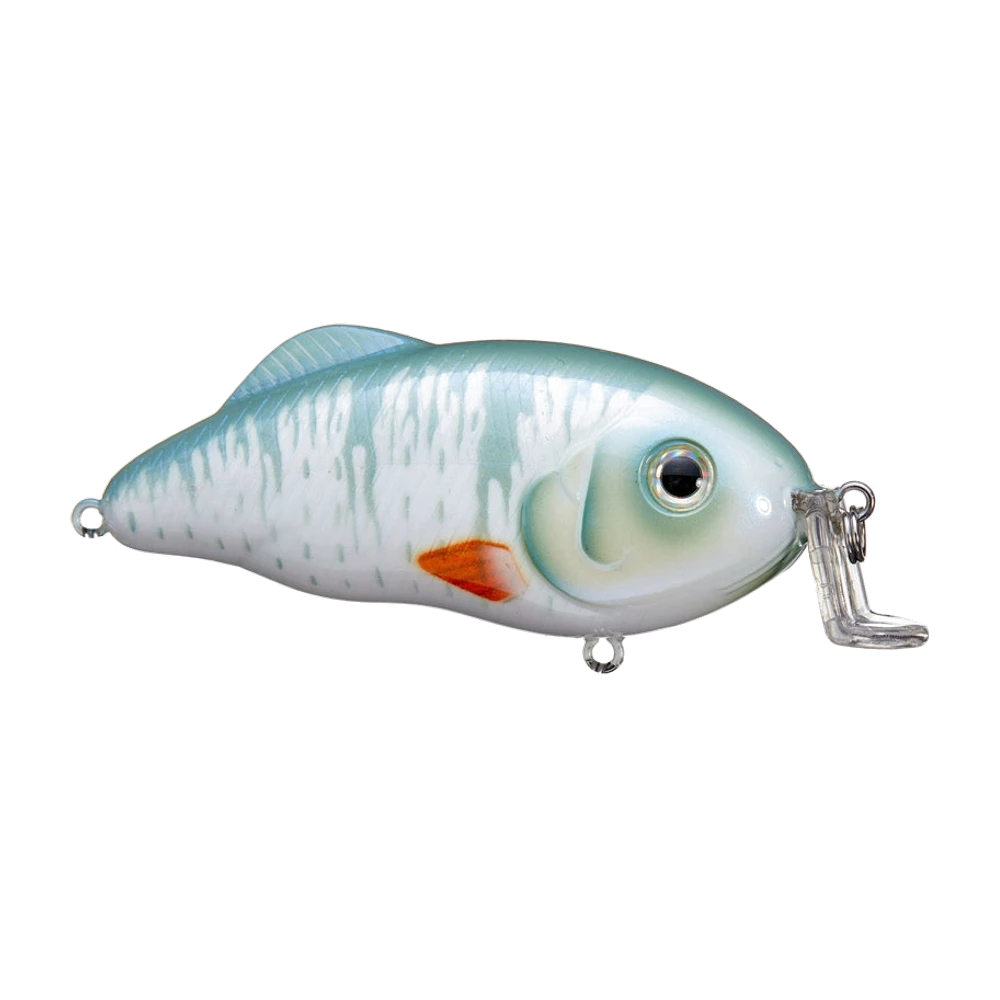
It is the most striking detail on the product photo. The bill looks nothing like a squarebill's square plate, nor like a deep diver's spoon: it drops almost vertically beneath the nose, then kicks forward at a right angle, forming a sort of L. The line tie sits at the top of that bend, carrying a split ring.
Strike King explains that this front shape creates the bait's eccentric action and helps it come through grass. What happens makes sense: the vertical section absorbs water pressure without stabilising the bait, and the horizontal return introduces an unstable pivot. The result is that the body never quite settles and regularly kicks out to one side.
What "hunting" actually means
You retrieve at a constant speed. The bait swims, vibrates normally, and then suddenly jumps twenty or thirty centimetres sideways before settling back and running straight again. That is not a manufacturing fault, it is the intended effect: a lure that changes direction abruptly imitates a panicking baitfish, and a bass following without committing gets caught out. For you it registers as a brief loss of contact in the rod at the moment of the kick — that is normal, do not set on it.
Do not try to correct the kick by taking up line or moving the rod. The moment you start steering this bait, you cancel the very thing that makes it interesting. Rod low, constant speed, and let it do its work. The bites almost always come a fraction of a second after the lure has darted off line.
The rattle, built for coloured water
The manufacturer insists on a deliberately very loud rattle system, meant to be located in murky or heavily stained water. That is consistent with the rest: a bait that changes direction without warning needs the fish to find it again, and sound does that job.
The flip side is that this is not the bait for gin-clear water under bright sun, where a silent crankbait will often go down better. Save it for the day after rain, for wind-churned reservoirs, for cluttered arms where visibility drops to half a metre.
Where to fish it
With a 0.6-1.2 m / 2-4 ft range, this is a shoreline crankbait, not a deep search tool. The spots that suit it: flats littered with wood, sparse weed edges, gently sloping banks, launch ramps, one-metre humps in late winter.
Strike King states it comes through grass better than most other hard baits. That is a manufacturer's claim with no numbers attached: take it as a design intention. In practice the vertical part of the bill does part the stems before the hooks arrive, but no treble-hooked crankbait goes through matted weed — beyond sparse vegetation you need a weedless bait.
The Jr. version is a downsized take on a bigger original. At 7.6 cm / 3 in it also makes a very good perch bait in Europe along cluttered margins, where a ten-centimetre crank simply rides over the heads of average fish.
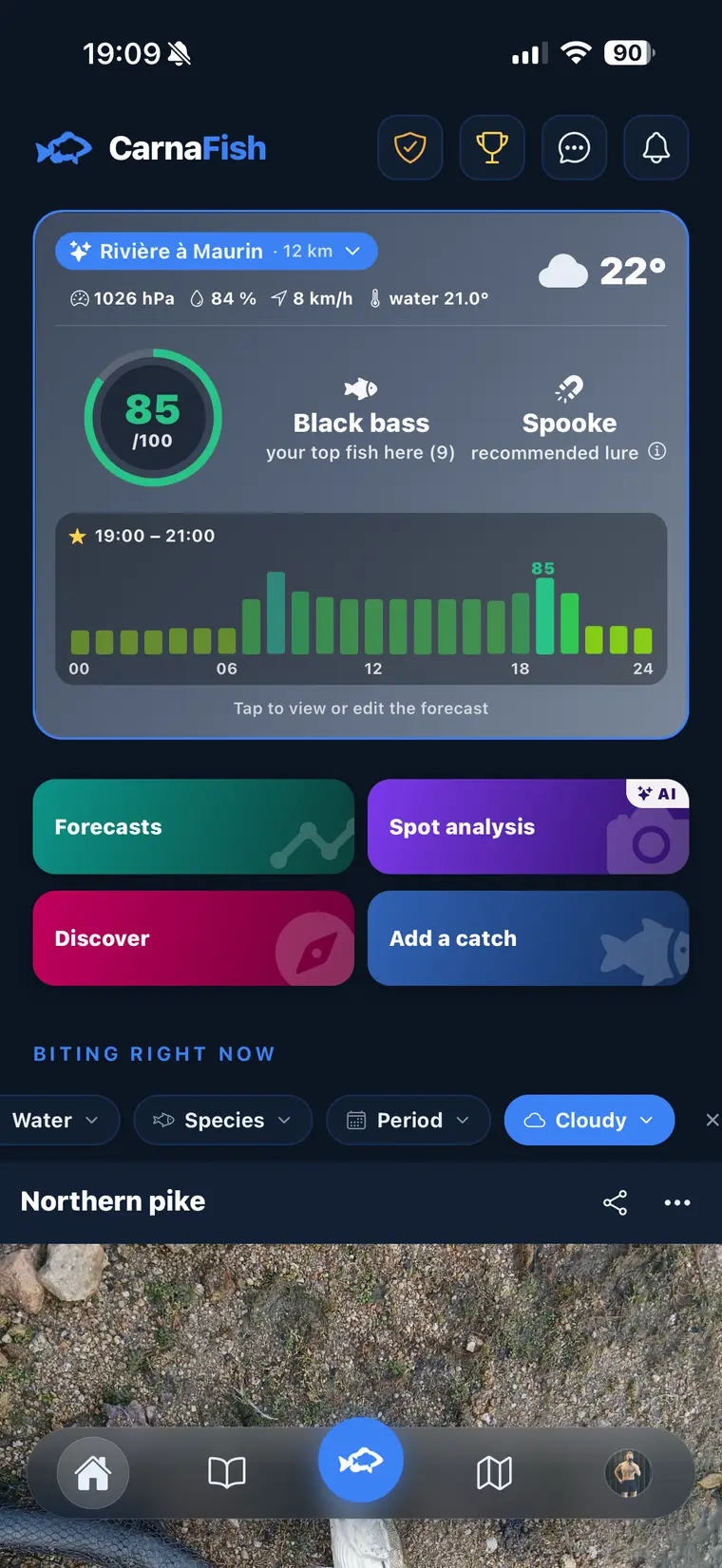
Not sure what to tie on?
Photograph your spot: CarnaFish reads the scene, cross-checks the conditions and gives you the zone, the lure and the retrieve. Free on iOS and Android.
Tackle and retrieve
A medium casting rod with a soft tip, a moderate-ratio reel, and fluorocarbon around 0.25-0.30 mm. Line matters particularly here: non-stretch braid transmits the off-line kick so sharply that you will want to strike at nothing every other cast.
Use a loop knot or a small snap. On a bill this unusual, a knot cinched against the eye binds the movement and can cancel the hunting effect outright. It is the same logic as on a Rapala Shad Rap, but with even more visible consequences.
On speed, stay medium and above all constant. Too slow and the bait stops kicking off line; too fast and it climbs above its stated depth range.
Colours by water clarity
- Clear water: Sexy Shad, the grey-and-white barred pattern of the Strike King palette — it is the family of the lure photographed here, with its pale blue back and streaked pearly flanks.
- Lightly stained water: Chartreuse Sexy Shad, which keeps a contrast point without turning gaudy.
- Hard bottom and coloured water: a crawfish pattern such as Powder Blue Back Craw, consistent with the real forage over that substrate.
Where it fits in the box
The Hybrid Hunter Jr. does not replace a classic squarebill like the Strike King KVD 1.5 Squarebill: that one is built to hit wood and deflect on contact, this one veers off by itself in open water. The two complement each other along the same bank. When the band to fish drops below a metre and a half, the Strike King Gravel Dawg 8 takes over on rock, and to cover a large area of coloured water quickly a Strike King Red Eyed Shad remains faster to comb.
Choosing the right crankbait starts with knowing what depth and what bottom type you are facing. That is exactly the service CarnaFish provides: a photo of the spot, and the AI suggests the zone, the depth and the lure type suited to conditions. To learn to decode a spot before you even cast, our guide to reading a fishing spot lays out the method.
What to remember
- 7.6 cm / 3 in, 14 g / 1/2 oz, rated 0.6-1.2 m / 2-4 ft: a shoreline crankbait, not a diver.
- The L-shaped bill manufactures a spontaneous off-line kick with no contact against cover at all.
- The rattle is described as very loud and aimed at murky water; in gin-clear conditions a silent model will often do better.
- The spec table publishes no buoyancy class, and the factory hooks are not detailed.
FAQ
What is the hunting action on a crankbait?
It is the bait's tendency to leave its straight track by itself, twenty to thirty centimetres sideways, before settling back. That abrupt direction change imitates a panicking baitfish and triggers fish that follow without eating.
How deep does the Hybrid Hunter Jr. run?
Strike King's spec table gives 0.6-1.2 m / 2-4 ft. It is a shallow runner, best kept for margins, cluttered flats and shallow humps.
Is it floating?
The manufacturer's table has no buoyancy column and the description never raises the subject, so it cannot be stated. Test it at the bank before relying on it rising on a pause to clear an obstruction.
How does it differ from the original Hybrid Hunter?
The Jr. is a downsized version of the original, with the same swimming logic in a smaller package. That size makes it more relevant on average or wary fish, and on perch in Europe.
Will it come through weed?
The manufacturer claims it comes through grass better than most other hard baits, without offering a measured comparison. In practice it copes well with sparse vegetation, but no treble-hooked crankbait goes through matted weed.
What retrieve speed should I use?
Medium and, above all, constant. Too slow and the bait stops kicking off its track; too fast and it climbs above the stated depth range.
The full bass lure guideSeason-by-season strategy: which family of lure, when, and why.Go from theory to fish
CarnaFish reads your spot from a photo and gives you the game plan: zone, lure, retrieve. Free on iOS and Android.